
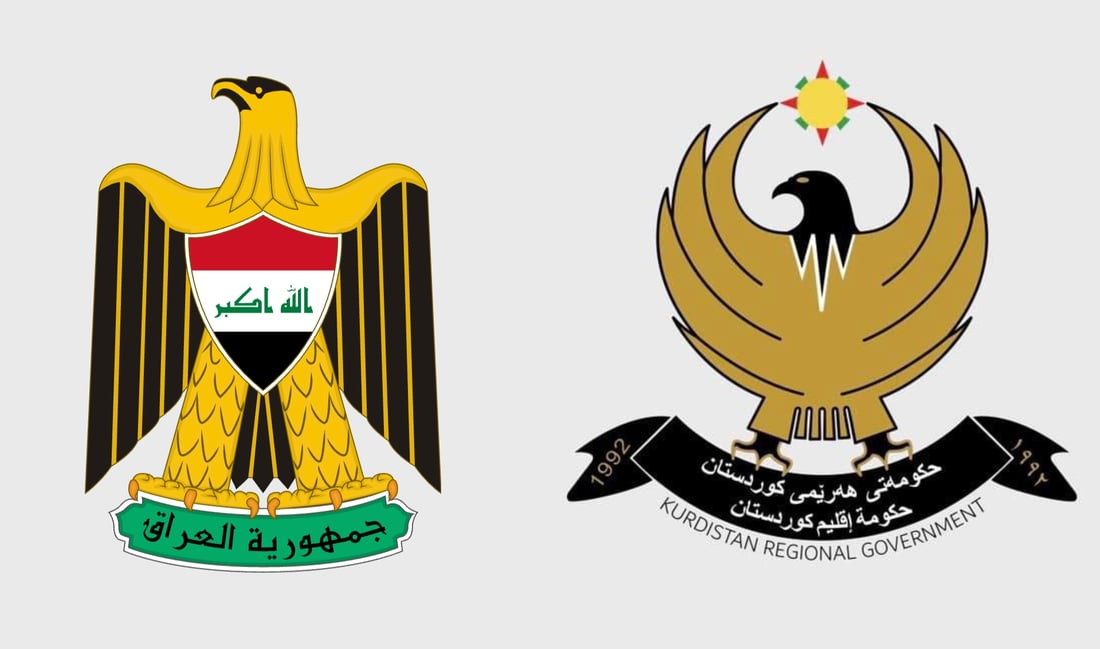
Emblems of the Iraqi Federal Government (left) and the Kurdistan Regional Government (right).
ASYCUDA talks advance
Kurdistan Region begins aligning customs tariffs with federal system, official says
BAGHDAD — The Kurdistan Region has begun responding to efforts to unify customs tariffs with federal border crossings, Iraq’s director general of the General Authority of Customs said Thursday, as talks continue to implement the electronic ASYCUDA system.
Thamer Qassim said the region “has begun responding to the issue of unifying the tariff with the federal crossings, and complying with Decision 597 and all customs instructions issued by the federal government.”
“There are preliminary agreements and meetings held over the past two days in Baghdad, and actual practical understandings have begun to unify the tariff. This is a very important step and will contribute to solving many problems,” he told the state news agency.
He said work is ongoing to implement ASYCUDA, with “advanced understandings in this regard.” A committee has been formed for goods imported through the Kurdistan Region’s Ibrahim Khalil crossing related to financial transfers.
Qassim said those affected by recent measures are “traders outside the customs and tax system, as financial transfers are not registered in the ASYCUDA system and they have no tax accounting.”
The latest tariff decision “did not include all goods, but rather the most imported goods that drain hard currency annually,” he said. “The goal is to rationalize imports, preserve the dollar and prevent the outflow of currency in exchange for poor-quality goods, as well as encourage national industry.”
He said the decision “will positively reflect on state revenues, as leaving the flat-fee system is a customs achievement after it was considered a waste of public funds.”
Qassim described ASYCUDA as “an integrated electronic system that regulates the import process and provides accurate information in real time,” adding that it “will control goods, contribute to leaving the estimation system and human intervention, and help combat money laundering.”
He said dozens of projects have obtained industrial licenses, including pharmaceutical factories and food processing plants, with the state granting customs and tax exemptions for 10 years under investment law.
The remarks mark a shift following weeks of tensions over customs enforcement. On Feb. 11, the customs authority announced four new offices along the boundary with the Kurdistan Region to collect tariff differences and prevent goods from bypassing federal crossings.
Earlier this week, traders in Baghdad and other cities protested increased duties they said reached 30 percent on some imports, compared with about 3 percent previously. Merchants said higher tariffs disrupted business, left goods stalled at ports and forced shop closures.
Federal officials have maintained that no new taxes were imposed, saying ASYCUDA applies existing tariffs under the 2010 customs law.