
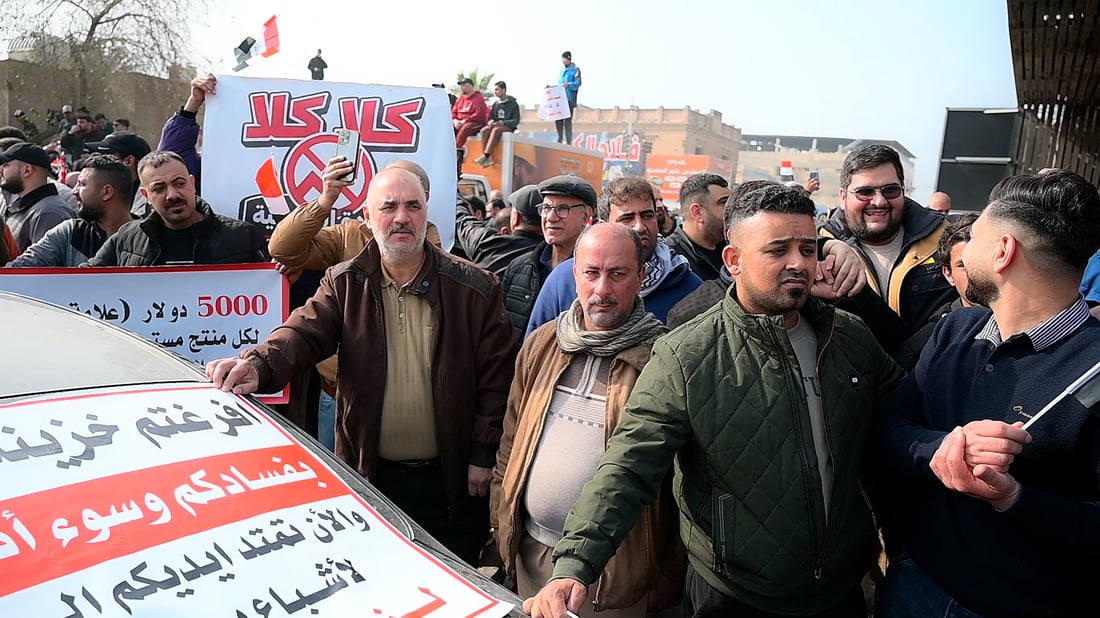
Traders gather in Baghdad during a protest against higher customs tariffs, holding placards warning of rising prices and economic strain.
Baghdad, Basra traders protest customs hikes, warn of price surge before Ramadan
BAGHDAD — Traders in Baghdad staged a protest Sunday outside the General Customs Authority, objecting to tariff measures they say have raised duties on imported goods to nearly 30 percent from about 3 percent, triggering shop closures and fears of price hikes.
Traders from Najaf, Karbala and Kut joined the demonstration alongside Baghdad merchants. Several markets in the capital shut down as protesters described the government’s decision as “the biggest crime” against the country, warning it could drive up prices and force businesses to cut jobs.
Trader Ziad Salem said customs fees that previously cost about 500,000 dinars ($333) have changed dramatically. “Customs has reached 30 percent, and now goods are stuck at the port because of this issue,” he said. “This decision is not applied to goods entering through the Kurdistan Region, and these decisions are incorrect and will cause the destruction of trade in Iraq.”
Ahmed Abboud said containers that previously cost 3 million dinars ($2,000) to clear — about 3 percent — now face duties of 30 percent. “This will double prices for citizens,” he said. “Work has stopped and goods are stuck at the port. This issue does not affect traders only, but also workers and daily wage earners. We will reduce the number of workers we employ.”
Trader Auras Jabbar said costs per container could reach 30 to 40 million dinars ($20,000 to $26,700). “This is a great injustice,” he said.
Similar protests were held Sunday in Basra, where traders and residents gathered in Umm al-Broom Square and closed shops. Demonstrators urged the government to review the decision before Ramadan, warning higher prices would hit low-income families hardest.
Mohammed al-Amir, an electronics shop owner, said prices have risen up to 30 percent. “Traders have stopped selling and distribution while waiting for the decisions to be reviewed,” he said. “The citizen is the biggest loser in this situation.”
Trader Kazem al-Ibrahimi called on the prime minister and Basra lawmakers to intervene. “The decision directly affects citizens, especially the poor,” he said.
The government announced at the start of the year a new customs tariff system covering various goods, including hybrid vehicles previously exempt. The rollout coincided with enforcement of advance customs declarations under the ASYCUDA electronic system, which verifies imports for traders seeking access to foreign currency — a combination traders say disrupted supply chains and left goods stranded at ports.
Officials have denied raising food tariffs. Trade Ministry spokesman Mohammed Hanoun said Jan. 15 that “the government has not approved any amendment to the customs tariff on basic needs, particularly food items,” blaming price increases on “speculative practices and the exploitation by some traders of the state of confusion in the market.”
Customs Director General Thamer Qassim said “there are no new taxes imposed on imported goods,” stressing that ASYCUDA applies existing tariffs under Customs Tariff Law No. 22 of 2010. The system automatically calculates duties based on goods type and origin and has been implemented at about 75 percent of federal border crossings.
The General Authority of Customs announced a 25 percent reduction in average import valuation levels within ASYCUDA, saying it aimed to ease the burden on importers. Traders said the measure did not change the tariff rates themselves.