
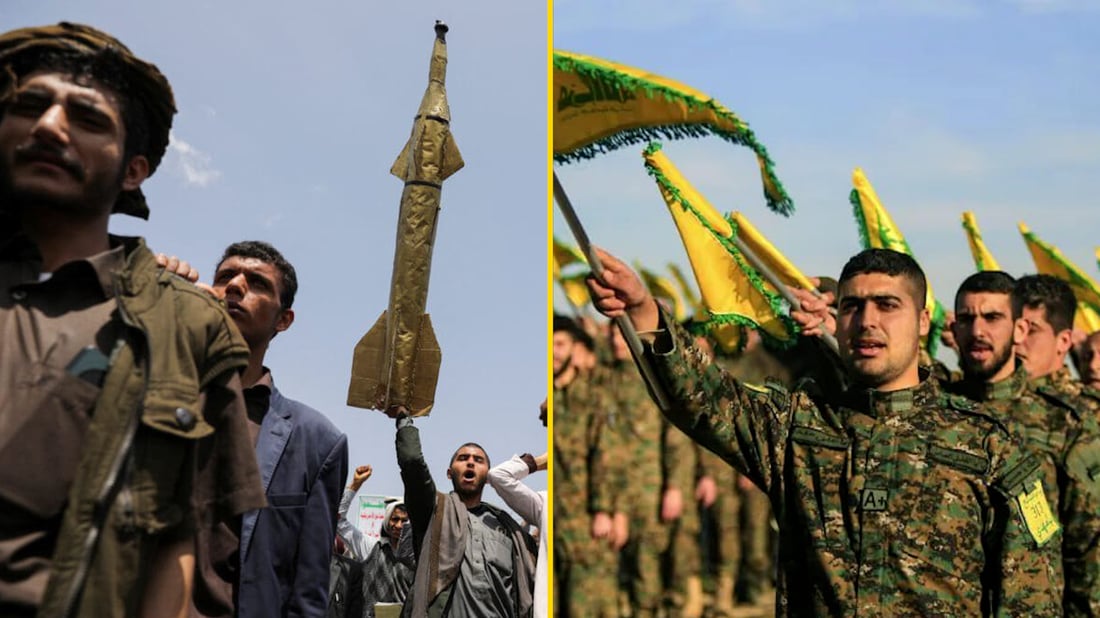
Supporters of Yemen’s Ansar Allah, left, and fighters from Lebanon’s Hezbollah, right.
Iraq freezes assets of Lebanese Hezbollah and Yemen’s Houthis
Editor’s note: Shortly after this article was published, Iraq’s Committee for Freezing Terrorists’ Assets said the inclusion of Hezbollah and Yemen’s Houthis on its list was “a mistake” caused by publishing an “unedited” version of the document in the official gazette, and that their names will be removed in a forthcoming correction. For the latest details, read our follow-up report
BAGHDAD — Iraq’s official gazette has published a decision freezing the assets of Lebanon’s Hezbollah and Yemen’s Ansar Allah, also known as the Houthis, under terrorism financing rules aligned with United Nations sanctions.
The latest issue of al-Waqa’i al-Iraqiya, dated Dec. 2, 2025, carries an update from the Committee for Freezing Terrorists’ Assets at the General Secretariat of the Council of Ministers. The notice says the measures are based on “official decisions issued by the Committee for Freezing Assets, related to identifying entities and individuals subject to counterterrorism and counter-financing measures.”
The decision cites multiple UN Security Council resolutions, along with Iraqi legislation that governs counterterrorism financing and asset-freezing procedures. Committee documents list Hezbollah and the Houthis in the category of “participation in committing a terrorist act,” in line with UN designations referenced in the listing.
The update also corrects the identity of the leader of Hayat Tahrir al-Sham. The gazette notes that the individual previously listed under the nom de guerre Abu Muhammad al-Jolani is now recorded under his legal name, Ahmed al-Shar’a, following a ruling by the UN Security Council’s ISIL and al-Qaida Sanctions Committee.
The committee said the measures take legal effect from the date of publication in the official gazette.
The move comes even as many of Iraq’s Shiite armed factions, which are historically and politically close to Iran, maintain relationships with Hezbollah in Lebanon and the Houthis in Yemen.