
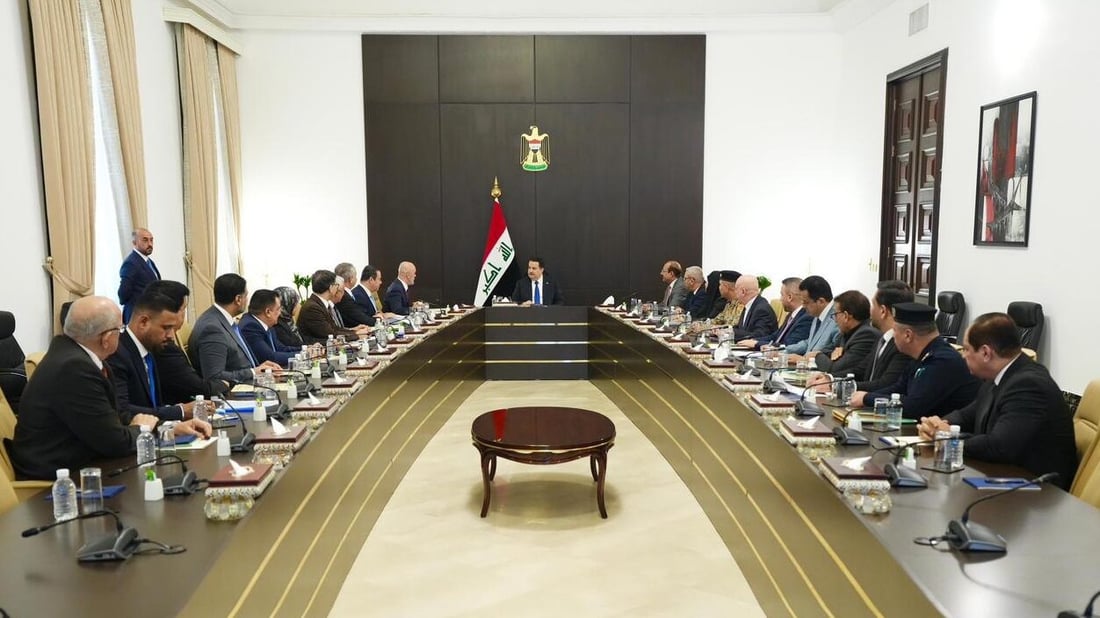
Prime Minister Mohammed Shia Al-Sudani chairs a meeting in Baghdad with senior officials to address rising air-pollution levels and review environmental conditions across the country.
Sudani orders weekly air pollution reports as Baghdad smog hits hazardous levels
BAGHDAD – Prime Minister Mohammed Shia Al-Sudani on Monday chaired a high-level meeting in Baghdad to review worsening environmental conditions in the capital and other cities, ordering weekly reports on air quality and tougher action against major pollution sources.
The talks brought together the environment minister, the governor of Baghdad, deputy ministers of electricity and industry, Baghdad Municipality and the commander of the environmental police, according to an official readout.
Al-Sudani reviewed reports from relevant departments on the causes of air pollution and stressed the need for coordinated action across agencies. He called for “joint work and coordination to develop short- and long-term solutions” to address environmental issues tied to economic and developmental security.
He directed authorities to step up the work of the air-pollution response team, monitor key landfill and waste-disposal sites, and adopt legal measures to curb pollution risks. The team was instructed to submit a weekly update to the prime minister on its activities and on the impacts of air pollution.
The meeting followed repeated warnings from Iraq’s Green Observatory, which has said air pollution in Baghdad has reached “dangerous” levels, driven by a buildup of nitrogen dioxide, sulfur dioxide and fine particulate matter.
The observatory said recent cloud cover created “a layer that keeps pollutants close to the surface of the earth,” pushing the Air Quality Index in Baghdad to readings of “150 to 200 and higher,” and on one night to “380,” a level classified as hazardous. It warned that pollution could spread to nearby governorates and said the gases detected can irritate the eyes and respiratory system, cause nausea and stomach pain, and contribute to long-term cardiovascular damage.
Full statement:
Prime Minister Mohammed Shia Al-Sudani on Monday chaired a meeting to review environmental conditions in Baghdad and several other cities, attended by the minister of environment, the governor of Baghdad, deputy ministers of electricity and industry, the Baghdad Municipality, and the commander of the environmental police.
He listened to details of the issues presented and to reports from the heads of the relevant departments on the causes of air pollution, stressing the importance of joint work and coordination to develop short- and long-term solutions to address environmental matters linked to economic and developmental security.
The prime minister directed an increase in the activity of the air-pollution response team, as well as monitoring of key waste-disposal and landfill sites, and the adoption of effective legal measures to reduce pollution risks. He instructed the team to submit a weekly report to him on its work and on the consequences of air pollution.
He also instructed the Ministry of Environment, the Baghdad Municipality, and the responsible directorates to intensify their efforts and provide the legal, administrative, technical, and financial requirements needed to identify solutions and treatments. He emphasized activating investment projects related to landfilling and waste recycling, and implementing existing plans to address air pollution and river-water contamination, in addition to environmental performance indicators, support for the environmental police, and action on the landmine file.
Al-Sudani stressed the need for fundamental solutions and a clear path for environmental work, with strengthened oversight, especially in light of global climate changes. He noted that these efforts are not limited to the Ministry of Environment and relevant institutions, but must also draw on community capacities and youth initiatives to help find solutions.
The meeting discussed the causes of pollution in Baghdad and the governorates, including landfill sites, brick factories, oil-refining operations, metal-smelting kilns, power-generation stations, private generators, vehicle emissions of all types, fuel stations and large storage tanks, and waste burning across cities and governorates.