
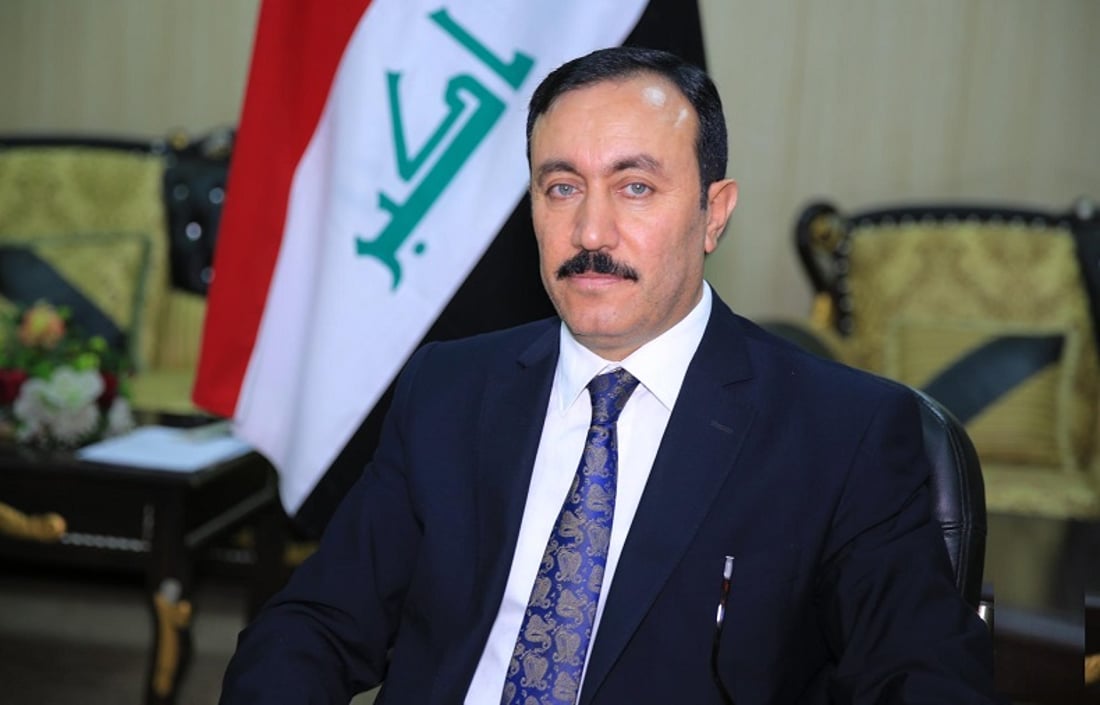
Khalid al-Mafrji, spokesperson for the Sovereignty Alliance, sits for an official photo in front of the Iraqi flag.
Media Monitor
Sunni blocs say new council aims to restore political influence in parliament
BAGHDAD — A senior figure in the Sovereignty Alliance said Sunday the newly formed National Political Council is intended to rebuild Sunni political influence in parliament, describing the bloc as a response to years of fragmentation and pressure to unify.
Khalid al-Mafrji, the alliance’s spokesperson, told UTV that regional actors “were surprised” by the council’s announcement. He said Turkey and Arab states “are even calling us to ask about the announcement of this council and how it came about,” adding that leading Sunni parties entered the post-election period facing a political landscape that made coordination necessary.
Al-Mafrji said earlier divisions weakened Sunni representation compared with past cycles, recalling the Iraqiya list when it held more than 90 seats. “In the Iraqiya experience, we were influential inside parliament — we could pass the laws we wanted to pass — while in later periods we were not influential,” he said. He added that the new bloc aims to reverse that trend, stating, “through the National Political Council, we want to restore that level of strength inside parliament.”
The National Political Council was announced on Nov. 23 in Baghdad as a joint Sunni platform comprising Taqaddum, Azm, the Sovereignty Alliance, the National Hasm Alliance and the Jamaheer Party. The parties won a combined 59 seats in the Nov. 11 elections and say the council will unify positions, coordinate decisions and act as the umbrella for major national files during the sixth parliamentary term.
Khalid al-Mafrji, spokesperson for the Sovereignty Alliance, on UTV:
Turkey and other countries, including Arab states, were surprised by what happened (the formation of the National Political Council). They are even calling us to ask about the announcement of this council and how it came about.
Brother Mr. al-Halbousi, the head of the Taqaddum Party, and brother Professor Muthanna al-Samarrai, the head of the Azm Alliance, reached the end of the election process and found themselves facing a reality that required them — and everyone — to meet so things could move forward.
We have many past experiences. For example, the Iraqiya experience, when it held more than 90 seats, and other experiences such as Taqaddum, Azm, Sovereignty and Mutahidoun after Iraqiya. In the Iraqiya experience, we were influential inside parliament — we could pass the laws we wanted to pass — while in later periods we were not influential. Therefore, through the National Political Council, we want to restore that level of strength inside parliament.
The National Political Council has 75 seats, so we are talking about a parliamentary bloc capable of acting with strength.
Sheikh Khamis al-Khanjar organized the leaders’ meeting for the National Political Council, and Sarmad al-Khanjar attended as the representative of the Sovereignty Alliance. He will be the alliance’s representative in the council’s upcoming meetings.
We have reached a stage where we are fed up with disputes, and we now urgently need real and fundamental solutions, not patchwork ones. That is why we found a solution to positions through understandings and political weight. The second point is that this council has no president; instead, it has collective leadership — a group leading the component.