
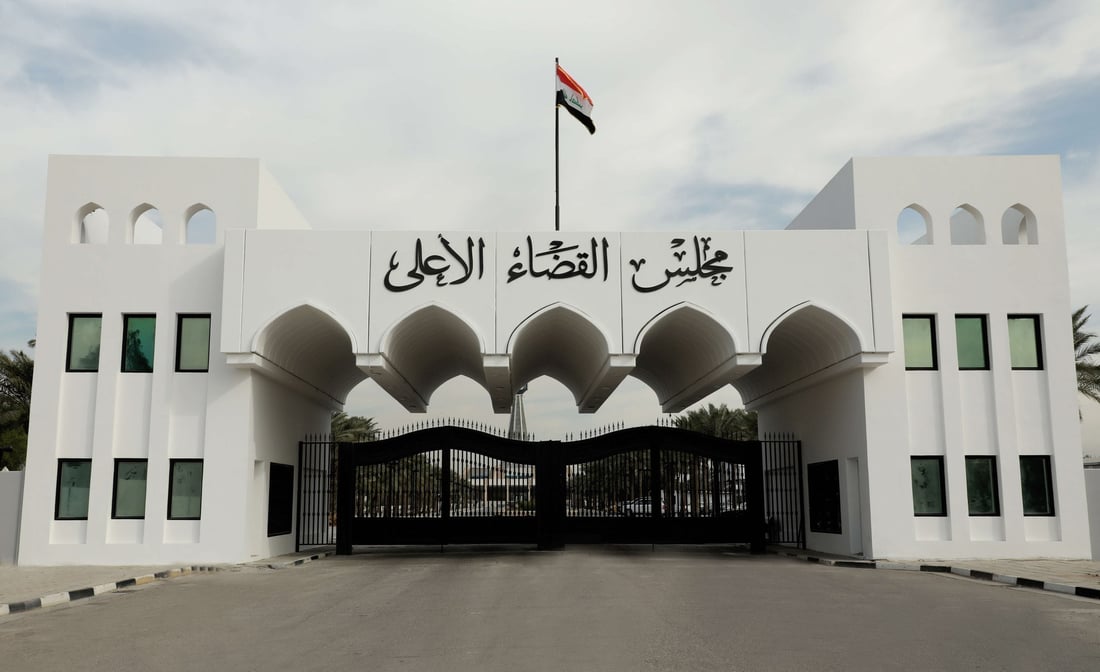
The headquarters of Iraq’s Supreme Judicial Council in Baghdad
Judiciary urges swift government talks after Iraq’s parliamentary elections
BAGHDAD – Iraq’s Supreme Judicial Council on Thursday called on political parties that won seats in the Nov. 11 parliamentary elections to move quickly toward forming the new parliament and government.
In a statement, the council congratulated the winning candidates, parties, and alliances, expressing hope for their success in the coming legislative term.
“On this occasion, the Supreme Judicial Council calls on the political parties that won to promptly engage in dialogues and understandings to expedite the formation of the new legislative and executive authorities within the constitutional timelines,” the statement said.
Iraq held its parliamentary elections on Nov. 11, and the Independent High Electoral Commission released preliminary results Wednesday. According to 964media projections, Prime Minister Mohammed Shia Al-Sudani’s Reconstruction and Development Coalition is expected to secure 46 seats, followed by Mohammed Al-Halbousi’s Taqadum Party and Nouri Al-Maliki’s State of Law Coalition with 29 each. Masoud Barzani’s Kurdistan Democratic Party is projected to win 27 or 28 seats.
Qais Al-Khazali’s Al-Sadiqoun Movement, which received 685,989 votes, is projected to win 27 seats. Other leading blocs include Ammar Al-Hakim’s National State Forces Alliance with 19 seats, Hadi Al-Amiri’s Badr Organization with 18, Bafel Talabani’s Patriotic Union of Kurdistan with 18, and Muthanna Al-Samarrai’s Azm Alliance with 15.
Under Iraq’s Constitution, the country is a federal parliamentary republic governed by a long-standing power-sharing arrangement in which the prime minister is a Shia Arab, the president is a Kurd, and the speaker of parliament is a Sunni Arab.
Once the final election results are ratified, the president must convene the new parliament, which then elects its speaker and, subsequently, the president of the republic. The president tasks the largest bloc’s nominee with forming a cabinet, and the prime minister-designate must present the government to parliament for a confidence vote.
Government formation in Iraq has frequently been delayed by months of political bargaining. After the 2010 elections, a new government was not formed until about nine months later following extended negotiations among rival blocs.