
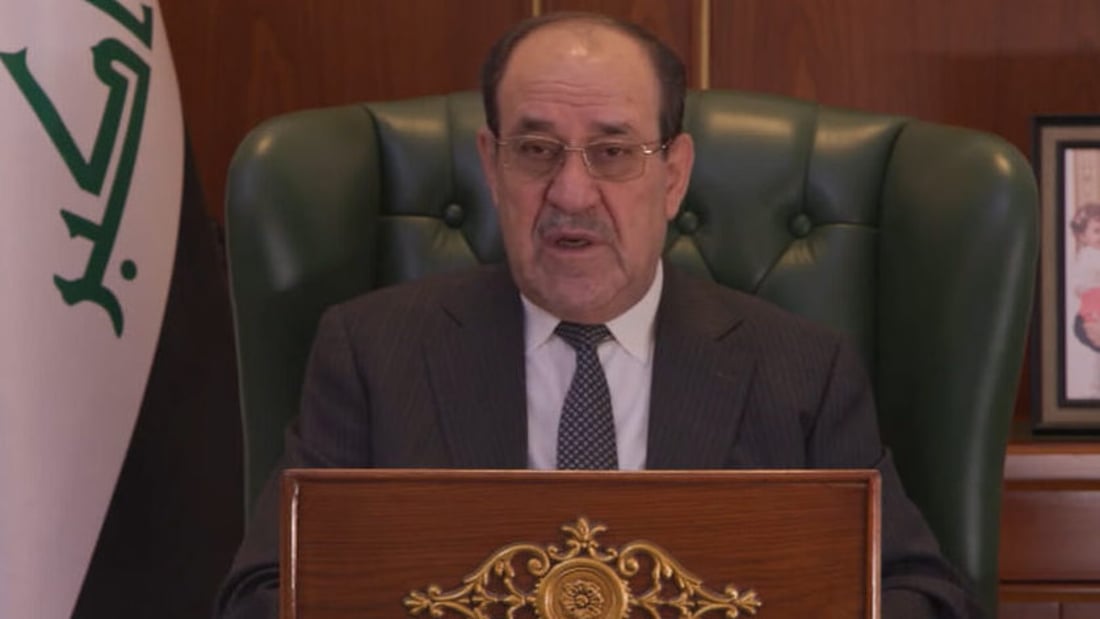
Nouri Al-Maliki, leader of State of Law Coalition
Media Monitor
Maliki says he would accept premiership if nominated, calls parliament ‘a failure’
BAGHDAD — Former Prime Minister Nouri Al-Maliki said he would accept a return to office if nominated by the Coordination Framework and his State of Law Coalition, though he insisted he is not seeking the position.
“I do not seek this position, but I will not back down from an assignment,” Al-Maliki said in an interview with Dijlah TV.
Al-Maliki, who served as Iraq’s prime minister from 2006 to 2014 and has led the Islamic Dawa Party since 2007, stepped down amid public and political pressure following the Islamic State group’s capture of Mosul and other cities.
The Coordination Framework, a coalition of Shia political parties, leads the current government.
Addressing voter apathy ahead of Iraq’s Nov. 11 parliamentary elections, Al-Maliki said many Iraqis have lost faith in the political system. “Parliamentary membership has become disreputable in the eyes of some due to discouraging scenes,” he said, blaming political dysfunction and delays in achieving reforms for “a state of frustration.”
He also accused some political groups of misusing state resources during campaigning. “There is massive use of state money and resources in the elections… the vote is worth $150 or $200,” he said.
Al-Maliki criticized the current parliament as “a failure,” saying many blocs avoid holding each other accountable. He pledged that, if appointed again, “the first decision I will take will be to form effective committees to hold accountable all those suspected of corruption or negligence.”
Excerpts from Nouri Al-Maliki’s interview with Dijlah TV:
The candidate for prime minister is not determined by the number of electoral votes. I wanted to generate momentum to increase participation in the elections after a widespread reluctance to vote. The reasons for this reluctance are many, most notably that parliamentary membership has become disreputable in the eyes of some due to discouraging scenes. Another part of the problem is related to the political process, as hesitation and delays in achieving the goals for which the process was established have caused a state of frustration. Our task is to eliminate frustration and despair.
If the Coordination Framework and my colleagues in State of Law decide to nominate me for the premiership, I will be obligated and will respond. I do not seek this position, but I will not back down from an assignment.
My warnings concern sectarians, who are a defeated minority, and the facilitation of the return of terrorists, who now speak without fear—this is a dangerous phenomenon. What is even more dangerous than the previous two points is the leniency toward Baathists. If it were a personal matter, I would say, ‘May God forgive what has passed,’ but this is a matter concerning the nation. The Baathists operate under a project and receive support. My partners in the Framework did not heed my warnings regarding the Baathists.
Corrupt money has been used in the electoral process alongside state funds. There is massive use of state money and resources in the elections. I demand action against this abuse of public funds and the buying of votes… the vote is worth $150 or $200.
The four presidencies informed us of drafting a document, but it was not adhered to.
Countries are not built by a single government. Each government lays the groundwork for the one that follows. But in Iraq, every new prime minister cancels everything that came before, as if the country is starting from zero. I left the country with thousands of projects, some of which remain unfinished because I signed them. The current government should benefit from the previous one and complete its work.
The next prime minister must be national, sincere in his commitments, and keen on the success of the experience. He must belong to all Iraqis, not just the group he represents. The Framework has not yet discussed candidates for the premiership, but the next prime minister should come from the Framework. Forming the next government will be difficult.
The Framework protected Iraq and became a reference for the partners. Everyone is thinking of supporting its continuity because it has been a successful experience.
I founded the Popular Mobilization Forces, and the religious authority gave it its true meaning. I rely on it in case of future emergencies. The army and the PMF need reorganization, and there is a shortfall in the rights PMF fighters should receive.
The current parliamentary session is a failure. It did not function as required. The worst part of Sunni-Shiite relations was the tit-for-tat mentality: ‘If you question our minister, we will question yours.’ This resulted in a continued failure to conduct proper oversight. The next parliament will not be like this.
The first decision I will take if assigned as prime minister will be to form effective committees to hold accountable all those suspected of corruption or negligence.