
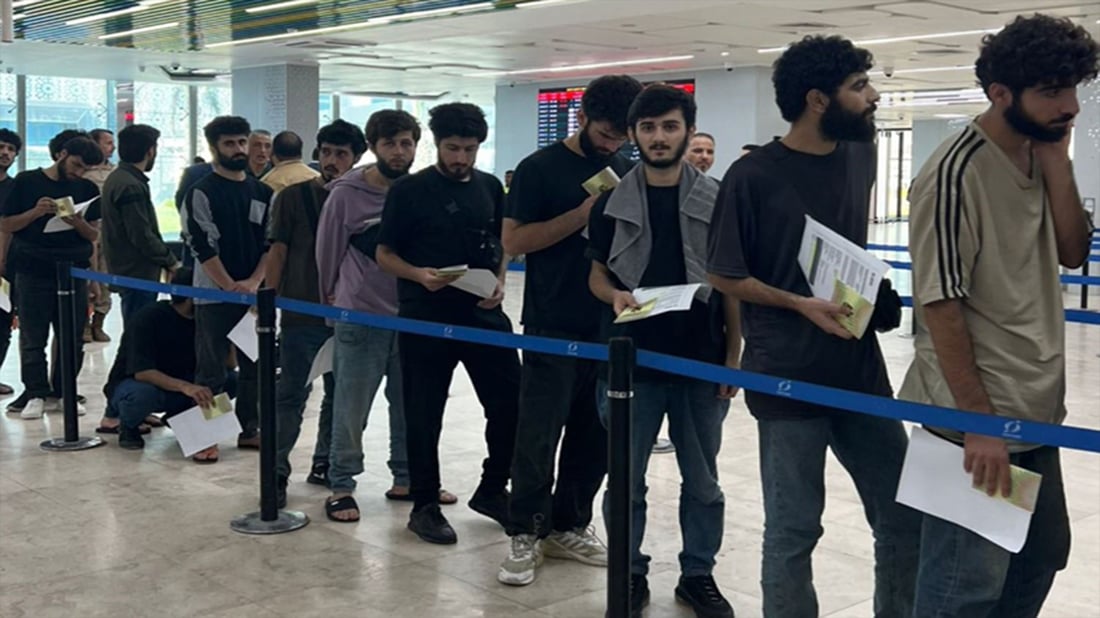
Failed attempt to reach Europe
40 prospective migrants from Kurdistan Region return after two months of detention in Libya
ERBIL — 40 people returned to the Kurdistan Region early Sunday morning after more than two months of detention in Libya.
The group, mainly residents of the Raparin administration in Sulaymaniyah, had been held after attempting to use Libya as a route for migration to Europe by sea.
The return was coordinated with Iraq’s embassy in Tripoli. The group arrived at Erbil International Airport at 4:00 a.m.
Many of the returnees showed signs of exhaustion and described difficult conditions in detention. One told 964media, “It was truly a disaster. Our living conditions there were terrible. They gave us very little food and water. When we got sick, no one helped or took us to a doctor.”
The group were transported back to the Raparin area on the same day. Most are from Qaladze, Hajiawa, and Zharawa.
Abubakr Hussein, a father of one detainee, told 964media that his son had left for Libya in July and was later imprisoned after being captured at sea. He described the conditions in detention as harsh, with insufficient food and medical care.
The last group of returnees from Libya included 25 people and arrived in the Kurdistan Region on Sept. 10.
Libya and Tunisia have been key transit points for refugees trying to reach Europe, but a crackdown on migration led to detentions in both countries, decreasing the number of departures.
A total of 41 individuals from the Kurdistan Region were detained in Libya. One, Hogir Aso Khidr, died from a stroke on Oct. 16 while in custody.
Earlier this month, another 16 Kurdish youth from the Kurdistan Region, who had been detained in Tunisia for two months while attempting to migrate to Europe, were released.
Iraqi and Kurdish asylum seekers commonly use the Eastern Mediterranean route through Turkey to Greece, Cyprus, and Bulgaria. However, traffickers have increasingly used new routes from the Turkish and Lebanese coasts to Italy, as well as the Western and Central Mediterranean routes through Algeria, Egypt, Libya, and Tunisia toward Italy and Malta.
In 2023, the European Union recorded its highest number of asylum applications since the 2015-16 refugee crisis, with over 1.14 million people seeking protection. Among these, 26,131 were Iraqis, most of whom are believed to be of Kurdish origin, according to a report by the European Union Agency for Asylum.