
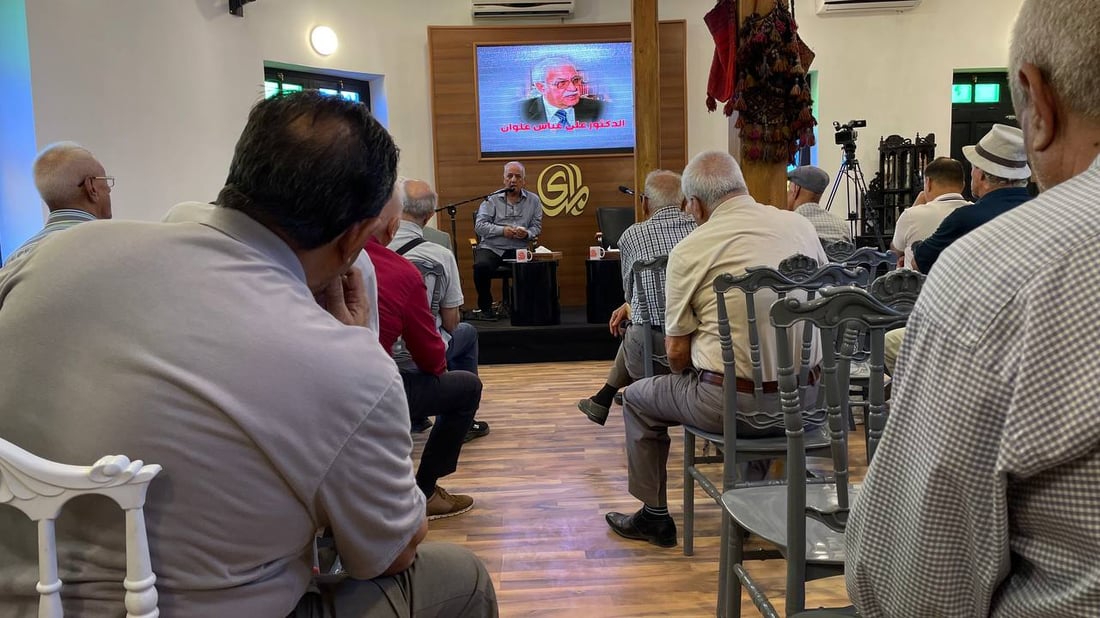
Attendees gather at Al-Mada Cultural Forum in Baghdad to honor the late scholar Dr. Ali Abbas Alwan. Photo by 964media.
Baghdad
Al-Mada Forum honors late literary critic Ali Abbas Alwan for his lasting influence on Iraqi culture
BAGHDAD — The Al-Mada Cultural Forum on Mutanabbi Street held its weekly session Friday to commemorate Dr. Ali Abbas Alwan, one of Iraq’s most prominent literary critics and academics, recognizing his enduring impact on generations of scholars and writers.
Born in Basra in 1938, Alwan graduated from the College of Arts at the University of Baghdad in 1960, obtained a master’s degree from Cairo University in 1966, and earned his Ph.D. there in 1974. He later served as president of the University of Basra from 2005 to 2009. His doctoral dissertation, Modern Arabic Poetry in Iraq: Visionary Trends and Aesthetic Structures, became a cornerstone reference in the study of modern Iraqi poetry.
Known for his boldness and candor, Alwan spent many years in Egypt studying under leading scholars from the French school of literary criticism. He was regarded as a continuation of the critical tradition established by Dr. Ali Jawad Al-Taher.
Critic and academic Qais Kazem Al-Janabi said, “Dr. Ali Abbas Alwan is one of the great figures of Iraqi culture. He began his journey early, earning his master’s and doctoral degrees in 1974 on the development of modern Arabic poetry in Iraq, studying both its aesthetic and thematic dimensions.” Al-Janabi described him as transparent and kind, “a true son of Basra,” adding, “Remembering him today is a cultural duty, a way to honor the professors who taught us and to introduce new generations to those who gave so much to the country, life, and culture.”
Ali Haddad, head of the Eshan Foundation for the Study of Popular Culture, told 964media, “Professor Dr. Ali Abbas Alwan was a distinguished cultural, critical, and academic figure with deep knowledge and awareness, supported by a strong methodological capacity he developed through his work with graduate students.”
“Many of those he supervised or whose theses he discussed later became important figures in Iraqi academia and culture,” Haddad said. He explained that Alwan “represented a unique Iraqi school of criticism that balanced impressionism with intellectual depth, much like Dr. Ali Jawad Al-Taher and Dr. Jalal Al-Khayyat.”
Haddad added, “At first, students might find him intimidating because of his strong voice and blunt honesty, but once you sit with him, you discover his humane side — and that made him beloved among his students.”
He said Alwan’s 1974 dissertation “reflected all his knowledge, awareness, and readings, becoming a major reference in the field of modern Iraqi poetry.”
“Dr. Alwan preferred silence,” Haddad said, “but anyone who sat with him was drawn into dialogue, which he used to refine his views and enrich his thinking.”