
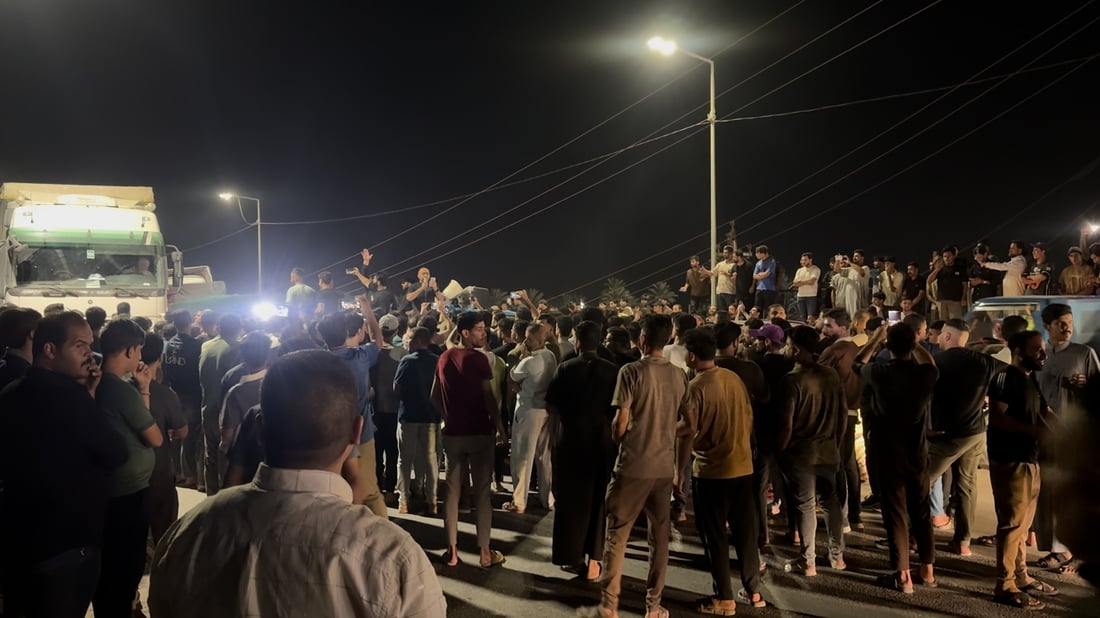
Protesters block Al-Saqi Bridge in Manathira district, Najaf governorate, during a demonstration over electricity shortages and public services.
Najaf protesters block bridge over services, give authorities Muharram deadline
NAJAF — Protesters in the district of Manathira blocked the al-Saqi Bridge on the Najaf-south highway Saturday evening, demanding action on deteriorating services and setting deadlines for authorities to address local grievances, with warnings of escalation after the 10th of Muharram if demands go unmet.
Demonstrators told 964media they have given the government until Tuesday to pave the road to the district hospital, an area used for religious processions during Muharram. The demands were delivered to Manathira police chief Col. Sattar al-Luhaibi. Protesters also erected a sit-in tent outside the district’s main congregation hall and said they would monitor implementation of their demands, with a broader deadline set beyond the 10th of Muharram for all requested measures to be completed.
In a statement, residents said years of promises on service projects and development plans had produced little progress. “The reality still witnesses clear delays and unjustified postponement in completing many essential files, which has harmed the public interest and directly affected the lives of citizens,” they said, holding the Najaf local government responsible and calling for “urgent and decisive measures” with binding timelines. “Enough insulting the dignity of citizens, enough disregard for their legitimate rights and just demands,” the statement said.
Among their demands: disclosure of the status of stalled projects, a binding timetable for completion, accelerated distribution of residential plots near the cement plant and resolution of Cabinet Decision 320 of 2022, which concerns converting land from agricultural to residential use and transferring ownership to current occupants.
Residents warned that if authorities fail to show “clear and tangible implementation steps” after the 10th of Muharram, they would resort to “all legitimate legal and constitutional means,” including peaceful demonstrations, an open-ended sit-in and further escalation.
The protest comes a day after residents of the al-Madina district in northern Basra marched to a local transmission substation over recurring power outages, giving authorities one week before launching a sit-in. Both demonstrations reflect a broader electricity crisis driven by reduced Iranian gas imports, lower domestic production and regional disruptions. Iraq relies on Iranian gas for more than 30% of its electricity generation, while private generators remain the primary power source for many households during summer months when temperatures regularly exceed 50°C in Baghdad and southern governorates.