
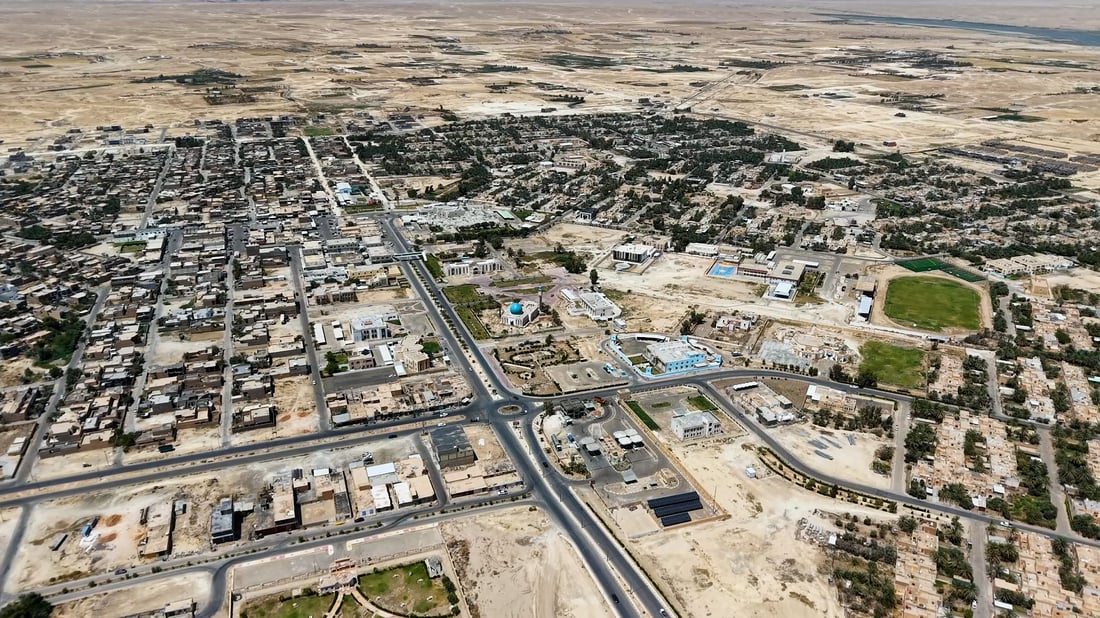
Aerial view of modern Anah in Anbar governorate, showing residential neighborhoods, mosques, and public buildings on the edge of the desert. Photo by 964media.
Anbar
Anah’s old city remembered for knowledge and history
ANBAR — The old city of Anah no longer stands on the banks of the Euphrates after being submerged by the Haditha Dam in the 1980s, but it endures in the memory of its people as a cradle of culture and learning.
“Anah is one of the ancient cities wrapped in the fragrance of history, and it is said that its founding dates back to 4000 years before Christ,” retired teacher Hatem al-Qudsi told 964media. “It is surrounded by mountain ranges on both sides, crossed by the Euphrates River, and its banks adorned with palm trees and river islands, which gave it an atmosphere of serenity and prosperous living.”
Historians trace Old Anah’s roots to the Akkadian, Babylonian and Assyrian periods. The city was contested by Persians and Romans before peacefully entering the Islamic state in the 7th century. “In the twentieth year of Hijra, the city was conquered by the commander Amr ibn Saeed during the time of Caliph Umar ibn al-Khattab,” al-Qudsi said.
Anah was long known for trade and craftsmanship, particularly textiles, leather, lime and dates. By 1936, it had established western Iraq’s first secondary school, drawing students from Hit, Al-Bukamal and Deir ez-Zor. Historian Abdul Razaq al-Hussein noted that Anah was free of illiteracy by 1946, reflecting its devotion to education.
“Anah is not just a city, but a continuous civilization stretching back thousands of years,” said Ziad al-Ani, a member of the Association of Historians of Western Cities. “It is the only city that has retained its name since that time, while other cities such as Isin, Larsa, Akkad, Eridu and Ashur have disappeared.”
He said the city once contained nearly 162 archaeological sites, including the famed Anah Minaret dating to 696 AH. In Assyrian times, it was known as the “capital of the land of Sukhi,” ruled by kings such as Kudu, Adad and Zimri-Lim.
By the Ottoman era, Anah became a district in 1825, with Rashad Bek as its first governor. It developed into an educational hub, opening the first vocational school in Anbar in 1956, and was known for its social life built around more than 170 guesthouses.
That continuity ended when the Haditha Dam flooded the old city in 1985–86. “It was a major shock when the waters drowned its memory and history that stretched for thousands of years,” al-Ani said.
For New Anah’s people, the old city lives on in identity and tradition. As al-Qudsi reflected, “Its people preserved their traditions, known for their solidarity and love of knowledge.”