
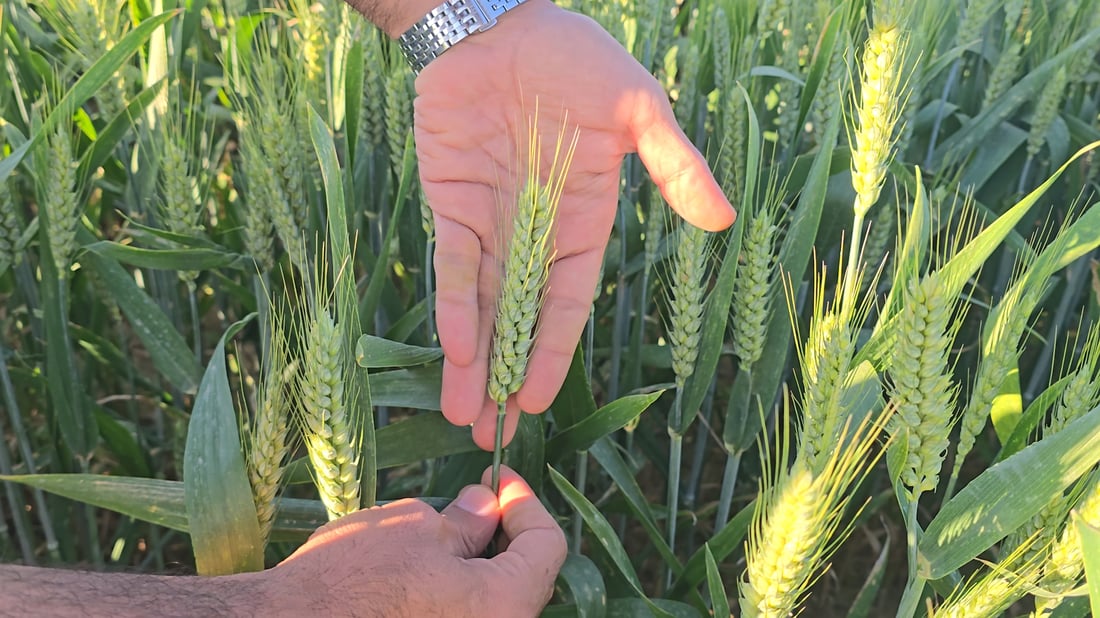
Caption: A farmer compares wheat varieties at a smart farm in Nineveh Governorate. Photo by 964media.
Food security
Smart farm in Nineveh tests foreign wheat varieties against local crop
NINEVEH — A farmer west of Mosul is running what he describes as a smart farm equipped with remote-controlled irrigation, field surveillance, weather monitoring and groundwater tracking, while conducting what he says are the first trials in Nineveh Governorate of imported wheat varieties alongside Iraq’s local crop.
Abdullah Ziad al-Ali manages his farm in al-Masaid village through electronic applications that control irrigation, water pumping and an alarm system linked to surveillance cameras. He has also built what he describes as the area’s first system for measuring wind speed, direction and rainfall. The system addresses one of Iraqi agriculture’s most acute structural problems: FAO assessments of the Tigris-Euphrates basin estimate that Iraq loses between 40 and 50 percent of its irrigation water to inefficiency, a figure that has worsened as river flows from upstream Turkey and Iran have declined. A reservoir covering 1.25 dunams holds 16,000 cubic meters of groundwater and doubles as a carp farm, with the fish sold in local markets and their waste used as organic fertilizer for wheat.
Ali is trialling five varieties: Iraq’s Rahab, Egypt’s Sids 14, Italy’s Bingo, Turkey’s Ceyhan and a Spanish variety. “The competition is intense between the five varieties,” he told 964media. “The variety that proves most resistant to climatic conditions and achieves the highest productivity will be planted again next season.”
He is tracking each variety’s water consumption, fertilizer requirements and disease resistance. ICARDA has identified variety diversification as a priority for Iraqi wheat production, warning that over-reliance on a handful of state-approved varieties leaves the crop exposed to climate shocks and disease outbreaks. Ali’s self-funded trials represent a private iteration of that goal.
The Iraqi Rahab is a soft wheat suited only for bread flour, reaching 80 centimeters with a seeding rate of 45 kilograms per dunam. “We hope its productivity will reach 1.5 tons or more per dunam,” Ali said. Italy’s Bingo, a high-protein, high-strength bread wheat whose resistance profile across powdery mildew, brown rust and septoria makes it a logical candidate for Iraqi growing conditions where fungal disease pressure has increased alongside erratic rainfall, has shown strong tillering and stalks reaching 110 to 120 centimeters at a seeding rate of 30 kilograms per dunam. Egypt’s Sids 14 is the tallest at 140 centimeters, “[and] resistant to drought and disease, growing quickly,” Ali said, and like Rahab is suited only for milling.
Turkey’s Ceyhan, with stalks reaching 110 centimeters and ear lengths of about 12 centimeters, proved too fertilizer-intensive for a second season, a known characteristic of a variety developed for higher-input Turkish farming systems. The Spanish variety, already in its second season after yielding more than 1.5 tons per dunam last year, “grows and flowers earlier than the others” and will be replanted.
With harvest underway, Ali called on Mosul Municipality and the Nineveh Agriculture Directorate to clear roadside vegetation near agricultural land and urged drivers not to discard cigarette butts that could ignite fires. He estimated around 6.5 million dunams of wheat require marketing this season, while roughly 5.9 million dunams relied on rainfall, with irrigated cultivation not exceeding 600,000 dunams.
“We hope the ministry receives all the wheat produced and spares farmers long waiting times at the silo gates and delays in payments as happened last season,” he said