
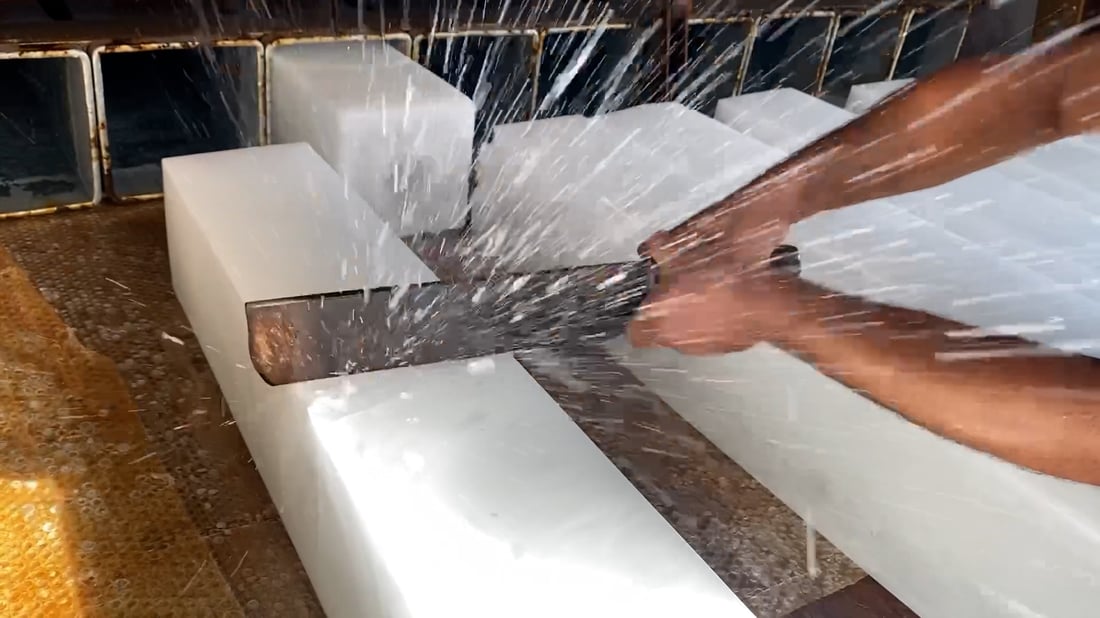
A worker cuts large ice blocks at Al-Nasser factory in Hit, Anbar governorate. Photo by 964media.
Anbar
Hit ice plants supply households, traders with purified and commercial blocks
ANBAR — In the city of Hit, ice production has shifted from informal neighborhood methods to organized plants that supply both households and businesses across western Anbar. Today, two facilities under the name “Al-Nasser” divide production between purified ice blocks for drinking water and commercial-grade blocks used for cooling fish or mixing concrete at construction sites.
The first plant, opened in 2005 in the city’s industrial district, produces about 1,200 blocks a day that are not suitable for drinking. A second plant, established eight months ago inside the city, is the only one in Hit that produces purified drinking water ice, with a daily capacity of 700 blocks delivered directly to households.
“Since 2005 we have had one factory in the industrial district, and eight months ago we opened a second one,” said plant administrator Ammar Khalid. “The first produces 1,200 blocks a day, not suitable for drinking, used by fish sellers and large vehicles. The second produces 700 blocks a day and is dedicated to drinking water.”
Each block sells for 2,000 dinars ($1.42). “We do not want to burden citizens with higher prices, and we provide clean drinking water for free,” Khalid said.
The plants run from 4:30 a.m. to 2:00 a.m. on private generators due to weak national electricity. Freezing each block takes nine to ten hours. Demand peaks from June through November, with the off-season reserved for maintenance.
The ice plants serve neighborhoods in Hit, the old city market, desert villages around Kubaisa subdistrict, and even customers from farther areas such as Kilometer 35.
“All the surrounding areas take ice from this plant,” said trader Saad Jassim. “I buy wholesale and sell retail in the old Hit market. The prices are good, the ice is clean, and the workers are excellent.”
For families working in remote areas, the blocks are vital to enduring Iraq’s summer heat. “We work in sheep trading in the desert near Kubaisa,” said Majid Ubaid. “It took us more than two hours to get here. We collect ice every six days because of the high temperatures and use it for drinking water for ourselves and our children. We rely on Al-Nasser because it is the best in terms of quality and treatment.”
Others buy daily because of chronic power cuts. “We are used to coming to Al-Nasser because it is the only factory in Hit,” said Ammar Mohammed. “We buy ice because of the power cuts and the heat. I buy for myself and for my neighbors, for free, as a good deed. The factory provides excellent ice suitable for drinking.”