
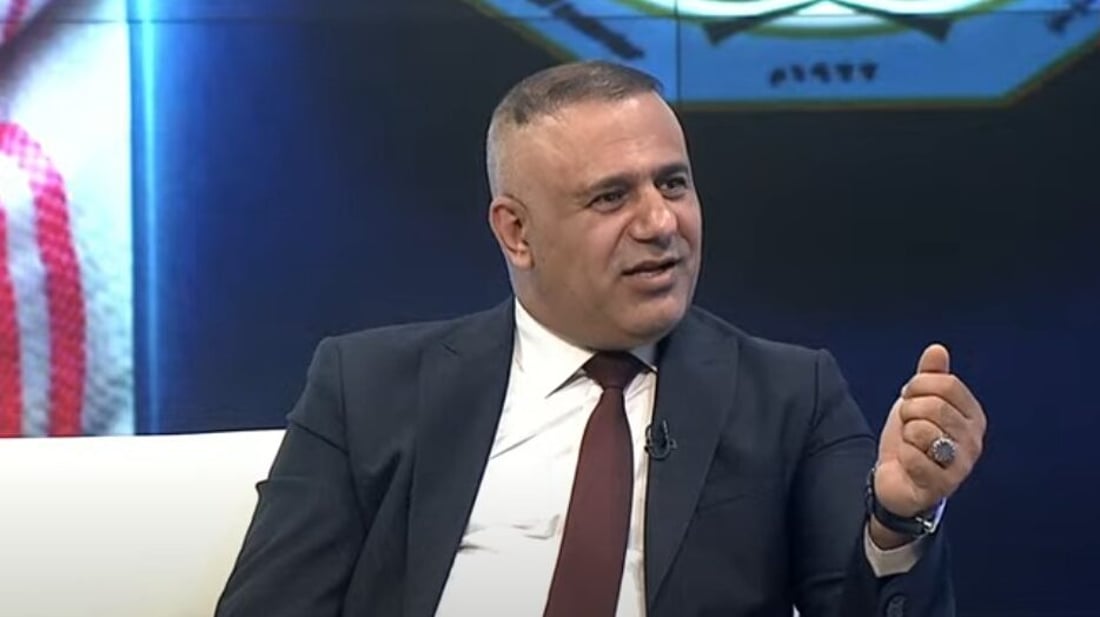
Brig. Gen. Miqdad Miri, director of relations and media at Iraq’s Ministry of Interior, speaks during an interview on Iraqiya TV
'Regional leader'
Iraq says it has dismantled hundreds of drug networks
BAGHDAD — Iraq’s Interior Ministry said it has dismantled hundreds of narcotics networks, seized millions of pills and secured 300 death sentences against traffickers over the past two and a half years, describing the results as the most extensive in the country’s history.
Brig. Gen. Miqdad Miri, director of relations and media at the ministry, told Iraqiya TV that Iraq carried out 16 operations abroad in the past 18 months, including one that targeted what he called “the largest drug factory in the Middle East.” He said a single raid with Saudi cooperation seized seven million Captagon pills moving through Syria, Turkey and Iraq.
“We have dismantled hundreds of networks, secured 300 death sentences against traffickers compared to only five in the previous 20 years, and killed more than 40 drug traffickers. We have also suffered casualties: around 10–15 killed and several wounded,” Miri said.
Some excerpts on Miri’s interview on Iraqiya TV:
The Ministry of Interior has made great progress on some of the toughest and most important files. The first is the narcotics file, followed by tribal disputes, organized crime, and many others. All of this falls within the government program, of which the ministry has implemented 98 percent.
What has been achieved in combating drugs under the current government and ministry is the broadest and most extensive in the history of the Iraqi state in this field.
If we compare what has been accomplished in the past two and a half years with everything from 2003 until October 2022, the difference is striking — in seizures, in the issuance of death and life sentences, and in the fight against narcotics. With the strong support of Prime Minister Mohammed Shia al-Sudani and the Minister of Interior, our operations have shifted from defense to offense.
Drug trafficking is a transnational crime that cannot be controlled without international cooperation. We have opened channels with all of Iraq’s neighbors, regional and global partners, and major organizations combating narcotics. As a result, Iraq was labeled a ‘regional leader’ at the Vienna conference and at the Council of Arab Interior Ministers, due to the operations we carried out. These operations targeted international and local gangs, traffickers, smugglers, and users.
In the past year and a half, we carried out 16 operations abroad. The latest was against the largest drug factory in the Middle East.
We seized seven million Captagon pills thanks to intelligence from Saudi Arabia. The shipment had originated in Syria, passed through Turkey, and then into Iraq. We also have cooperation with Kuwait through joint operations. They handed over 10 of the most dangerous drug traffickers, and in return, we handed over wanted suspects to them. We also cooperate with Turkey and Syria.
International traffickers, including Iraqis and foreigners, have been arrested in Syria with the cooperation of Syrian authorities.
In Lebanon, specifically in the Bekaa Valley, a major international trafficking network was dismantled six months ago at intersections in northern Iraq. Among the detainees — Iraqis and foreigners — was a suspect who had critical information about the factory in the Bekaa. We coordinated with Lebanon’s State Security, who sent officers to gather intelligence from the detainee. They then planned an operation with the Lebanese Army. The factory was well hidden, resembling an entire city inside. It was enormous, managed by an international trafficker with advanced scientific expertise in mixing chemical precursors to produce high-quality narcotics. Large quantities were seized, and this is rightly credited to Iraq’s General Directorate for Combating Narcotics.
I say it clearly: we are now the best agency fighting narcotics in the Middle East. We have dismantled hundreds of networks, secured 300 death sentences against traffickers — compared to only five in the past 20 years — and killed more than 40 drug traffickers. We have also suffered casualties: around 10–15 killed and several wounded.
Drug prices in Iraq have risen sharply. In the past, one gram cost $5, while now it exceeds $100, whether Captagon or crystal meth. This is due to the shortage in supply after major international networks working in Iraq were dismantled.
There are many methods used to smuggle drugs into Iraq — inside the human body, hidden within goods, through border crossings, or via smuggling routes. But our borders are secure and fortified, especially those with Syria.