
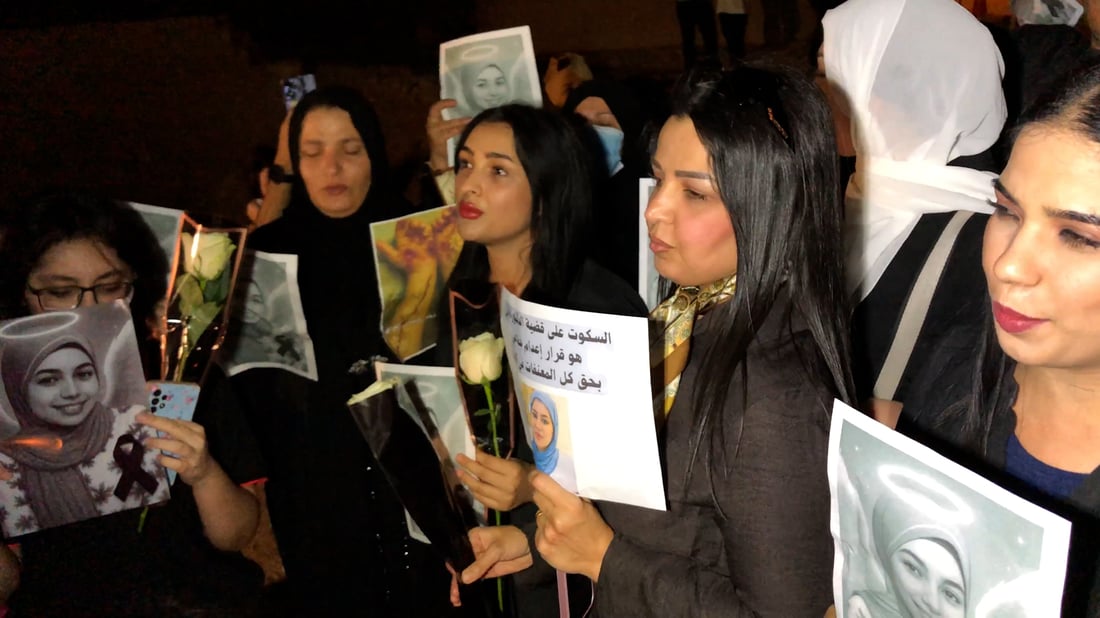
Women hold photos of Dr. Ban Ziyad Tariq and white flowers during a protest in Erbil calling for justice in her case.
Nationwide outcry spreads
Protests in Erbil and Diyala intensify scrutiny over death of psychiatrist Ban Ziyad Tariq
ERBIL — Demonstrations in Erbil and Diyala on Sunday added pressure on authorities to deliver accountability in the death of psychiatrist Ban Ziyad Tariq, whose case has become a national flashpoint over women’s safety and the handling of sensitive investigations in Iraq.
Activists in Erbil gathered in front of the citadel, rejecting political commentary that came before the release of forensic findings. “This solidarity stand today is important to show the truth to society, because facts are currently being manipulated,” said lawyer Zainab Jawad. “Some claim the incident was a suicide, while the evidence is clear that what happened was not suicide but a premeditated murder and mutilation of the body.”
Protester Mohammed Aflouk said participants were also denouncing efforts to shape public perception of the case. “Our other position was to reject and denounce political statements made before the appearance of forensic and medical reports, as some politicians tried to manipulate public opinion and convince Iraqis it was a suicide. These corrupt politicians are still insisting on misleading the people, and the Iraqi judiciary must investigate them,” he told 964media.
In Baqubah, capital of Diyala governorate, dozens of young people rallied in al-Falah Square. One group of women said, “The passing of this incident without fair accountability will pave the way for its repetition. We stress that revealing the truth to the public is necessary to prevent impunity and protect women from violence.”
The protests follow earlier demonstrations in Baghdad and Kirkuk, where citizens and activists demanded transparency and rejected the initial classification of suicide. Forensic specialists and lawmakers have publicly cited details they say point to foul play, including reports of strangulation marks, bruises, and disabled surveillance cameras at Tariq’s home.
Tariq, a psychiatrist in her thirties, was found dead in her home in central Basra on Aug. 4. Police initially reported she had cut her wrists, but colleagues and human rights advocates questioned whether her injuries were consistent with self-harm. A fellow psychiatrist, Mohammed Mahdi Mnakhour, said, “We have reviewed the preliminary forensic report and seen disturbing images that suggest torture and mutilation. The hands have been slashed down to the bone, a procedure that is impossible to imagine being self-inflicted.”
Authorities have not announced final conclusions. The Basra Third Investigative Court has said it is pursuing “expanded legal measures” under a specialized judge, recording witness statements and detaining one suspect while awaiting a full forensic report. Prime Minister Mohammed Shia al-Sudani has ordered “close and rapid follow-up” and called for the results to be announced with “full transparency.”
On Sunday, Parliament Speaker Mahmoud al-Mashhadani said he had formed a six-member committee, chaired by Basra lawmaker Uday Awad Kazem, to follow up on the investigation. The parliamentary Human Rights Committee has described the case as one that shocked the medical community and warned it underscores broader risks facing women and health workers in Iraq.