
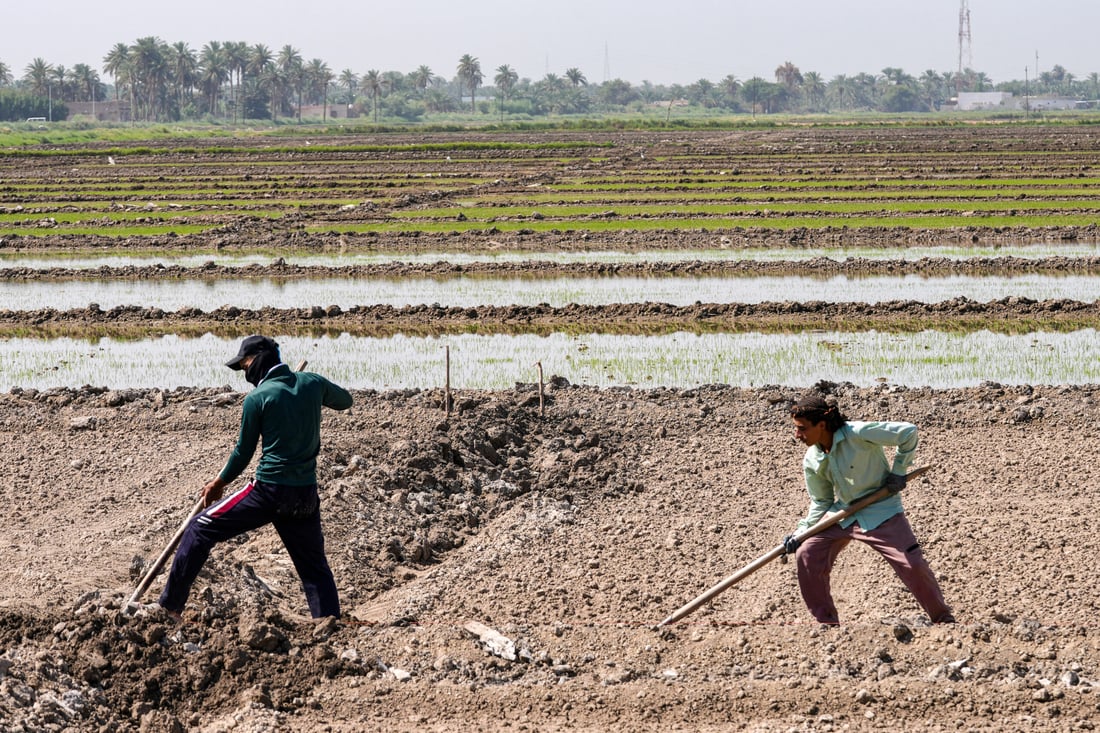
PHOTO FILE Farmers work in a rice field in Mishkhab in Iraq's Najaf (Photo by Qassem al-KAABI / AFP)
Monitor
Iraq’s Agriculture Ministry expands research to combat water shortages, climate change
BAGHDAD — Iraq’s Ministry of Agriculture is expanding research programs to address water shortages and climate change, focusing on developing crop varieties able to withstand drought and salinity, a senior official said.
“The Ministry of Agriculture has given great attention, within its agricultural plans, to implementing agricultural policy in facing water scarcity and climate change,” Administrative Undersecretary Mahdi Suher told the Iraqi News Agency. He said programs have produced “varieties characterized by high productivity.”
Iraq is among the five countries most vulnerable to climate change, according to the United Nations.
Suher said these initiatives have cut irrigated land by about 60%, reducing Iraq’s reliance on the Tigris and Euphrates rivers. Wheat output rose from about 3 million tons in 2023 to more than 5 million tons in 2025, which he attributed to the work of agricultural researchers “to achieve food security.”
This year marks one of Iraq’s most difficult for water scarcity, driven by prolonged drought and reduced inflows from upstream countries, particularly Turkey, according to Minister of Water Resources Aoun Dhiab.
Dhiab said Turkey uses a system of dams along the Euphrates to generate hydroelectric power and transfer water between reservoirs before releasing it downstream, a process that has cut Iraq’s share by half. He said the reduction has worsened the country’s water crisis. Iraq is continuing technical negotiations with Ankara to establish a clear framework for sharing responsibility during regional water shortages, he said.
Mahdi Suher’s statement to Iraqi News Agency:
The Ministry of Agriculture has given great attention, within its agricultural plans, to implementing agricultural policy in facing water scarcity and climate change, through supporting agricultural research to develop varieties tolerant to drought, salinity, and climate change.
Agricultural research has been carried out by researchers in multiple programs supported by the Ministry of Agriculture, including the National Program for Higher Ranks to propagate rice, wheat, barley and yellow corn.
These programs have resulted in the development of several varieties of various crops, characterized by high productivity and their ability to withstand drought and salinity.
Thanks to these agricultural programs, we have seen a significant decrease in Iraq’s use of water from the Tigris and Euphrates rivers, as irrigated areas have been reduced by approximately 60%.
Wheat production has increased at present compared to three years ago. In the 2023 season, production reached about 3 million tons, while it exceeded 5 million tons in 2025.
This significant increase in production came as a result of the efforts of researchers in the agricultural sector to develop high-yield varieties to achieve food security.
The National Program for the Propagation of Vegetable Crop Seeds has been launched to provide them to farmers at subsidized and substantial rates, supported by the ministry, alongside funding these projects and scientific research projects in seed development by the Seed Support Fund of the National Seed Council, which gives great attention to agricultural research and funds it in order to achieve food security and self-sufficiency in Iraq.