
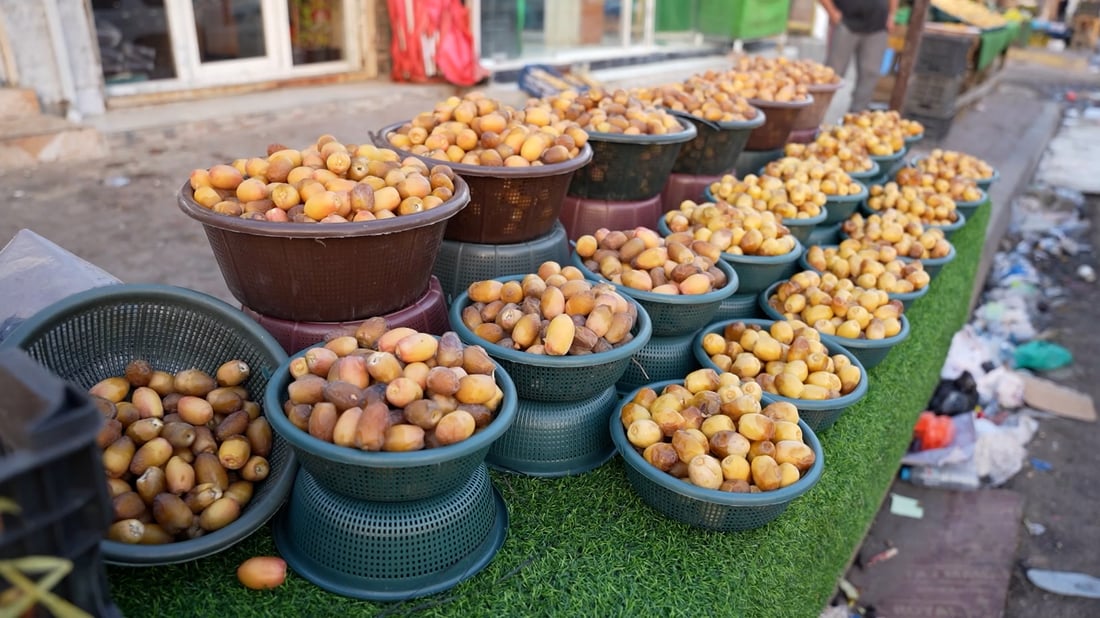
Baskets of freshly harvested dates are displayed for sale at a street market in Basra, July 2025.
'Irreplaceable'
Basra agriculture chief warns of shrinking dates as salinity reaches deeper inland
BASRA — Date palms in southern Iraq are producing smaller fruit due to rising salinity in the Shatt al-Arab waterway, the director of Basra’s agriculture department said, warning of long-term damage to the region’s famed orchards in Abu al-Khasib.
Hadi Hussein Qasim said the effects are most visible in Abu al-Khasib, a historically fertile area known for producing rare and high-quality dates, including the prized Barhi variety. The orchards, located along the western bank of the Shatt al-Arab and less than 100 kilometers from the Gulf, have been hit hard by saltwater intrusion caused by upstream water shortages.
“The palm sector in Basra is going through a real crisis due to the saltwater surge that has infiltrated the Shatt al-Arab,” Qasim told 964media. “This has severely impacted Basra’s orchards and other crops, especially in the southern areas like Abu al-Khasib and al-Seeba.”
Traditionally, freshwater flows from the Tigris and Euphrates have helped push back saltwater from the Gulf. But with declining river levels, seawater has encroached further inland — affecting not only Abu al-Khasib but parts of central Basra city, Qasim said.
While older date palms have largely survived, younger offshoots have been damaged, leading to smaller fruit and reduced quality across the governorate.
Qasim called on the federal government and local authorities to accelerate the construction of water desalination projects, including the long-delayed Muhaila plant in Abu al-Khasib. He also urged renewed efforts to build a dam near Umm al-Rassas Island in the Shatt al-Arab to block saltwater from moving farther inland — a proposal that remains controversial due to soil concerns and Iraq’s water-sharing arrangements with Iran.
“The gradual disappearance of Abu al-Khasib’s orchards will leave only lower-grade varieties like Zahdi to dominate the market,” he said. “The damage is not only agricultural, but also cultural and economic.”
Qasim said the agriculture department continues to support farmers through technical guidance and pest control, but warned that assistance alone is insufficient without major infrastructure investment.
“We continue advising farmers and helping them fight pests like Dubas bugs, dust mites, and the red palm weevil,” he said. “But without urgent intervention, we risk losing an irreplaceable part of Iraq’s agricultural identity.”