
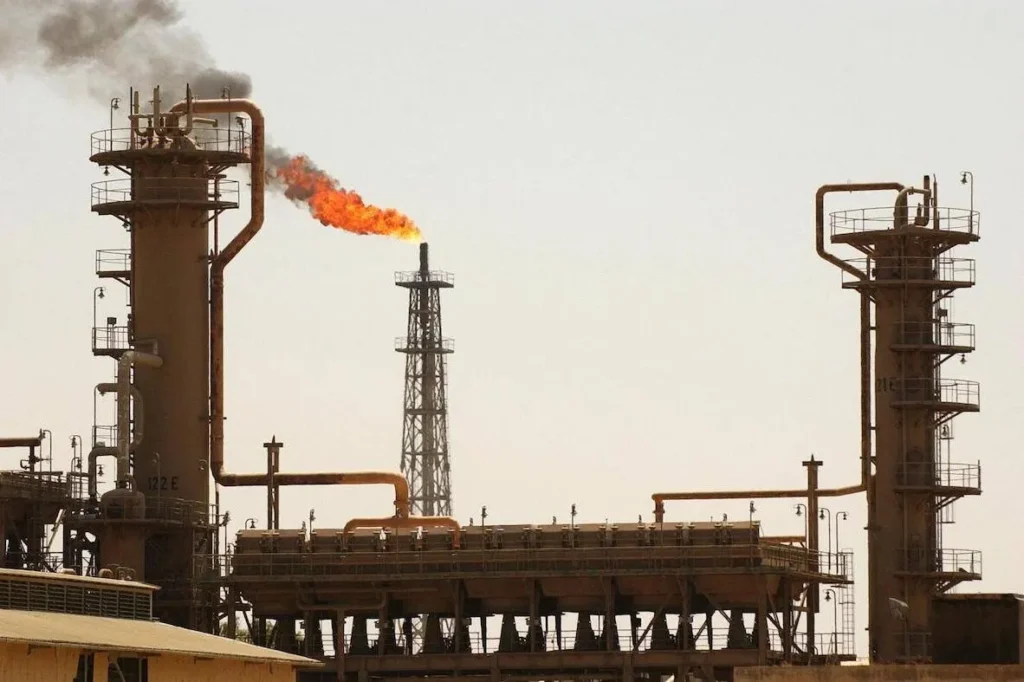
A general view shows Iraq’s largest oil refinery in the northern town of Baiji 05 August 2003. [STAN HONDA/POOL/AFP via Getty Images]
Oil firms say exports can resume if Iraq, KRG provide binding guarantees
ERBIL — International oil companies operating in the Kurdistan Region say they are ready to resume crude exports through the Iraq-Turkey Pipeline, but only if binding agreements are reached that guarantee payments and uphold their contractual rights.
The Association of the Petroleum Industry of Kurdistan, which represents several major energy companies in the region, said in a statement Monday that its members participated in a July 12 meeting with officials from both the Kurdistan Regional Government and Iraq’s federal government. Talks focused on restarting exports that have been suspended since March 2023.
“APIKUR member companies stand ready to resume exports as soon as written agreements are executed that honor our existing contracts which are governed by international law,” said spokesman Myles B. Caggins III. He said the companies are seeking payment certainty, resolution of arrears, and respect for their production-sharing contracts with the KRG.
The group said payments must be made in cash or through in-kind transfers of oil entitlements and must be carried out transparently and promptly, in a manner acceptable to both the companies and the KRG.
The statement comes amid continued deadlock between Erbil and Baghdad over oil revenue-sharing, contract authority, and export control. At the heart of the dispute is the question of who holds legal authority to manage and market oil from the Kurdistan Region.
Oil exports from the region halted on March 25, 2023, after the International Chamber of Commerce in Paris ruled in favor of Baghdad in a long-running arbitration case. The tribunal found Turkey had breached a 1973 pipeline agreement by allowing the KRG to independently export oil without federal approval. Exports had averaged 450,000 barrels per day.
In response, Ankara shut the pipeline and has not reopened it, citing maintenance issues and the lack of a unified export agreement between Baghdad and Erbil.
Iraq’s federal government argues that under the constitution and national budget law, all oil must be marketed by the state-run SOMO. The KRG maintains that its contracts, signed under its 2007 oil and gas law, are legal and internationally recognized.
On July 12, Iraq’s Oil Minister Hayan Abdul Ghani told state media that Baghdad and Ankara are ready to reopen the pipeline but said the KRG’s request to increase its internal oil consumption quota remains the final obstacle.
“The estimated internal consumption of 46,000 barrels per day is the point of disagreement before resuming exports,” he said. “The region now demands this quantity be 65,000 barrels per day, which is a violation of the budget law.”
He added that Baghdad had proposed a $16-per-barrel payment mechanism and the appointment of an independent consultant to verify production costs. The proposal, he said, was approved by federal and regional audit agencies and submitted to Parliament.
The KRG said earlier this month that it had fulfilled its obligations, including transferring oil revenue to the federal Finance Ministry, and accused Baghdad of using the dispute to delay salary payments.