
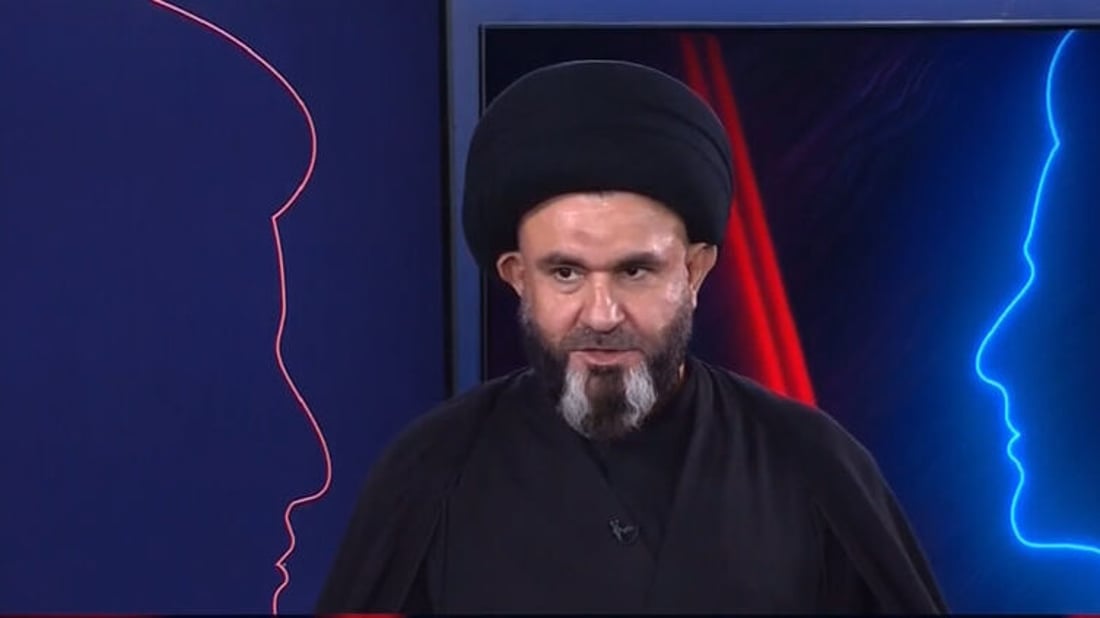
Wathiq al-Battat, leader of the Iraqi "Mukhtar Army" faction
Media Monitor
Mukhtar Army leader Wathiq Al-Battat pledges support for Iraqi PM over Iranian influence
BAGHDAD — Wathiq Al-Battat, leader of Iraq’s Mukhtar Army faction, stated in a recent interview that he would support Iraqi Prime Minister Mohammed Shia Al-Sudani if forced to choose between Iraqi and Iranian decisions in the country. Al-Battat expressed his desire to enter Iraq’s political process, saying he awaits an opportunity from Al-Sudani to participate formally.
Al-Battat criticized Iran’s political decisions, blaming them for the ‘continued existence’ of Israel following Hezbollah leader Hassan Nasrallah’s assassination.
He noted that he expected all resistance factions to unite against Israel after Nasrallah’s death, but alleged that “the Iranian decision” prevented this shift in focus.
He added that while Iran directs decision-making for most resistance factions in Iraq and elsewhere, the Houthis are an exception, as they reject foreign oversight—a stance he contrasted with that of Iraqis, who, he claimed, accept it.
The Mukhtar Army (Jaysh Al-Mukhtar) is a Shia militia group in Iraq founded in 2013 by Al-Battat, who was formerly a senior official in the Hezbollah Brigades, another prominent armed faction in Iraq.
Excerpts from Wathiq al-Battat’s interview with Al Sharqiya:
The Islamic Republic is currently setting the strategy for the resistance, and what is keeping Israel from disappearing—despite all its crimes—is the political decision of the Islamic Republic. Despite Israel’s assassination of Sayyed Hassan Nasrallah, which we had thought was a red line for them, the borders are now open for fighters to head to the fronts, and the decision is in Iran’s hands.
Israel is not invincible. If all Iraqis marched to Israel’s borders, and each one of them urinated on its borders, floods would sweep Israel away. “What is Israel in front of a nation of one billion people?” As for the resistance, it was expected to direct all its capabilities toward Israel and eliminate it after the assassination of Sayyed Nasrallah, but it was the Iranian decision.
The resistance in Iraq is controlled by Iran, and the Quds Force holds the decision over all resistance factions in the region, except for the Houthis, who have more freedom than others due to their nature that rejects guardianship, unlike the Iraqis who accept it.
The Iraqi front is the least effective among the resistance fronts because the resistance factions responded to the commander-in-chief of the armed forces, except for the Nujaba Movement, which officially announced its participation in the war. However, all the factions that entered politics decided to place the responsibility on the commander-in-chief in this matter.
Personally, and as a faction, I believe that there is no doubt about Prime Minister Sudani’s ideological commitment, revolutionary spirit, and concern for Iraq’s interests. So, when there is a leader with such qualities, one should not be more royalist than the king. Therefore, we must follow him, and I am ready to lay down my arms and enter politics if given the opportunity. I am willing to comply with the orders of the commander-in-chief of the armed forces, not the Iranian decision. But we are waiting for an initiative from the government to offer us the opportunity to enter the political process.
When the armed forces collapsed in 2014, the Mukhtar Army was able to supply these forces with more than 57,000 fighters. Today, we have 280,000 fighters, including 140,000 in Mosul alone. If the front were opened to me, I would sweep over Israel, but I do not want to undermine the political decision of the state, as this would be incorrect.
There are two decisions in Iraq: Iranian and Iraqi. If the two decisions conflict, I will choose the one to which I belong, which is the Iraqi prime minister, provided he receives me and allows me to enter politics. Otherwise, I will choose the Iranian decision, and I may return to fighting alongside the Nujaba Movement.
If I entered the elections, I would win a large number of seats, but I am convinced that the electoral process is rigged and controlled by the political class. It is up to the prime minister to prove otherwise in the upcoming elections. He must change all the commissioners and bring in independents with no sectarian or Baathist tendencies.
I could join the war, but that would expose Iraq to war with the entire international community. The best decision is to offer my capabilities to the Iraqi state and give it the opportunity to build the country. This is exactly what Iran did when it agreed with Israel on limited strikes, and the whole issue was settled. The reconstruction of Gaza and Lebanon was entrusted to the Gulf states.
Currently, I do not have the greatest influence, but I will have significant influence in the future. If I decide to head to the Golan and invade Israel, I will be the number one decision-maker. At that time, I will be highly influential. However, if I join the state, I will be even more influential and will have many strategies to find solutions with our Sunni and Kurdish brothers through my influence on the Iranian political decision.
Thousands of Iraqis are fighting in Lebanon and Syria. My estimates are that their numbers reach around 15,000 fighters, who went after the announcement of Sayyed Hassan Nasrallah’s martyrdom.