
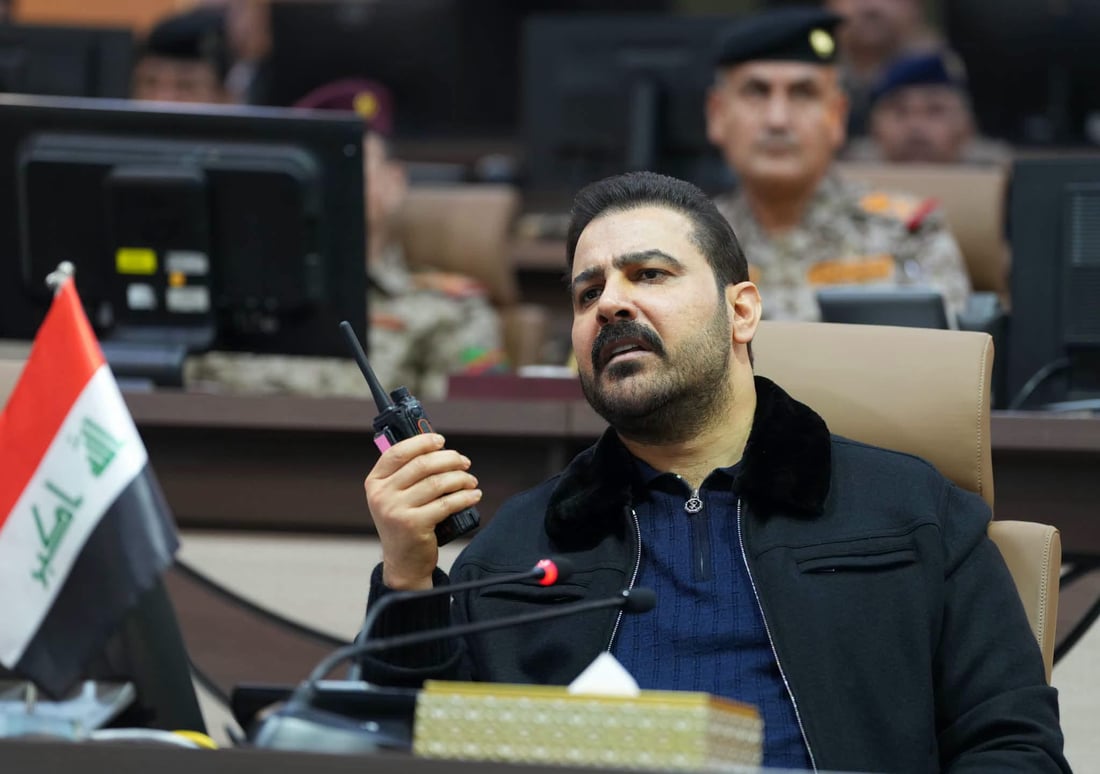
Zaidi says state control of all Iraq starts in Jurf al-Sakhar
BAGHDAD — Prime Minister Ali al-Zaidi on Friday told the forces moving into Jurf al-Sakhar, the stronghold of the Iran-aligned faction Kataib Hezbollah, that the state’s drive to impose its authority across Iraq starts there.
In an address to the units holding the northern Babil area, officially renamed Jurf al-Nasr in 2014, Zaidi asked them for “self-restraint and wisdom.”
“We are not fighting a battle. Everyone there is your brother; there is no enemy among you and no adversary in front of you,” he said. “They are sons of this nation, and their blood is our blood.”
He said the new phase was about containment, not exclusion. Everyone would join the armed forces “under one flag, one command and one law,” he said. He did not say what would happen to Kataib Hezbollah’s fighters or where its brigades would go.
“Our decision is firm: no weapons outside the authority of the state, no weapons but Iraq’s weapons, no decision but Iraq’s decision and no flag above Iraq’s flag,” Zaidi said.
He thanked Iraqis for standing with the state “in protecting Iraq’s wealth and thwarting corruption and rebellion.”
“From Jurf al-Nasr begins the imposition of state authority over all Iraqi land, so that we confront any corruption or unruly weapons in our country,” he said. “It is the beginning of one Iraq, strong and just, governed by the constitution and the law.”
Zaidi followed the operation from the headquarters of the commander-in-chief’s office with Interior Minister Yasser al-Maliki, Defense Minister Nayef al-Shammari and senior officers, his media office said in a statement released with photos. Gen. Abdul Amir al-Shammari, the director of Zaidi’s office, was also there. Zaidi reviewed how the units were carrying out the handover and how well they were coordinating, the office said.
Iraqi forces began replacing Kataib Hezbollah’s 45th, 46th and 47th brigades, which are part of the Popular Mobilization Forces, on Friday morning, as a new joint command took charge under Federal Police leadership. The Energy Police took over the 5-kilometer stretch of oil pipeline that crosses the area. None of the officials who spoke Friday said where the three brigades would go.
In Najaf, Friday prayer leader Sadr al-Din al-Qabanji welcomed the easing of the crisis in his sermon. All Iraqi parties had agreed on the need for a joint leadership to protect security in Jurf al-Sakhar, the oil wealth that runs through it and the sovereignty of the state, he said. “Jurf al-Nasr is Baghdad’s flank, so a danger to it is a danger to Baghdad,” Qabanji said.
Kataib Hezbollah has held Jurf al-Sakhar for 12 years and kept the army and other security forces out. 964’s Kurdish service described the area as the faction’s stronghold, with workshops that make missiles, mortars, drones and other weapons. 964media could not independently verify that.
The forces taking over will assess security and search the area before the government restores services so displaced residents can return, the commander-in-chief’s spokesperson said Friday. The standoff began after an Interior Ministry intelligence report started circulating Nov. 9. It alleged that oil was being drawn from pipelines in the area and carried away in tanker trucks. Kataib Hezbollah denies smuggling oil.
Iraqi forces and allied armed groups recaptured Jurf al-Sakhar from the Islamic State group in 2014. The area has been closed since.