
Iraqi MP demands inquiry into officer’s appearance at Saudi-led coalition briefing
BAGHDAD — Iraqi lawmaker Hamed al-Mousawi has submitted urgent requests to the defense and foreign ministers seeking an investigation into the appearance of a senior Iraqi military officer at a Saudi-led coalition press briefing in Riyadh, raising questions about Iraq’s position on the war in Yemen.
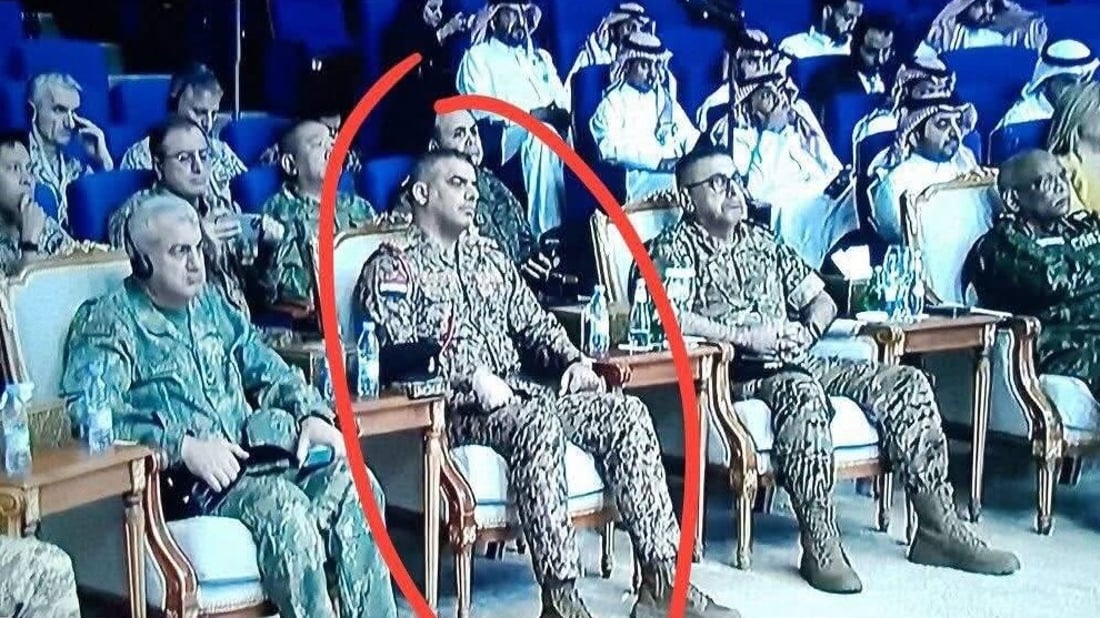
The move followed the circulation of an image from an Al Hadath television broadcast showing an officer wearing an Iraqi military uniform seated in the front row alongside representatives of other Arab military delegations.
The briefing, held Thursday, Oct. 15, was delivered by Maj. Gen. Turki al-Maliki, spokesperson for the Saudi-led coalition fighting Yemen’s Houthi movement. He outlined recent Houthi attacks on Saudi Arabia, saying Riyadh’s King Khalid International Airport had been targeted 20 times in October and that Houthi attacks had killed 17 people and injured more than 300.
In formal letters to the two ministers, Mousawi described the officer’s appearance as a serious departure from Iraq’s official foreign policy of staying out of regional conflicts.
The lawmaker asked the defense minister to identify who authorized the officer’s attendance and hold any officials responsible for violations accountable. He also urged the foreign minister to clarify Baghdad’s diplomatic position and address any potential consequences for Iraq’s regional relations.
Mousawi argued that the officer’s participation in an official military uniform could suggest Iraqi government approval of the coalition’s activities, regardless of whether the appearance had been formally authorized.
He pledged to continue following the matter to prevent the Iraqi military’s national identity from being used in foreign conflicts.
Mousawi’s letters seek an official explanation of the Iraqi officer’s presence at the coalition briefing and an investigation into whether his attendance was authorized by the defense establishment.
The officer’s identity, the circumstances of his attendance and whether he was officially authorized to participate have not been established. His presence at the briefing does not, by itself, indicate Iraqi participation in the coalition’s military operations.
The controversy comes as some Iran-aligned Iraqi armed factions have openly supported the Houthis despite Baghdad’s efforts to keep Iraq out of regional conflicts. On Oct. 12, Kataib Hezbollah praised Houthi attacks on Saudi Arabia, including a strike on Riyadh’s King Khalid International Airport, and dismissed the Iraqi government’s condemnation as unrepresentative of the Iraqi public. The group described the attacks as a response to what it called a Saudi blockade of Yemen and urged the Houthis to continue their operations.
The Houthis have also maintained a presence in Baghdad for years. Abu Idris Ahmed al-Sharafi has been identified as the group’s representative, while a Houthi-linked office has been reported in Baghdad’s Jadriya district. Its formal status remains unclear, and Iraqi authorities have not publicly confirmed whether it operates as a licensed representative mission.
In September, Iraqi politician Jamal al-Dhari, secretary-general of the Iraq National Project, called for the closure of Houthi offices in Iraq after Saudi Arabia accused the group of attempting to target Mecca with a drone. The Houthis denied the accusation.
The group’s presence has also raised security concerns. Houthi representatives have reportedly held meetings in Baghdad, Basra, Najaf and Karbala, while allegations have emerged about Houthi personnel operating in Jurf al-Sakhar, south of Baghdad. Reports have also raised the possibility that attacks against Saudi Arabia were carried out from Iraqi territory with assistance from Iraqi armed factions, although those specific allegations remain unverified.
Relations between Baghdad and Riyadh have faced growing pressure over cross-border attacks. In July, U.S. and Saudi airstrikes hit Popular Mobilization Forces positions in seven Iraqi governorates, killing at least 20 PMF members, according to preliminary figures. Washington and Riyadh said the strikes were a response to drone attacks on Saudi Arabia, while Baghdad condemned the operation as a violation of Iraqi sovereignty.
Iraq’s official position has differed from that of the armed factions supporting the Houthis. On Oct. 11, the Iraqi government condemned an attack on Riyadh’s King Khalid International Airport that killed 12 people and wounded 309. Baghdad rejected attacks on civilians and civilian infrastructure and called for an immediate halt to military operations across the region.
Three days later, Prime Minister Ali al-Zaidi met Saudi Crown Prince Mohammed bin Salman in Riyadh and reaffirmed that Iraq would not allow its territory to be used to launch attacks against Saudi Arabia or other neighboring countries. The two discussed regional security and bilateral relations.
The government has also pledged to bring Iraqi armed factions’ weapons under state control and disarm non-Iraqi armed groups operating in the country by June 30, 2027. Zaidi announced the plan on Oct. 1, saying decisions involving war and peace must remain exclusively with the Iraqi state.