
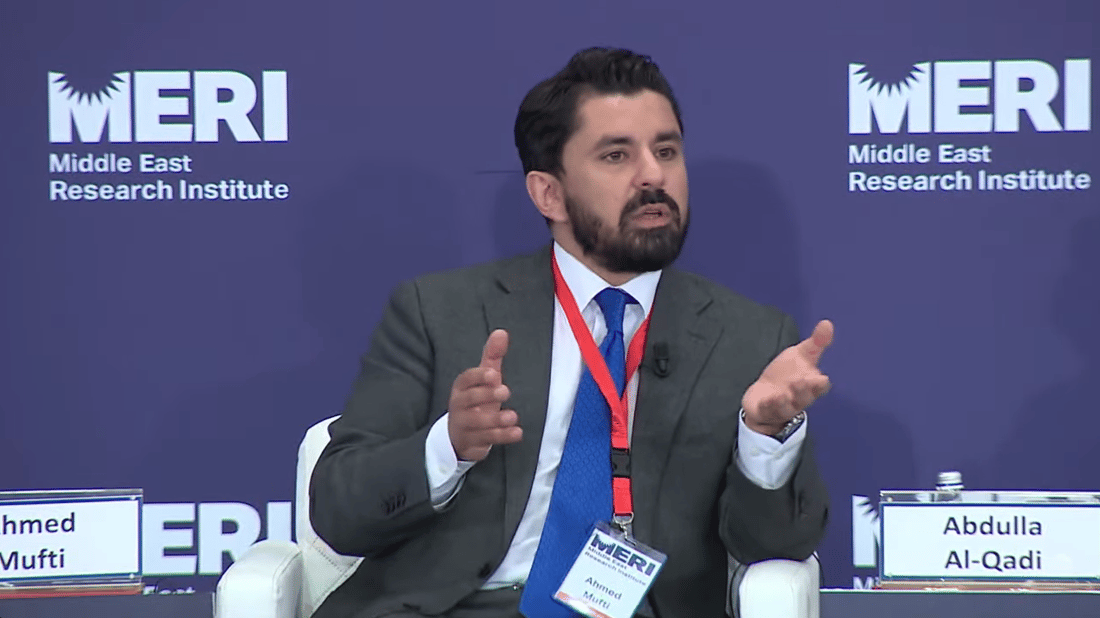
Ahmad Mufti, deputy minister of natural resources in the Kurdistan Regional Government, speaks at the Middle East Research Institute (MERI) Forum in Erbil.
Op-ed
From fuel subsidies to gas investment: a shared opportunity for Iraq
Iraq does not lack energy resources. What it needs is to turn them into reliable electricity, competitive industry and investment that keeps going rather than stalling with every crisis. Neither Baghdad nor Erbil can do that alone, but a partnership between them could make gas part of the solution instead of a resource whose potential we have never fully tapped.
At Erbil’s MERI Forum, I set out a plan for reforming the energy sector built on shared priorities: gradually redirecting subsidies, developing gas fields, protecting facilities, settling what is owed to companies, and connecting production to a more integrated national electricity system.
For all its security and financial difficulties, I believe this moment gives us a chance to rethink how we manage our resources. What we need is to spend in a way that delivers a lasting return for the economy and for citizens.
Start with subsidies
At the forum I presented estimates putting annual waste in the energy sector at around $10 billion, and showing that subsidies on industrial fuel for cement and steel plants hit nearly $8 billion a year.
The real question is how we manage that subsidy. How do we turn part of a bill that comes due every year into investment that develops a gas field or lets factories switch to a cleaner fuel, thus reducing the need for subsidies in future?
Iraq’s government has taken a step in this direction that is worth building on, by reorganizing the pricing of heavy fuel oil for industry. At the time of writing, the reference price is about $650 a ton. Under the new formula, $150 is deducted and 80% of the remainder is charged, bringing the price for industry to $400 a ton.
That keeps industry supported, at $250 a ton below the reference price. Part of the savings from reforming the subsidy could then go toward supporting national industry in a more sustainable way: investing in gas infrastructure, making it easier for gas to reach factories, and helping them make the switch.
The Bazian area of Sulaymaniyah shows how big the opportunity is. Its factories burn about 3,000 tons of heavy fuel oil a day. Switching to gas would cut pollution and production costs while freeing fuel oil for export.
But this switch needs a phased program: a gas supply, incentives for factories to adapt their systems, and a clear timetable plants can plan around. Industry should not have to bear the cost of the transition before alternatives are in place.
In that sense, this is not about abandoning support for industry but changing how we support it.
Put gas at the center of energy policy
By estimates I presented, Iraq needs about 8 billion standard cubic feet of gas per day to provide round-the-clock electricity. Against that need are gas resources that could reduce reliance on imported gas, through the development of the Akkas, Khashm al-Ahmar and Mansuriya fields and others in Diyala and the western areas.
I propose an investment round focused on developing these resources, backed by enforceable legal, security and financial guarantees. Announcing an investment opportunity is not enough if investors do not know the terms under which they will work, how their facilities will be protected and when they will be paid.
The Kurdistan Region’s experience offers something to build on as part of a joint Iraqi effort. Its gas development has relied on attracting foreign investment rather than direct public funding. According to figures I presented at MERI, output at the Khor Mor field has risen from about 350 million standard cubic feet a day in 2020 to about 750 million, and the Region’s total production is approaching 1 billion cubic feet a day.
That experience can help develop resources in the rest of Iraq. Developing the Chemchemal, Kurdamir and Topkhana fields could also raise the Region’s output to between 2 billion and 3 billion cubic feet per day, given the required investment and conditions.
That is the case for a “gas-to-power” policy: using gas to generate electricity, then sending that electricity through the national grid to where it is needed. This approach can connect the Region’s potential with Iraq’s needs, making integration a practical and mutual interest for both sides.
No lasting investment without security and reliable payment
Gas fields are part of electricity security and of people’s daily lives. Relying on a handful of facilities means any attack on them puts supply at risk.
Protecting fields and infrastructure must therefore be a shared priority, backed by a specialized security system and genuine coordination between the authorities in Baghdad and the Kurdistan Region. Investors need incentives, but first they need to know their staff are safe and operations will continue.
Likewise, settling arrears owed to oil companies is an economic necessity. Mounting debts hold up investment, drilling and production growth. A clear payment mechanism would help that work resume and strengthen the sector’s ability to meet its production commitments.
Expanding investment should also go hand in hand with developing local talent. According to the figures I presented, about 80% of the workforce at Khor Mor is local. That is expertise worth building on, so that developing fields also means investing in skills and jobs.
A partnership beyond crisis management
When I proposed at MERI that the Oil Ministry be renamed the Ministry of Oil and Gas, the point was for gas to take its rightful place in priorities, administrative structures and investment decisions, and for its development to be part of a lasting strategy rather than a stopgap response to fuel shortages or power cuts.
Iraq needs a comprehensive program that brings these strands together: subsidies gradually turned into investment, protected fields, companies that get paid, factories transitioning to gas, and electricity delivered through an integrated national grid.
On this issue, the relationship between Baghdad and Erbil should not be a contest over who owns resources but a partnership in how to make the most of them. The electricity that reaches citizens, the jobs investment creates and the revenue the state earns are gains shared by all Iraqis.
The opportunity is still there. What is needed is a decision that turns gas from untapped potential into a source of electricity and economic stability.
Ahmad Mufti is the deputy minister of Kurdistan Regional Government’s Ministry of Natural Resources. He holds a bachelor’s degree in chemical engineering from HU University of Applied Sciences Utrecht and a master’s in natural resource management.