
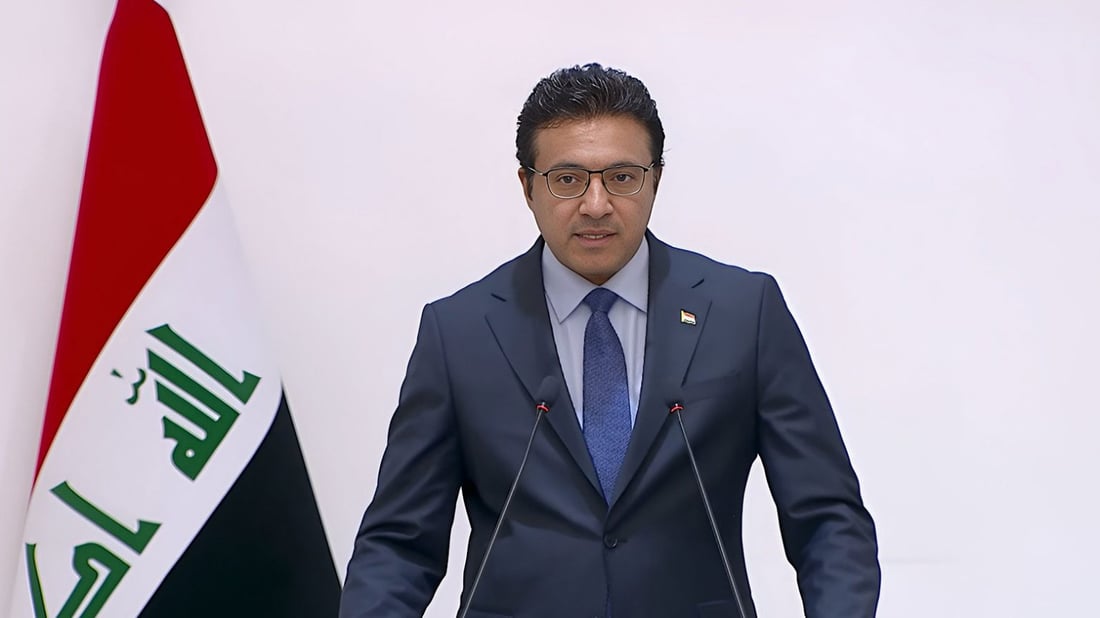
Government spokesperson Haider al-Aboudi speaks during a news conference in Baghdad
2023 rate cut cost the treasury nearly 36 trillion dinars, government says
BAGHDAD — The previous government’s decision to strengthen the dinar in 2023 cost the treasury nearly 36 trillion dinars and fed currency speculation, government spokesperson Haider al-Aboudi said Sunday, defending last week’s devaluation.
“Reliance on the Central Bank began when the exchange rate was reduced in 2023, not just now,” Aboudi told Al-Rabiaa TV. “The losses resulting from that decision between 2023 and early 2026 approached 36 trillion dinars.” Mohammed Shia al-Sudani’s government cut the official price of the dollar to the public from 147,000 to 132,000 dinars per $100 in February 2023, so each dollar of oil revenue the Central Bank bought from the Finance Ministry yielded 150 fewer dinars. “Had the Iraqi government at the time maintained the rate of 147,000, it would have saved 36 trillion dinars as a balance at the Central Bank,” Aboudi said.
The cheaper dollar had widened speculators’ margins, drawn in imports and encouraged currency smuggling, he said. “The margin for speculators increased, and the dollar became cheap in Iraq, attracting foreign goods and encouraging currency smuggling.” The 2023 change followed a surge in the parallel rate after the U.S. Federal Reserve tightened controls on Iraq’s dollar transfers.
Iraq’s economy was “under blockade,” Aboudi said, and no country involved in the regional war had granted an exemption for its oil to pass. “I am responsible for what I say. Iraq’s economy is under blockade, and no party has granted Iraq an exemption for the passage of its oil,” he said. Iraq had asked the parties to the conflict, including Iran, for help, he said, “but there was no response.” Companies buying discounted Iraqi crude are now responsible for shipping it to market, he said.
Iraq’s foreign minister thanked Iran in April for allowing Iraqi oil tankers through the Strait of Hormuz, and the state oil tanker company said on Oct. 3 that it had moved 2 million barrels through the strait on a very large crude carrier, its first such voyage in decades.
Since Wednesday, the Central Bank buys dollars from the Finance Ministry at 1,500 dinars, sells to banks at 1,510 and sets the public rate at 1,520, up from 1,300, 1,310 and 1,320. The parallel market passed 1,700 dinars per dollar in Baghdad after the change and stood at 1,630 to 1,640 on Sunday.
Prime Minister Ali al-Zaidi told the parliament speaker and committee chairs on Thursday that devaluation was necessary to keep paying salaries without more borrowing, after the government had weighed three alternatives: compulsory savings deducted from salaries, paying public employees every 45 days, and taking on more debt. Revenues covered only 76% of salaries and welfare in the first seven months of the year, leaving a gap of 29 trillion dinars, economist Nabil al-Marsoumi said on Oct. 4. Oil provides more than 90% of federal revenue, and exports have recovered to about 2.6 million barrels a day after collapsing when shipping through the Strait of Hormuz was disrupted in March, against 3.3 to 3.5 million before.