
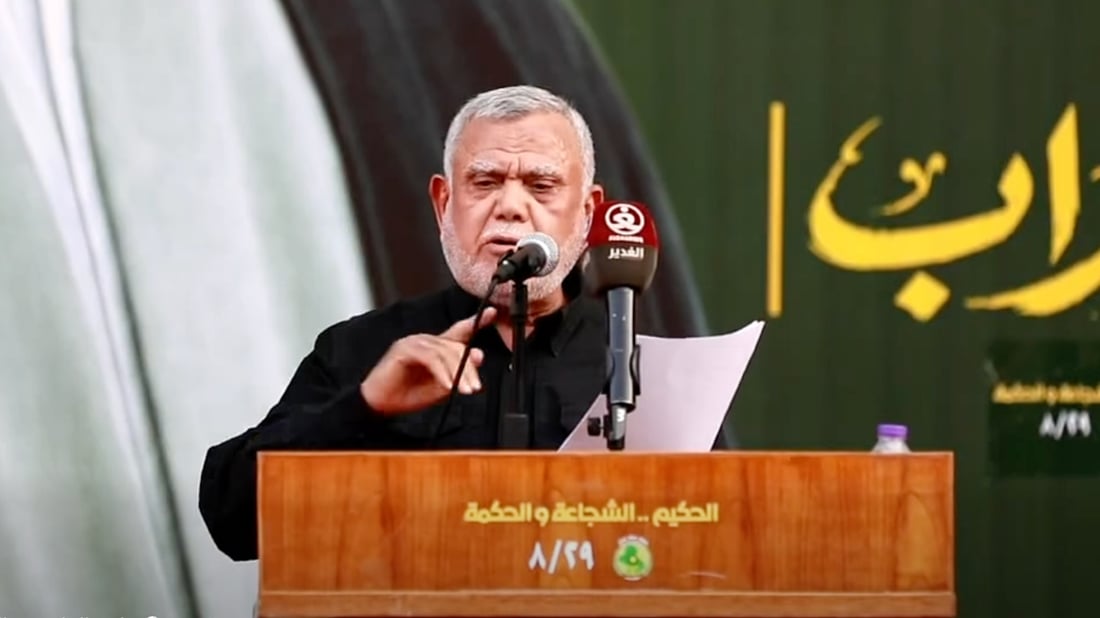
Badr Organization Secretary-General Hadi al-Amiri speaks during a memorial ceremony marking the anniversary of the death of Ayatollah Mohammed Baqir al-Hakim on Aug. 30, 2026.
Hadi al-Amiri’s ‘Tishreen sedition’ remarks draw legal complaint, calls for investigation
WASIT — A lawyer has filed a formal complaint with prosecutors in Wasit governorate seeking an investigation into Badr Organization leader Hadi al-Amiri over remarks crediting the “resistance” with confronting what he called the Tishreen sedition, adding to objections and renewed calls for accountability over the deadly crackdown on Iraq’s 2019 protest movement.
Al-Amiri made the remarks Aug. 30 during a memorial ceremony marking the anniversary of the death of Ayatollah Mohammed Baqir al-Hakim. “The resistance stood courageously against the Tishreen sedition and preserved the state and the political system,” he said, using “resistance,” a term commonly used in Iraq to refer to Iran-aligned armed factions.
Lawyer Hazem Mazen al-Badri subsequently submitted a formal complaint to the chief public prosecutor in Wasit, arguing that al-Amiri’s remarks raised legal questions about the identity of the groups he described as the resistance and their activities during the protests.
The complaint asks prosecutors to authenticate the circulating video, establish when and where it was recorded and summon al-Amiri to clarify which groups he meant and the nature of their role.
Al-Badri said the remarks warrant an investigation into whether any of those groups were involved in firing on protesters or other acts that resulted in deaths or injuries. The filing does not establish that al-Amiri or the Badr Organization committed such acts but asks prosecutors to determine whether criminal responsibility exists.
The lawyer also requested that authorities obtain relevant orders, reports, communications and recordings concerning the movements and activities of the groups during the Tishreen protests and compare any findings with previous investigations and case files involving protesters who were killed or wounded.
The Tishreen movement erupted in October 2019, with demonstrations in Baghdad and central and southern Iraq demanding political reform, better public services and action against corruption. Large numbers of protesters were killed and wounded during the unrest, and questions over responsibility for the violence have remained a focus of victims’ families and rights advocates.
The remarks have also prompted objections from activists and relatives of people killed during the demonstrations. Baha al-Sarai, brother of slain protester Safaa al-Sarai, said he intended to pursue legal action against al-Amiri, while Ali al-Abadi, head of the Iraq Center for Human Rights, called for a serious and transparent investigation into the deaths and injuries associated with the protests.
Mahmoud al-Hayani, a Coordination Framework member who said he is close to al-Amiri, defended the Badr leader and said the phrase “Tishreen sedition” was not intended as a description of the protest movement as a whole.
Al-Hayani said al-Amiri had supported what he considered the protesters’ legitimate demands at the beginning of the movement and had instructed his allies to support them. He said al-Amiri was instead referring to what he described as activities conducted through “dark rooms” and a ‘U.S.-Zionist’ plan aimed at inflaming the streets and bringing down the government.