
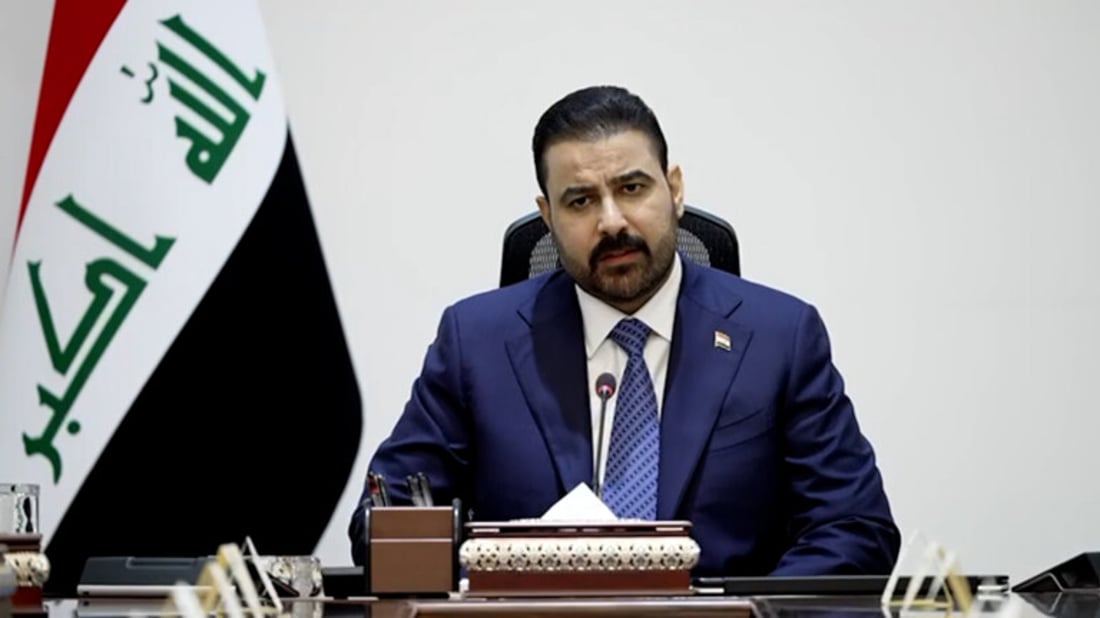
Zaidi says there will be no armed confrontation over weapons
BAGHDAD — Prime Minister Ali al-Zaidi ruled out any military confrontation over his government’s drive to bring weapons under state control, telling a conference in Baghdad that all political forces are in complete agreement on proceeding and that mechanisms for handing over weapons are being worked out.
“There are no intentions or possibilities of any military confrontation, and we will not allow Iraq’s enemies to exploit any opportunity,” he said at the eighth Baghdad Dialogue Conference. “All political forces are in complete agreement on proceeding with restricting weapons to the state, and work is underway on mechanisms for handing over weapons and completely ending this situation.”
Three factions have said otherwise. Kataib Hezbollah said this month it would keep and expand its arsenal, its security official set the dissolution of the Peshmerga among the conditions for any accommodation, and its affiliated Huqooq bloc said it expects the disarmament law to fail. Harakat al-Nujaba and Kataib Sayyid al-Shuhada have also refused while U.S. forces remain. Asaib Ahl al-Haq, Saraya al-Salam and the Imam Ali Battalions have moved toward compliance.
The remarks follow a week of friction over the detention of Abbas al-Yaqoubi, intelligence director for the PMF’s Baghdad Belt Operations and a figure linked to Nujaba, who was held by Counter-Terrorism Service forces in Dhi Qar and released after the judiciary dismissed the accusations. Nujaba accused the government of escalating against armed factions, and a senior figure in Asaib Ahl al-Haq’s Sadiqoun bloc — from a faction that backs the policy — criticised the way the arrest was handled. On Thursday, Asaib Ahl al-Haq leader Qais al-Khazali received a Nujaba delegation led by political council chief Ali al-Asadi, and the two sides called for closer coordination among political forces.
On the economy, Zaidi said salaries and government payments had been secured and alternative export routes for oil had been found. July salaries were paid in stages up to 50 days late, prompting protests by university staff in Basra and Kirkuk, and on Monday he gave Oil Ministry officials one week to produce alternatives to the Strait of Hormuz — a deadline that expires next week.
He said the next budget would prioritise electricity generation, transmission and distribution and expand solar power, and that reforms to domestic fuel consumption under a new economic model would save 17.8 trillion dinars over a full year, about $13.5 billion at the official rate. He said the anti-corruption campaign would continue with broad political backing.