
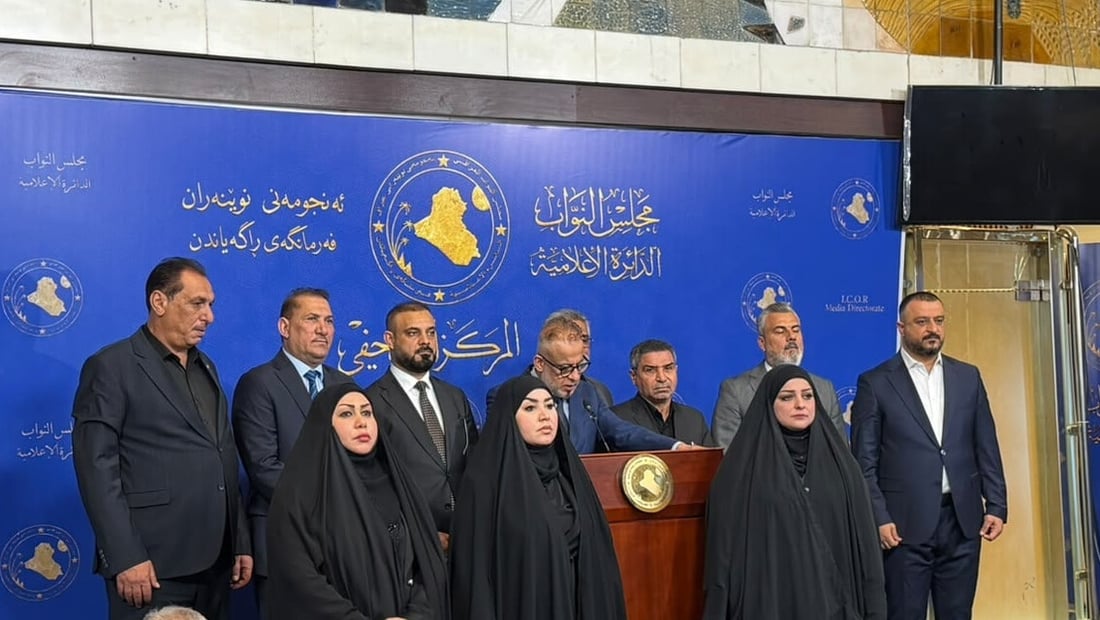
FILES: Members of the Sadiqoun parliamentary bloc hold a news conference at the Iraqi Parliament in Baghdad on July 25, 2026
Media Monitor
Sadiqoun wants US-sanctioned Laith al-Khazali as future Iraqi prime minister
BAGHDAD — Sadiqoun hopes Laith al-Khazali, Asaib Ahl al-Haq’s U.S.-sanctioned candidate for deputy prime minister, will one day become prime minister and is working to have his name removed from U.S. sanctions lists, a Sadiqoun lawmaker said, calling former Prime Minister Mohammed Shia al-Sudani the Coordination Framework’s “most unsuccessful experiment.”
“We hope Laith al-Khazali becomes prime minister. If that does not happen, he will remain an important figure in the Sadiqoun movement,” Safaa al-Jabri told Iraq 24 TV. Sadiqoun is Asaib Ahl al-Haq’s political wing. Khazali might no longer want the job, he said. “Perhaps he believes he is bigger than the position of prime minister. We do not know what will happen over the next four years.” Jabri said he had asked Khazali before the current government was formed whether Iraq needed a prime minister with a military background or an economist. “He told me that we need an economist, and that is the direction the political forces later took.”
The United States designated Laith al-Khazali and his brother Qais, Asaib’s leader, Specially Designated Global Terrorists in 2020.
“The Coordination Framework made a mistake when it chose Mohammed Shia al-Sudani as prime minister, not once but twice,” Jabri said. “Corruption emerged on a massive scale, and he handed over the government without money. Sudani was the Framework’s most unsuccessful experiment, and the Framework alone should not bear the responsibility.” Zaidi’s spokesperson, Haider al-Aboudi, said on Sunday that Sudani’s 2023 decision to strengthen the dinar had cost the treasury nearly 36 trillion dinars.
Jabri defended Prime Minister Ali al-Zaidi’s plan for four deputy prime ministers as a way to share out work rather than hand out salaries and privileges. “The purpose of having deputy prime ministers is to distribute the workload within the Council of Ministers and divide responsibilities,” he said. A country of 46 million with a large budget needed the extra support, he said, and prime ministers who governed without deputies had little to show for it. “Where are the results? There have been no real results over the past years. We want Zaidi’s government to operate differently from previous governments.” The deputies would bring “an administrative transformation that people will feel during the first year, and we will be held accountable for that,” he said.
Parliament is due on Thursday evening to vote on nominees for deputy prime minister, the vacant ministries and newly proposed ministries. It confirmed 14 of 23 ministers when it approved Zaidi’s government on May 14, leaving nine portfolios unfilled. Hussein al-Shihani, a member of Sadiqoun’s political bureau, said on Monday that the four deputies would have equal authority, with no first deputy, and would oversee government projects, with Khazali responsible for public services rather than security. He said on Sunday that Zaidi had tried during his New York visit to soften U.S. objections to Khazali.