
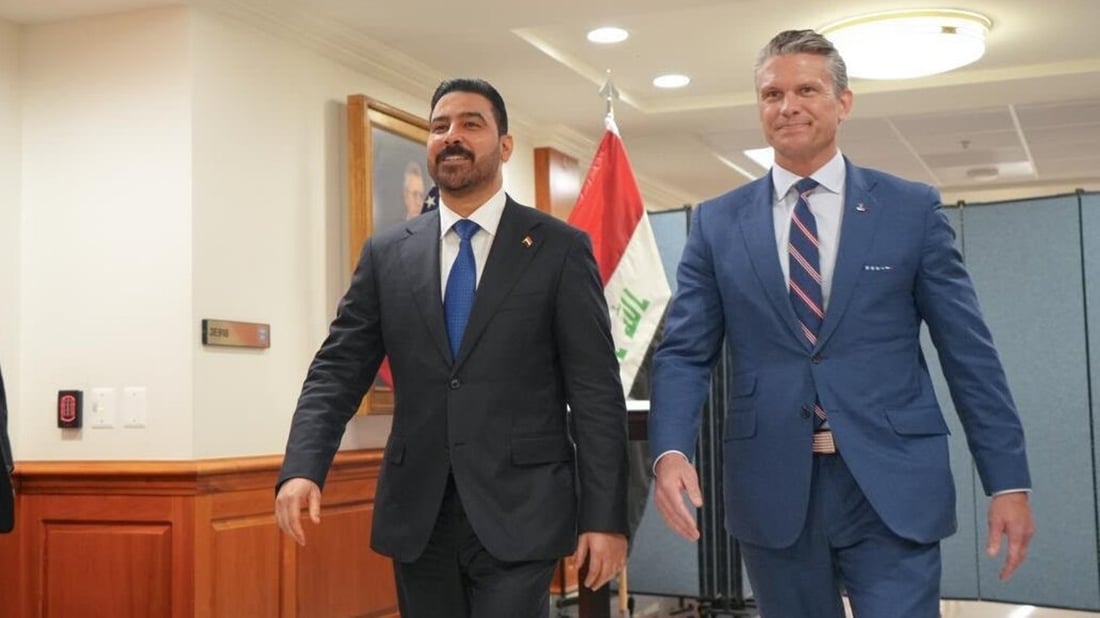
(Photo: the Prime Minister's Media Office)
Zaidi meets Pentagon and Treasury chiefs as coalition exit nears
WASHINGTON — Iraqi Prime Minister Ali al-Zaidi met separately with senior U.S. defense and treasury officials as Baghdad and Washington discussed the future of their security relationship after the planned withdrawal of coalition forces and efforts to expand economic cooperation, according to Iraqi government statements.
Zaidi, who is also commander-in-chief of the armed forces, held talks with U.S. Defense Secretary Pete Hegseth at the Pentagon on Tuesday, where the two sides reviewed bilateral security and military relations.
A statement from Zaidi’s spokesperson said the officials agreed to continue intelligence sharing in support of counterterrorism operations and to increase coordination to dismantle terrorist support networks and safe havens. They also agreed to expand cooperation in military training, strengthen the capabilities of Iraq’s armed forces across all branches, and increase technical cooperation on security and military equipment and armaments while safeguarding Iraqi sovereignty.
After the meeting, Zaidi ordered the formation of a committee to negotiate the future framework for security and military relations with the United States ahead of the planned conclusion of the U.S.-led Global Coalition to Defeat ISIS mission on Sept. 30. He instructed that the relationship be based on “the parameters and requirements of Iraqi sovereignty” and support “the full authority of Iraq’s Armed Forces throughout Iraqi territory,” the statement said.
The United States and Iraq announced in 2024 that the coalition’s military mission would end by Sept. 30, 2026. The coalition was established in 2014 to support Iraqi forces against ISIS after the group’s rapid territorial gains. Although ISIS no longer holds territory in Iraq, Iraqi and coalition officials say it continues to pose a threat through insurgent attacks and sleeper cells.
Zaidi later met U.S. Treasury Secretary Scott Bessent at his residence in Washington, where the talks turned to economic cooperation and reform. The prime minister’s media office said Zaidi described Iraq as “at the threshold of a new phase” in which it seeks “to build a strong, sovereign state free of corruption and supported by a strong and sustainable economy.”
He said the government had made “combating corruption and restricting arms to the authority of the state” a priority, and that Iraqis would see “the results of these measures during the coming year,” particularly through improvements in energy and investment. Zaidi said the government is also pursuing reforms in the banking and insurance sectors, alongside tax and customs reforms, to build “a more efficient and sustainable economy.”
President Donald Trump hosted Zaidi at the White House on Tuesday, where the two highlighted plans for closer economic cooperation. Before the meeting, Trump told reporters, “We love Iraq,” adding that the country was “well represented.”
Zaidi, a businessperson with no previous political office, was nominated as prime minister-designate by the Shiite Coordination Framework in April, after months of deadlock following Iraq’s 2025 parliamentary elections. Parliament approved his government in mid-May, though several cabinet posts remained vacant pending political agreement.