
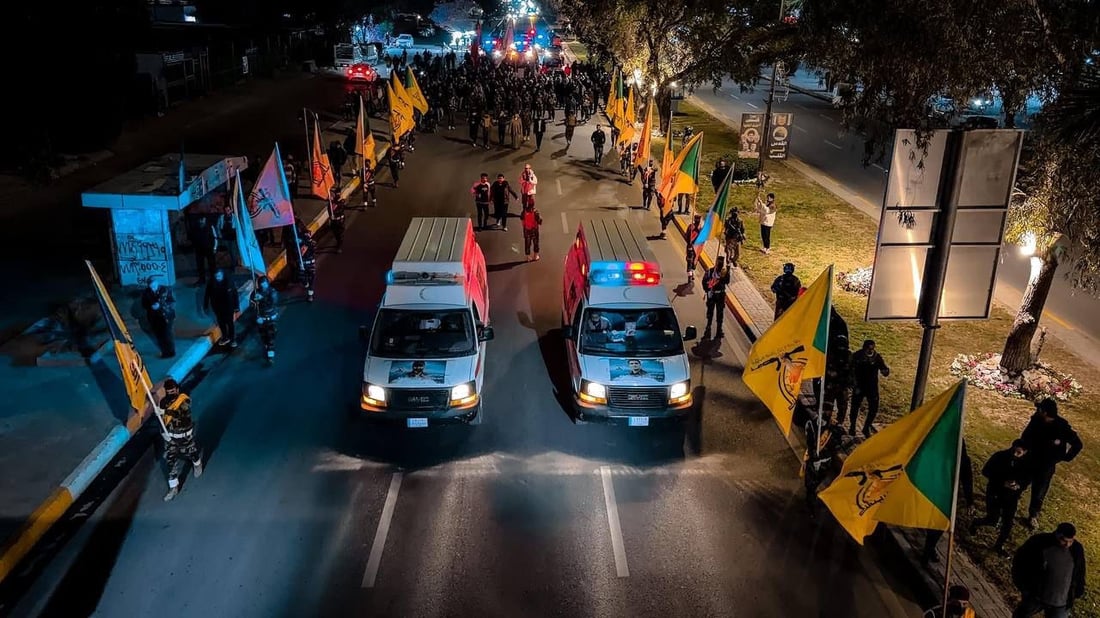
Supporters of Kataib Hezbollah carry flags and march during a funeral procession in Baghdad for two fighters killed in airstrikes on Jurf al-Sakher, Feb. 28, 2026.
Media Monitor
Kataib Hezbollah affiliate defends weapons, warns disarmament would endanger security
BAGHDAD — Al-Huquq Movement, affiliated with Kataib Hezbollah, pushed back Tuesday against the Coordination Framework’s support for restricting weapons to state control, with a senior member warning that disarmament would create a security vacuum and endanger the state.
Saud al-Saadi, speaking on Alawla TV, rejected the term “weapons outside the state framework,” arguing that efforts to restrict weapons are “not in the hands of the government but in the hands of the Americans.” He said “the resistance is part of the state” and that armed factions had helped preserve state institutions, restore territorial control and confront both US forces and the Islamic State group. “Abandoning the real sources of strength possessed by the state exposes the security of the state and the people to danger,” he said.
Al-Saadi said Kataib Hezbollah, Harakat al-Nujaba and other factions opposed handing over their weapons, describing that position as consistent with their convictions. Responding to claims that weapons outside state control threaten Shiite governance, he rejected the concept outright, arguing that what exists is “American governance” under a Shiite label. He also questioned the Coordination Framework’s ideological credentials: “Does the Coordination Framework have an Islamic program to build a state according to Sharia and establish God’s rule on earth? The Framework does not adopt the identity of building a Shiite Islamic state. Its conduct is almost civil.” Al-Saadi said his movement supports the establishment of a joint Shiite-Sunni Islamic government through political understanding between the two communities.
His remarks came a day after the Coordination Framework announced support for limiting weapons to state control and separating the PMF from political organizations. On May 30, Kataib Hezbollah security official Abu Mujahid al-Assaf said the faction was prepared to receive weapons from groups withdrawing from armed activity and pay for them, including drones and anti-armor weapons.
The pushback comes as several factions move in the opposite direction. Muqtada al-Sadr announced on May 27 the separation of Saraya al-Salam from his movement and its integration into state structures, and Asaib Ahl al-Haq announced the formation of a committee to implement its own separation from PMF formations.
Kataib Hezbollah, one of the most powerful Iran-backed militias in Iraq and a key component of the Islamic Resistance in Iraq, has repeatedly rejected calls to disarm, arguing its weapons are tied to Iraq’s security and the presence of foreign forces. Other Iran-aligned factions have similarly linked any future disarmament to broader arrangements on foreign military presence. The US State Department’s Rewards for Justice program has offered up to $10 million each for information on three faction leaders: Harakat al-Nujaba founder Akram al-Kaabi, Kataib Hezbollah leader Ahmad al-Hamidawi and Kataib Sayyid al-Shuhada secretary-general Abu Ala al-Walaei.