
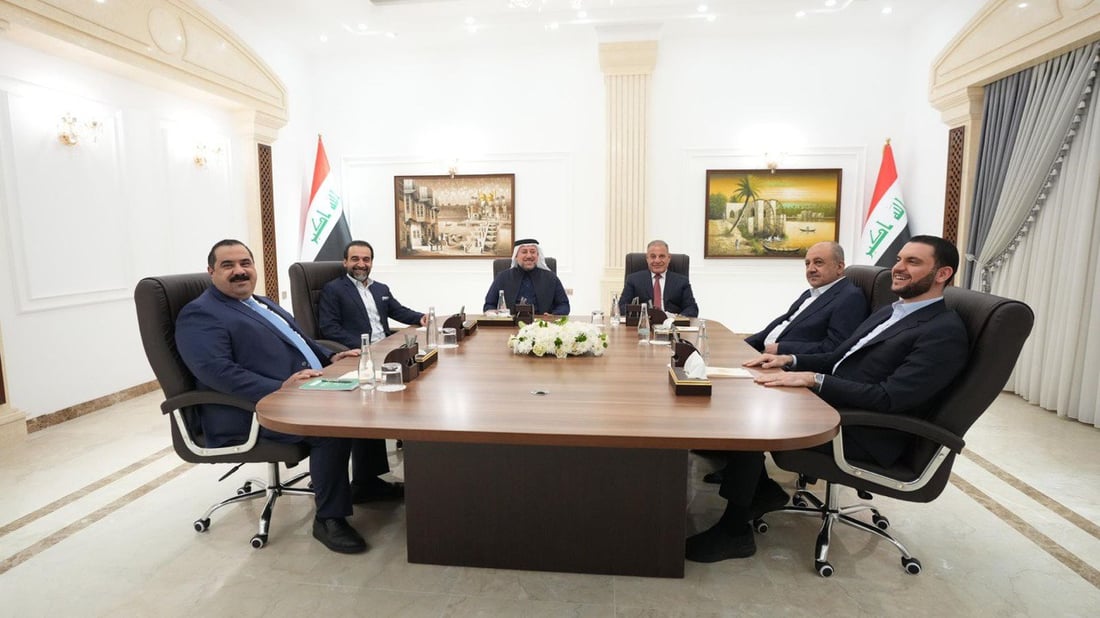
Members of Iraq’s National Political Council, known as the Sunni Framework, meet in Baghdad to discuss the nomination of a parliament speaker, talks that ended without agreement and were deferred to a later date.
US embassy letter fuels rifts inside Shiite Coordination Framework over Maliki nomination
BAGHDAD — An English-language letter delivered through the U.S. Embassy to Iraq’s Shiite Coordination Framework triggered sharp internal debate during a closed-door meeting of alliance leaders, according to multiple senior figures within the framework, as divisions deepened over the nomination of former Prime Minister Nouri al-Maliki.
A senior Coordination Framework official provided 964media with a copy of what he described as an “American message,” saying it was circulated among framework leaders and read aloud during a meeting Monday. The source said discussions escalated into heated arguments and “physical friction” between some leaders, while local media reported hearing intermittent gunfire inside Baghdad’s Green Zone during the meeting.
Framework sources said the letter consisted of six points and was conveyed through official embassy channels, rather than via U.S. envoys who have recently engaged Iraqi leaders with high-profile messaging. Five points reflected familiar U.S. diplomatic positions, including calls to dismantle Iran-aligned armed factions and exclude them from government. A sixth point drew particular attention by explicitly naming Maliki, stating that “the governments headed by Nouri al-Maliki were negative,” language several framework figures described as unusual.
Three senior officials from different Coordination Framework factions confirmed to 964media that the letter was authentic and discussed internally, though none of the confirmations came from factions most supportive of Maliki’s nomination. One source said the letter was in the possession of Hikma Movement leader Ammar al-Hakim. Several figures cautioned that the document appeared to have been re-edited and lacked an embassy seal or official format, raising questions over whether the reference to Maliki was quoted verbatim or conveyed in substance.
Hussein al-Sheikhani, a member of the political bureau of Asaib Ahl al-Haq’s Sadiqoun bloc, said in an interview on Al-Dijla that “the American paper was indeed discussed in the last Coordination Framework meeting.” He said the document had reached three framework leaders in English, leading to variations in translation. “If it becomes clear in the coming days that this paper or other positions are firm,” Sheikhani said, “I believe Mr. al-Maliki himself, as a man who values the country’s interest, may reconsider whether to proceed or step back.”
Sheikhani added that Asaib leader Qais al-Khazali did not vote in favor of Maliki’s nomination but would respect the framework’s collective decision. “Sadiqoun will vote for the Patriotic Union of Kurdistan’s candidate for president [for the presidency], and we say that clearly,” he said. He added that if a broad national consensus ultimately supports Maliki, “we will support him and will not be a tool to undermine his path.”
Rahim al-Aboudi, a senior figure in the Hikma Movement, said in an interview on Al-Hadath that there had been “no change so far” in the internal equation supporting Maliki, though he acknowledged that last-minute talks could still alter outcomes. “There are nine candidates within the framework,” Aboudi said, adding that unresolved disputes between the Kurdistan Democratic Party and the Patriotic Union of Kurdistan over the presidency could affect the prime ministerial nomination.
The controversy preceded a direct intervention by U.S. President Donald Trump, who warned on Truth Social that the United States would “no longer help” Iraq if Maliki returned to power, describing his previous tenure as a period in which Iraq “descended into poverty and total chaos.” Trump’s remarks, issued days after the Coordination Framework announced Maliki’s nomination, undercut claims by Maliki allies that U.S. silence signaled acceptance and intensified debate within Shiite parties over the political and diplomatic costs of pressing ahead.