
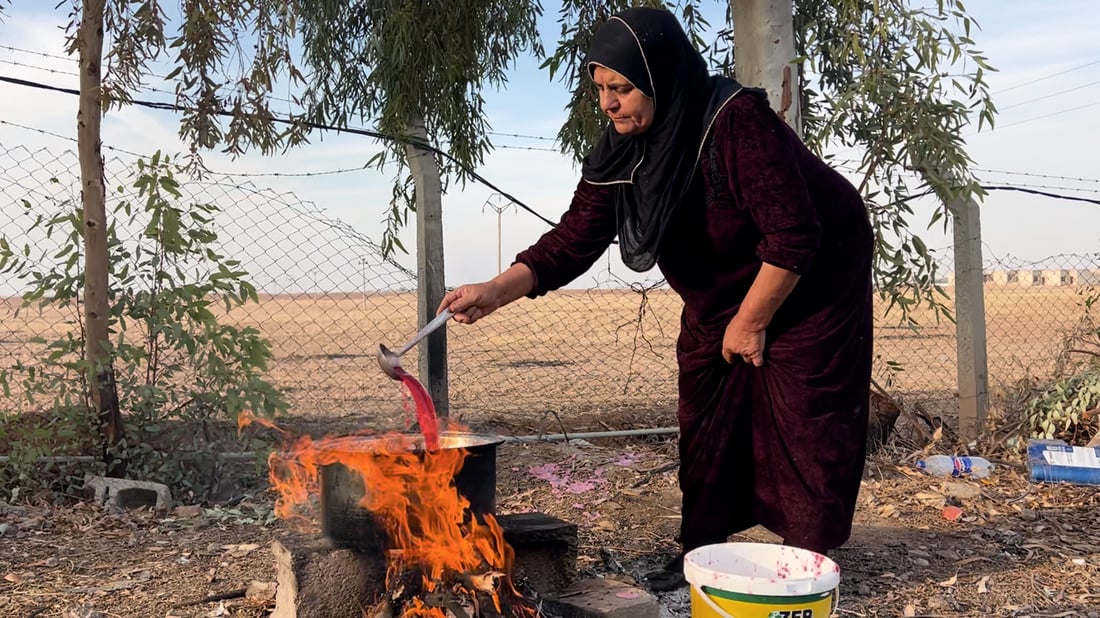
A woman stirs boiling pomegranate juice over an open fire in a field in Zand village, Daquq district, as part of the traditional process of making pomegranate molasses during the harvest season. Photo by 964media.
Pomegranate molasses season returns to Daquq as families keep Kurdish tradition alive
DAQUQ — The work starts when the first rain arrives: the signal Kurdish farming families have trusted for generations to begin the pomegranate harvest and set aside the tart fruit for molasses. In villages south of Kirkuk, crates of pomegranates are stacked near orchards and fires lit with dry wood gathered from the same land that grew the fruit.
Iraq produces about 300,000 tons of pomegranates each year, with roughly one-third coming from the Kurdistan Region and nearby areas where the climate suits the crop. 964media documented this year’s molasses-making season in communities around Daquq that have kept traditional methods intact.
Farmers sort the harvest by feel as much as by sight, distinguishing sweet pomegranates from sour ones using shape, texture and other familiar traits. The sweet fruit goes to market. The sour fruit goes to the family storehouse, transformed into a dense molasses made in quantities meant to last until the next winter.
The family of Kak Azad Rustam welcomed 964media to their small orchard in Zand Mulla Yusuf village, part of a cluster of villages south of Kirkuk known locally as Aftikharat, or “Haft Tagharat” by its old Kurdish name. There, Mawat Hamid walked through the process as it unfolded.
“First, the sour pomegranates are shelled, then placed in a blender, filtered through gauze or cloth, and the juice is put on the fire,” she said. “It takes about three hours until the molasses is ready.”
The fire is fed with dry orchard wood, and the mixture is stirred continuously as foam rises and is skimmed away. The math is part of the tradition, too. “It takes two crates of pomegranates, about 20 kilograms, to produce one kilogram of molasses,” Hamid said. “Nothing is added except a small amount of salt.”
Once the liquid thickens, it is left to cool before being sealed into glass jars, with no room for error in storage. “Any water causes spoilage,” Hamid said.
Hamid said Daquq’s molasses holds its own against the best-known pomegranate areas in the region. “The pomegranate trees planted here originally came from the famous orchards of Shahroban in Muqdadiya, north of Diyala,” she said.