
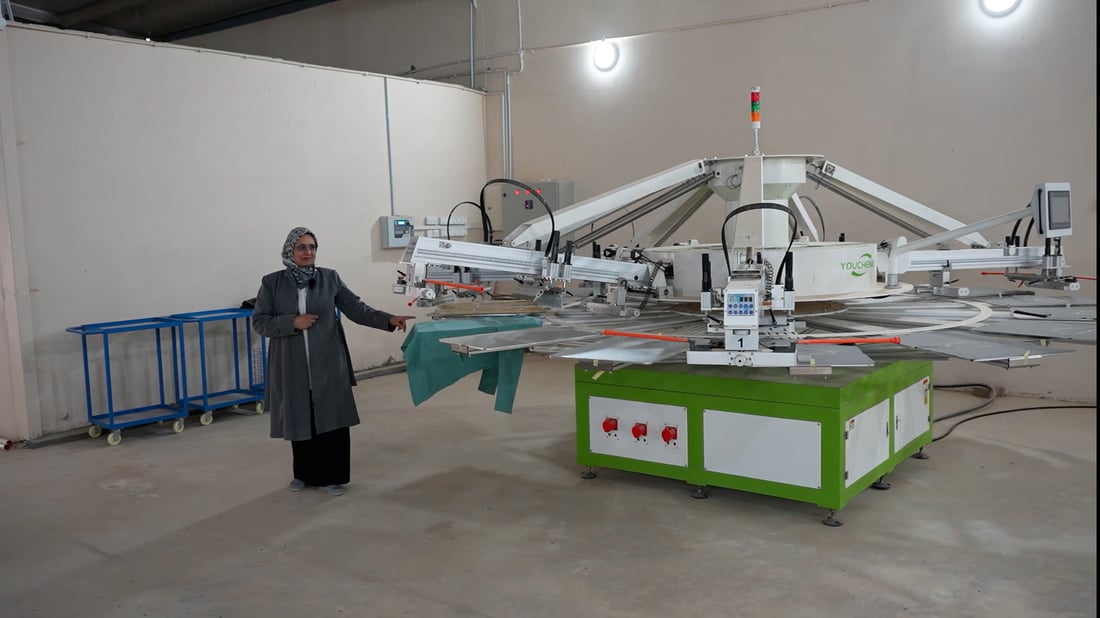
A worker gestures toward a large automated screen-printing machine inside the Anah Sewing Factory in Anbar governorate, where modern equipment is being used to produce uniforms and medical garments. Photo by 964media.
Anah sewing factory resumes production after UNDP-backed rehabilitation
ANBAR — The Anah Sewing Factory has returned to production after years of shutdown, joining a small group of Iraqi industrial facilities restarting operations with local and international support, according to factory officials.
Founded in 1994 and damaged during the ISIS war in 2014, the factory has been rehabilitated and now operates with 71 employees, producing thousands of items each month for public and private sector clients.
Factory manager Omar Dheeb Aboud said the rehabilitation was carried out by the United Nations Development Programme and included construction of a 78-by-30-meter production hall, refurbishment of two warehouses measuring 30 by 18 meters each, and the supply of advanced equipment. He said the current management was formed through coordination between the Reconstruction Fund and Anah’s local administration.
“The main challenge we face now is the shortage of labor, especially seamstresses, due to the suspension of hiring and the retirement of most female tailors,” Aboud said. “We hope the general company for textile and leather industries and the cotton products factory will work to operate this facility at full capacity.”
The factory’s current production includes hospital and nursing uniforms, firefighting suits, laboratory vests, disposable medical sheets and occupational safety clothing, supported by modern high-capacity machinery. Some of the equipment is larger than the production halls and is housed in designated areas, officials said.
Inside the main hall, work is divided into specialized technical units, including production, maintenance and quality control.
Kadwa Hamdi, head of the production unit, said products are inspected at every stage. “All products undergo inspection according to standards approved by the Central Organization for Standardization and Quality Control,” she said.
Hamdi outlined pricing for several products, saying a single-piece work suit, used as an official uniform by many factories and companies, is priced at 25,000 dinars ($17.73), with multiple colors and sizes available, while other designs are priced at 35,000 dinars ($24.82). She said disposable medical sheets for hospitals cost 1,250 to 1,500 dinars ($0.89 to $1.06), laboratory vests range from 12,000 to 15,000 dinars ($8.51 to $10.64), and nursing uniforms range from 15,000 to 20,000 dinars ($10.64 to $14.18), depending on fabric type and sleeve design. Two-piece work suits are priced at 30,000 dinars ($21.28), she said.
Hamdi said final-stage processing includes automated pressing using a fusing press in which pressure and temperature are adjusted based on fabric type, with garments moving along conveyor belts. She said the factory also uses automated pocket-opening machines, six-head embroidery machines capable of producing logos in up to nine colors, and computer-controlled fabric-spreading machines.
Larger systems housed in storage areas include laboratory fabric inspection equipment and screen-printing units used to apply logos and branding for client factories and companies, Hamdi said, adding that the printing process uses customized templates and allows color selection to match fabric tones.
“These machines are modern and require a limited number of workers, as most operations are controlled by computer systems,” she said.
Quality control manager Atban Rafi said all fabrics are inspected upon arrival. “We use a fabric inspection machine equipped with a light screen and computer to detect weaving defects, contamination or transport-related damage,” he said.
Rafi said testing includes tensile strength using air-pressure systems, weight per square meter, thread count per square centimeter, color fastness using gray-scale measurement, and shrinkage through controlled washing and heat exposure.
“For example, if a fabric sample weighs 2.08 grams, the full square meter weight is calculated at 208 grams,” he said, adding that the tests determine whether materials meet Iraqi specifications before production. He said the laboratory currently performs essential physical tests, while some advanced chemical testing remains unavailable.
Factory officials said locally produced garments are sold at prices below comparable imported products and credited the relaunch to support from UNDP, the Ministry of Industry and Minerals, the general company for textile and leather industries, the cotton products factory, the Reconstruction Fund and factory staff.
“We hope to see this factory operating at full capacity and competing strongly in the Iraqi market,” Aboud said.