
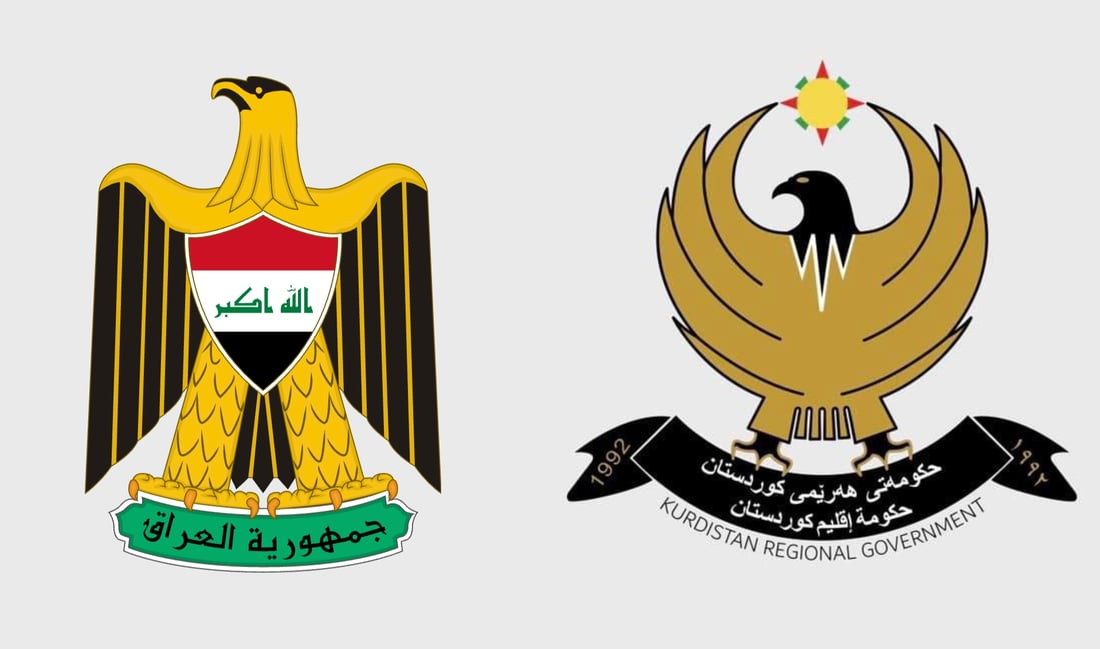
Emblems of the Iraqi Federal Government (left) and the Kurdistan Regional Government (right).
'Lack of jurisdiction'
Iraq’s top court dismisses salary, electricity lawsuits tied to Kurdistan Region
BAGHDAD — Iraq’s Federal Supreme Court on Monday dismissed three separate lawsuits related to salary payments for Kurdistan Region public employees and a regional electricity initiative, ruling it lacked jurisdiction over the cases.
Two of the suits were filed by five employees of the Kurdistan Regional Government against Iraqi Prime Minister Mohammed Shia Al-Sudani and Finance Minister Taif Sami. The plaintiffs had requested that the federal government disburse monthly salaries to KRG employees on schedule and separate the payments from political disputes between Baghdad and Erbil.
One of the lawsuits asked the court to order the Finance Ministry to continue salary disbursements regardless of tensions with the Kurdistan Regional Government. Both cases were thrown out on the grounds that the court lacked jurisdiction to hear them.
The rulings came as the Iraqi Ministry of Finance began disbursing salaries for May—more than 80 days after the last payments to KRG public sector employees. Officials in both governments have described the transfer as the result of a “mutual understanding.” However, salaries for June and July remain unpaid, with August days away.
In a separate ruling, the court also dismissed a case filed by lawmaker Srwa Abdul Wahid, head of the opposition New Generation bloc, which challenged the legality of a KRG decision establishing the Region’s 24-hour electricity program. The lawsuit named Kurdistan Region President Nechirvan Barzani and Prime Minister Masrour Barzani as defendants. The court again cited lack of jurisdiction.
The 24-hour electricity initiative, known as the Runaki program, was launched in October 2024 to expand access to uninterrupted power from the national grid. The Kurdistan Region’s Ministry of Electricity recently reported that the program now serves parts of Erbil, Sulaymaniyah, and Duhok, covering about 2.5 million residents, with plans to expand to all Kurdistan Region households and business by the end of 2026.