
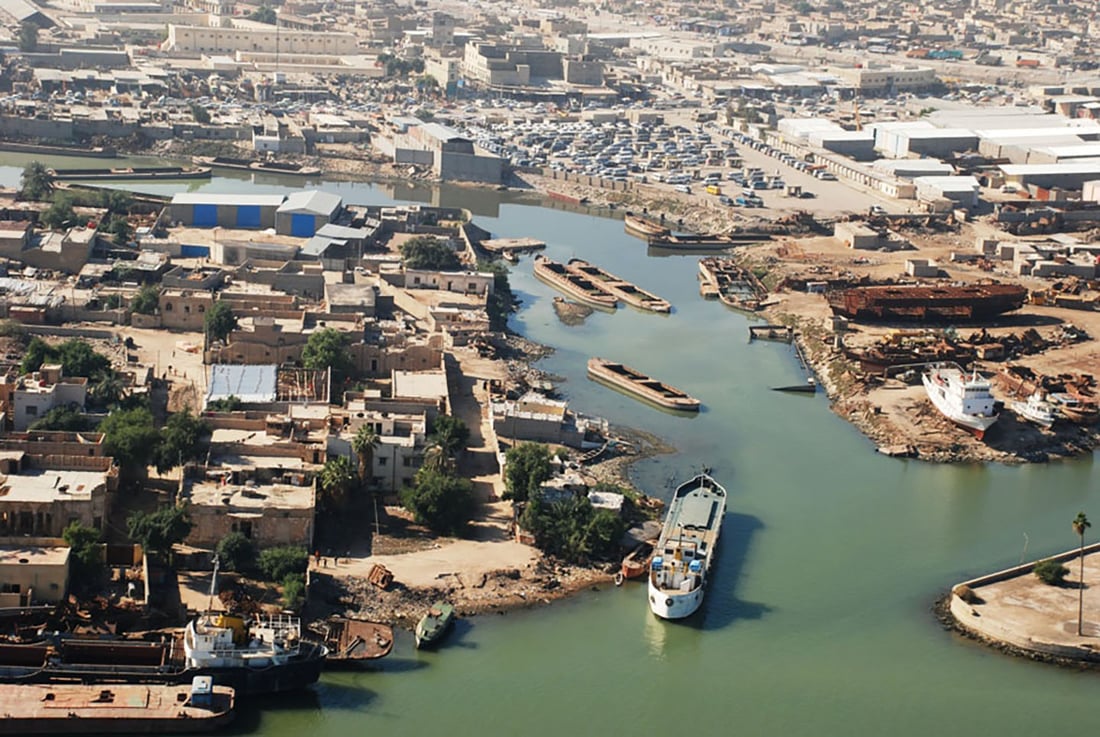
Aerial view of Basra
Power supply returns to 4-on, 2-off schedule after fault disrupts Basra grid
BASRA — A technical fault on a major transmission line disrupted electricity supply across parts of Basra early Tuesday, forcing grid operators to impose emergency power rationing before repairs restored the system to its regular schedule.
The fault occurred on the Rumaila–Basra high-voltage transmission line, a key artery in the governorate’s electricity network, affecting the operation of more than 10 substations, according to a source at Basra’s electricity control center who spoke to 964media.
The disruption prompted operators to implement a temporary emergency schedule of two hours of electricity supply followed by two hours of outage to prevent a wider collapse of the grid.
Technical and transmission crews began repair work and restored the line Tuesday morning, allowing power loads to be gradually returned to the network.
Electricity supply has since resumed at the current schedule used in most areas of Basra — four hours of power followed by two hours of outage, the source said.
This comes as hundreds of residents gathered outside an electricity station in the Shuaiba area of Basra’s Zubair district Monday evening, demanding an end to power outages that demonstrators say leave them without electricity for up to eight hours a day as summer temperatures rise.
The protest is the latest in a series of demonstrations over electricity and public services in southern Iraq. On Friday, residents of the al-Madina district in northern Basra marched from Martyrs Square to the local transmission substation, demanding an end to recurring power outages and giving authorities one week to respond before launching an open-ended sit-in. Protest organizers called for a dedicated generating station for northern Basra and complained that communities located near oil fields continue to suffer from poor services.
The protests reflect a broader supply crisis driven by reduced Iranian gas imports, lower domestic production and disruptions linked to the regional conflict. Iraq relies on Iranian gas for more than 30% of its electricity generation, but imports collapsed after strikes on Iran’s South Pars gas field in March. Oil production also fell sharply as the closure of the Strait of Hormuz cut off southern export routes, reducing associated gas output. Authorities have since explored alternatives including floating liquefied gas terminals, increased electricity imports from neighboring countries and expanded solar projects.
Private neighborhood generators remain a primary electricity source for many Iraqi households during summer, when national grid supply often declines and temperatures regularly exceed 50°C in Baghdad and southern governorates. Many families cannot afford enough generator supply to run air conditioning for extended periods.