
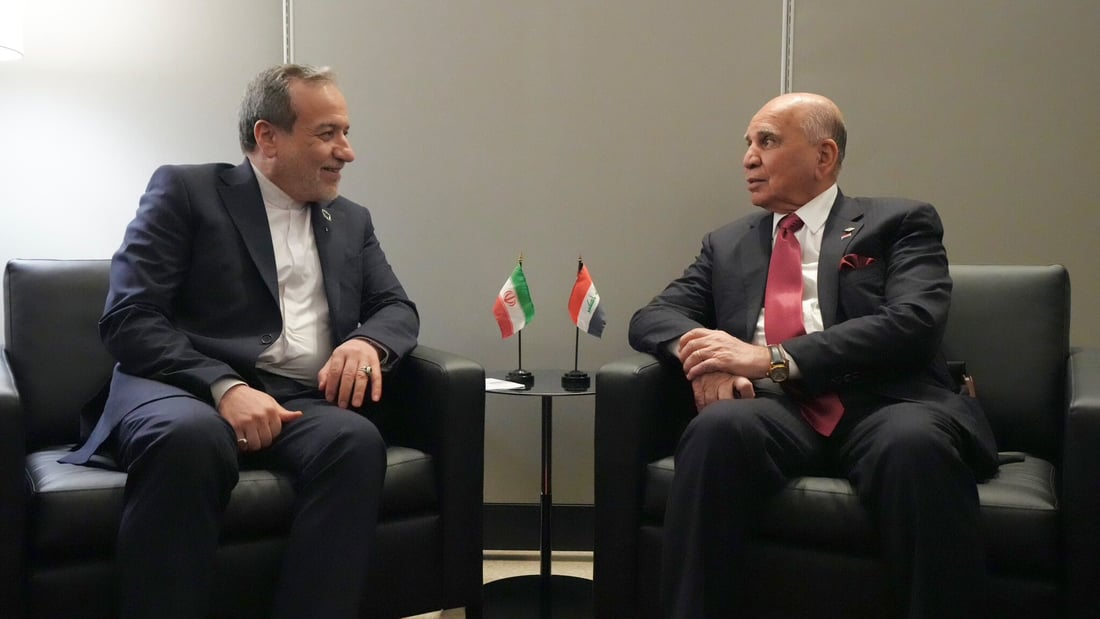
Iranian Foreign Minister Abbas Araghchi, left, meets Iraqi Foreign Minister Fuad Hussein in New York on the sidelines of the U.N. General Assembly.
Iraqi foreign minister says indirect US-Iran contacts are ongoing
NEW YORK — Iraqi Foreign Minister Fuad Hussein said he discussed ongoing indirect contacts between Tehran and Washington with his Iranian counterpart Abbas Araghchi, who told him Iran had reached an understanding with Oman on safe routes for commercial shipping through the Strait of Hormuz.
“I met in New York with the foreign minister of the Islamic Republic of Iran, Mr. Abbas Araghchi, and we discussed bilateral relations, regional developments, the ongoing indirect contacts between Tehran and Washington, and efforts aimed at reducing escalation and reopening the Strait of Hormuz to navigation,” Hussein wrote on X after the meeting on the sidelines of the UN General Assembly. “I stressed that dialogue and diplomacy remain the most effective path to contain tensions and prevent their expansion, and that regional security and freedom of navigation require regional cooperation and responsible dialogue among the concerned parties.”
Hormuz matters directly to Iraq, whose exports collapsed when shipping through the strait was disrupted in March and have since recovered to about 2.6 million barrels a day, largely through tanker transfers outside it. Araghchi blamed the insecurity in the strait on American and Israeli actions, saying according to his office that “the return of security to the strait requires an end to U.S. measures that cause insecurity.” Iran gave no detail of the arrangement with Oman.
The meeting took place on Tuesday afternoon and covered economic, commercial, consular and security cooperation, the Iranian Foreign Ministry said, with both sides stressing implementation of existing border security agreements. A 2023 agreement committed Iraq to preventing Iranian Kurdish opposition groups from using its territory for cross-border attacks. Araghchi also called on regional states not to let their territory or resources be used to prepare or carry out what Iran considers hostile acts against it.
The border has been the source of attacks in both directions this month. Drones struck Komala sites in Sulaymaniyah on Sept. 7 and Sept. 15, which the Iranian Kurdish party blamed on Iran, and drones launched from Maysan, which borders Iran, hit a Saudi oil pipeline on Sept. 11, after which Iraq temporarily closed three crossings with Iran. When drones struck the Kurdistan Region prime minister’s office in August, Araghchi called it a terrorist act in a call with Hussein without addressing responsibility.
Hussein said the two had agreed to continue consulting on regional security and stability.