
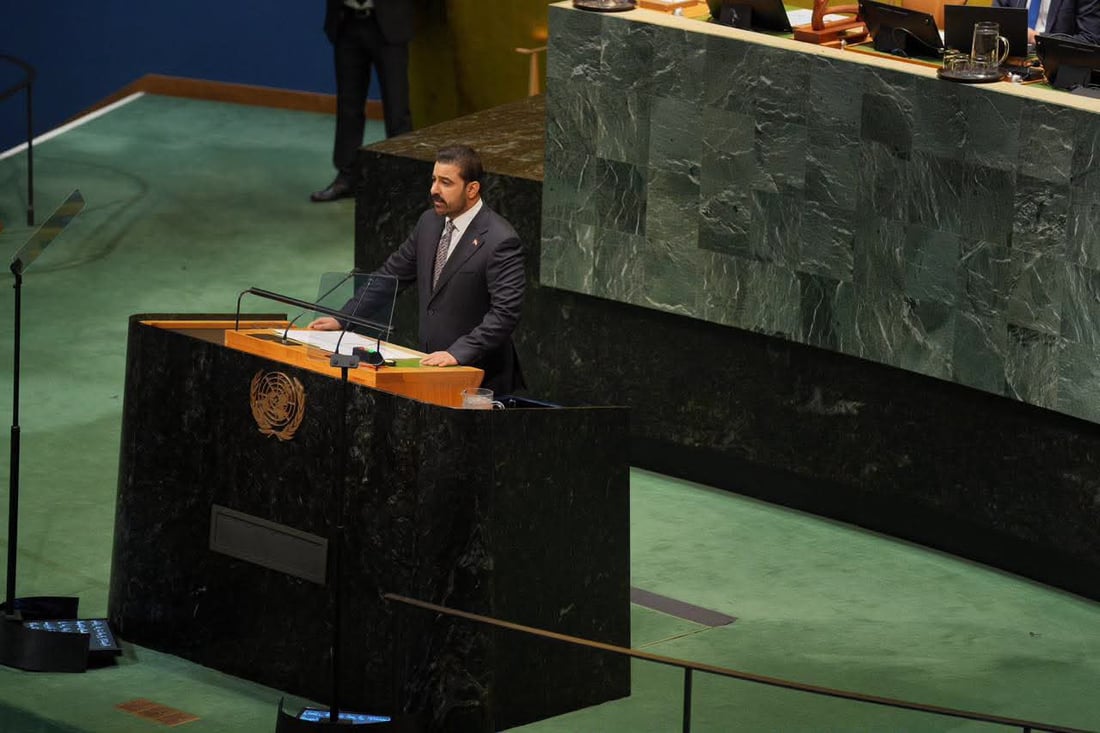
Iraqi Prime Minister Ali Al-Zaidi addresses the 81st session of the United Nations General Assembly in New York on Sept. 25, 2026.
Zaidi tells UN the state alone will decide war and peace
NEW YORK — Prime Minister Ali al-Zaidi told the UN General Assembly that weapons and the decision of war and peace must belong to the state alone, and that the end of the coalition mission this month would shift Iraq’s relations with its partners from military cooperation to economic partnership.
“We are determined to ensure that the state alone holds the authority to decide on matters of war and peace, and that weapons and instruments of force remain exclusively in the hands of its constitutional institutions, so that the law serves as the ultimate arbiter and the national interest as our guiding compass,” he said. He told The New York Times this week that the handover would be complete by June 30, 2027, after a 90-day halt to attacks from Sept. 30, nine months after the deadline he gave President Donald Trump in July.
“With the conclusion of the international coalition’s mission in Iraq, we are moving our relations with our strategic partners into a new phase, transitioning from military cooperation toward economic and development cooperation in service of our mutual interests,” he said. France agreed last week to continue military cooperation with Iraq after the mission ends, including a roadmap for arms purchases and a letter of intent on air defence, and Baghdad and Washington are negotiating bilateral arrangements covering counterterrorism, intelligence sharing and training. The mission set up in 2014 is due to finish at the end of this month under the 2024 agreement, after advisers left bases in federal Iraq in January, including Ain al-Asad.
Energy dominated the economic section. The government plans to raise crude production in line with proven reserves, develop gas fields and expand refining and petrochemicals, he said. “Our ambition is for Iraq to become a global energy production hub, harnessing its potential to sustainably enhance regional and international security and stability.” Concerned by disruption to shipping and its effect on energy prices, Iraq is working to diversify export routes through pipelines and corridors to Turkey, Jordan and Syria, he said. Exports collapsed when traffic through the Strait of Hormuz was disrupted in March and have recovered to about 2.6 million barrels a day this month, largely through tanker transfers outside the strait.
He said the government aims to reduce the effects of Iraq’s reliance on oil revenue, build production and export capacity, and support the private sector through legal, tax and customs measures and guarantees. “Iraq possesses the resources, the market, the location, and the determination to build a new economy,” he said. “Iraq aspires to exercise its influence as an active economic power in the region and a bridge for dialogue and cooperation among its peoples.”
On foreign policy he called for dialogue, non-interference and good-neighbourly relations. “Genuine stability is not built through wars, but through shared interests that make cooperation more beneficial than conflict,” he said, describing Iraq’s aim as moving the region “from conflict to integration, from competition to cooperation, and from the depletion of resources to their investment in development.”