
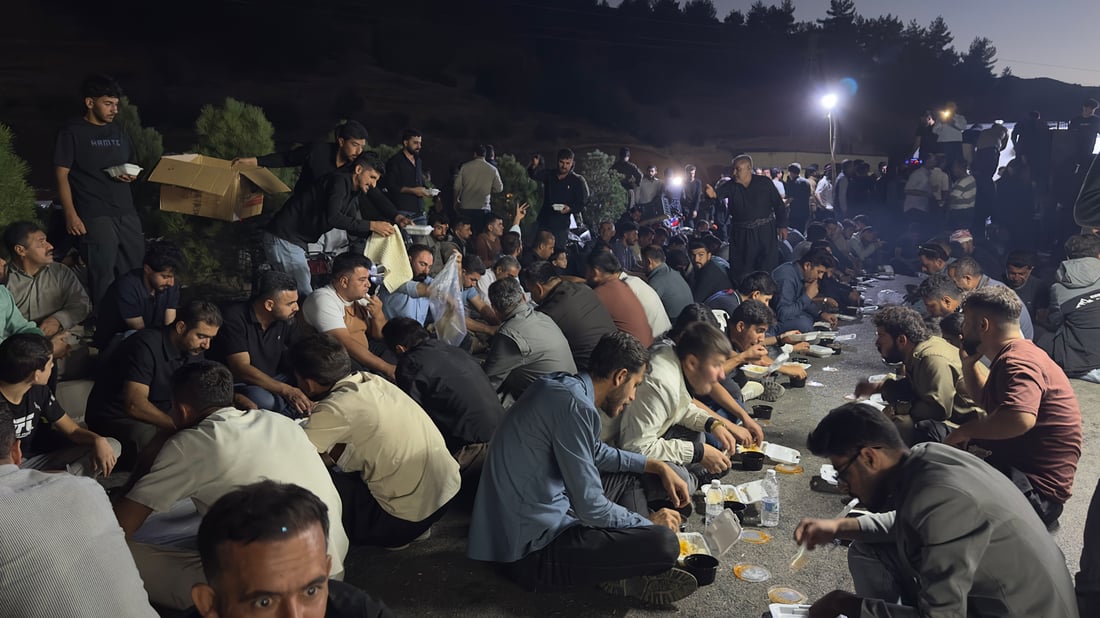
Protesters in Penjwen gather for a communal meal during demonstrations over the Kurdistan Regional Government’s Runaki electricity program and proposed smart-meter tariffs.
Security forces disperse Penjwen electricity protest
PENJWEN — Security forces broke up a two-day protest camp in Penjwen before dawn on Tuesday, detaining a large number of people demonstrating against the Kurdistan Region’s Runaki electricity billing and the installation of smart meters, according to a protester who spoke to 964media.
A large force entered the site around dawn from the directions of Sulaymaniyah, Bashmakh and central Penjwen, masked and approaching without vehicle lights, said the protester, whose name is being withheld. “Close to the dawn call to prayer, a large number of masked forces attacked the protesters with violence and gunfire,” he said, adding that some people escaped and others were detained. He estimated nearly 100 were taken away in four buses and said the protesters’ tent was burned. 964media could not independently verify the number detained or his account of the operation. He said the protest had been peaceful and called for the detainees’ immediate release.
Penjwen district mayor Adnan Kaka-Rash did not respond to repeated requests for comment, and no security agency has issued a statement.
The dispute is about how power is billed rather than whether it arrives. Penjwen has had continuous electricity for more than 17 years under a system that capped household supply, first at 10 amps and later at 16. Connecting it to Runaki would replace that with smart meters charging by actual consumption. Residents say the district’s mountain winters force them to heat with electricity far more than households in milder Sulaymaniyah, and a protest committee member said bills could reach 400,000 dinars a month without a special arrangement. Protest representatives said they were not against Runaki itself but wanted a tariff or discount reflecting the climate and people’s means. “The district is a mountainous and very cold area,” said Bakhtiar Ali, one of the representatives, asking the government to take the geography into account.
Protesters closed shops and blocked freight during the demonstrations on a road that serves the Bashmakh and Sairan Band crossings with Iran, and organisers said more than 1,200 people ate dinner together at the site on Monday evening.
Runaki, launched in October 2024, is meant to replace limited public power and neighbourhood diesel generators with 24-hour grid electricity across the Region by the end of this year. Customers are billed on a progressive tariff, with the first 400 kilowatt-hours in a 30-day period charged at 72 dinars each and higher use moving into more expensive brackets. The KRG says it has cut costs for most participating households and that more than 90% of the Region had round-the-clock power under the programme by July. Its supply depends heavily on gas from Khor Mor, which fell by 1,000 MW last week when Dana Gas cut deliveries.
The dispute predates this week. When Runaki teams arrived in Penjwen on June 29 to install meters, security forces detained three members of the local protest committee who had gone to tell them residents objected to the terms.
Penjwen’s tomato growers blocked roads in the district last week in a separate protest over imports from Iran.