
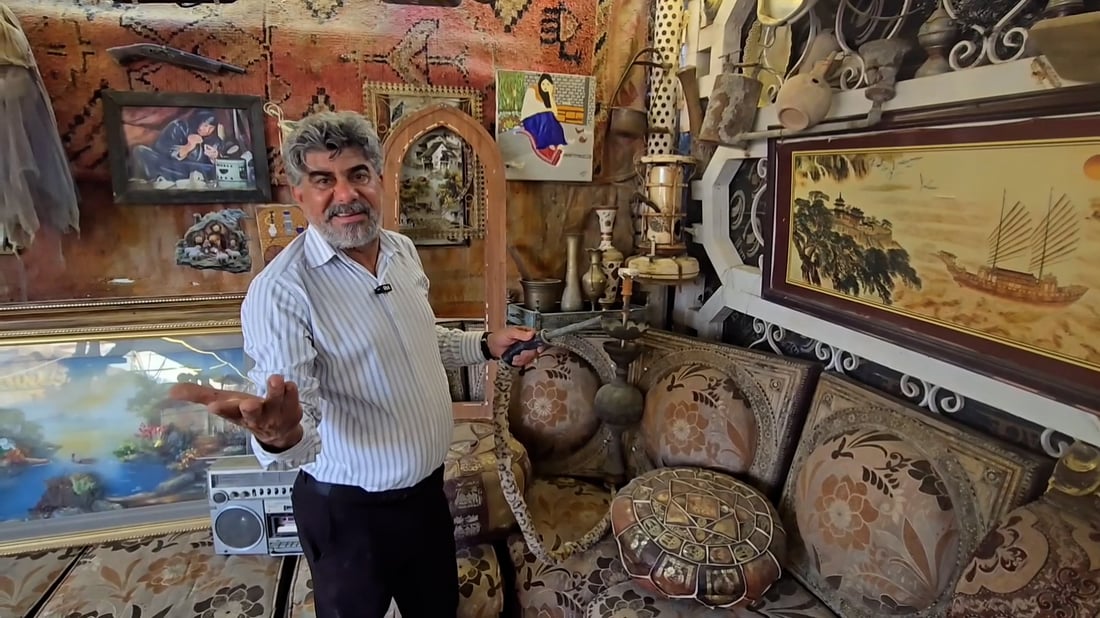
Nasiriyah collector turns decades of antiques into free heritage museum
NASIRIYAH — After nearly 20 years of collecting old household goods, military items and electronics from across Iraq, Ali Ridha Ali, known locally as Abu Barakat, has turned his collection into a free heritage museum overlooking Nasiriyah’s corniche.
The museum brings together objects once common in Iraqi homes and military life but now unfamiliar to many younger visitors, including social media personalities who often ask Abu Barakat to explain what the items were used for.
Among the exhibits are a charcoal iron, cassette tapes and a recorder dating to 1975, copper and silver utensils, traditional water-cooling containers, a kerosene heater used to warm bathing water, lanterns, radios, old televisions and military equipment.
Abu Barakat began collecting the items about two decades ago, searching markets in Nasiriyah and later traveling to Baghdad, Basra and other cities to buy pieces that caught his attention.
Part of the museum is devoted to military life, including an old belt, helmet, water container used with UAZ military vehicles and a large eating bowl that Abu Barakat says was shared by six soldiers.
For younger visitors, many of the objects require explanation. Haider Adel, who regularly visits the museum, told 964media that he does not know how many of the items were used.
Abu Barakat explains their purpose and how they fit into the lives of previous generations, giving visitors a chance to see objects they did not grow up with.
Older visitors have a different relationship with the collection. Raad Salem, who belongs to the generation of the 1960s, told 964media that items such as lanterns, mortars, radios and old televisions were part of his everyday life.
He said the museum brings back details of earlier years and that the “scent of the past” keeps drawing him back.
Raji Sultan, who is in his 50s, said he often finds something he had not seen on previous visits. “It is not new, it is originally old,” he said, adding that some pieces take him back 30 or 40 years.