
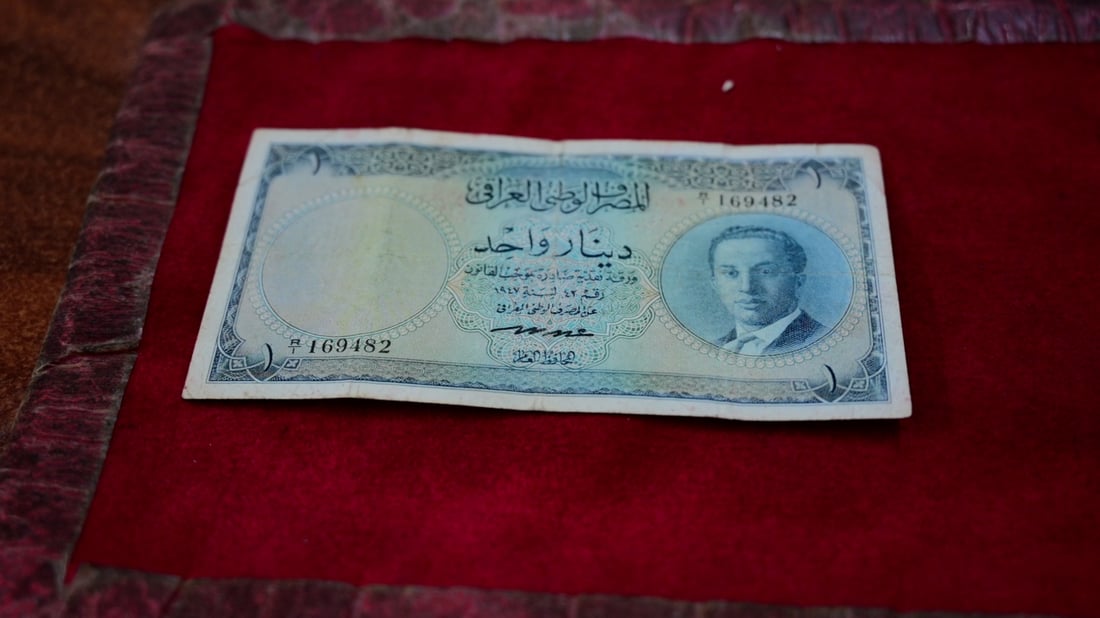
A royal-era Iraqi one-dinar banknote featuring King Faisal II is displayed at the Iraqi Philatelic and Numismatic Society in Baghdad. Photo by 964media.
Rare notes soar
Iraq’s royal-era currency draws collectors decades after end of monarchy
BAGHDAD — A royal-era 100-dinar note bearing the image of King Faisal I can fetch 150 million dinars, about $98,000, at the weekly auction of the Iraqi Philatelic and Numismatic Society in Baghdad.
Collectors from Baghdad and other governorates gather every Saturday morning to bid on banknotes, coins and stamps, with monarchy-era currency the most sought after because so little survives. Prices climb further with date and rarity, said Ahmed Kamil of the society’s administrative board, pointing to notes carrying the image of King Faisal II from 1949 and quarter-dinar notes from his reign.
Small denominations carry their own premium. A collector known as Abu Ramzi said a 100-fils coin had sold for 200,000 dinars, about $130, and one from 1955 for about a million dinars, roughly $650.
Royal-era paper is the rarest category traded, followed by coins, said Jawad Kadhim, the society’s secretary. The society was founded in 1951 and began the auction a year later as a regular venue for collectors, and it has run since. Kadhim described it as a cultural and social gathering as much as a market.
Buyers check watermarks and paper quality for signs of forgery, Kamil said, adding that he believes genuine royal-era currency is difficult to reproduce. Iraq’s monarchy ran from 1921 until the revolution of July 14, 1958, which overthrew Faisal II.