
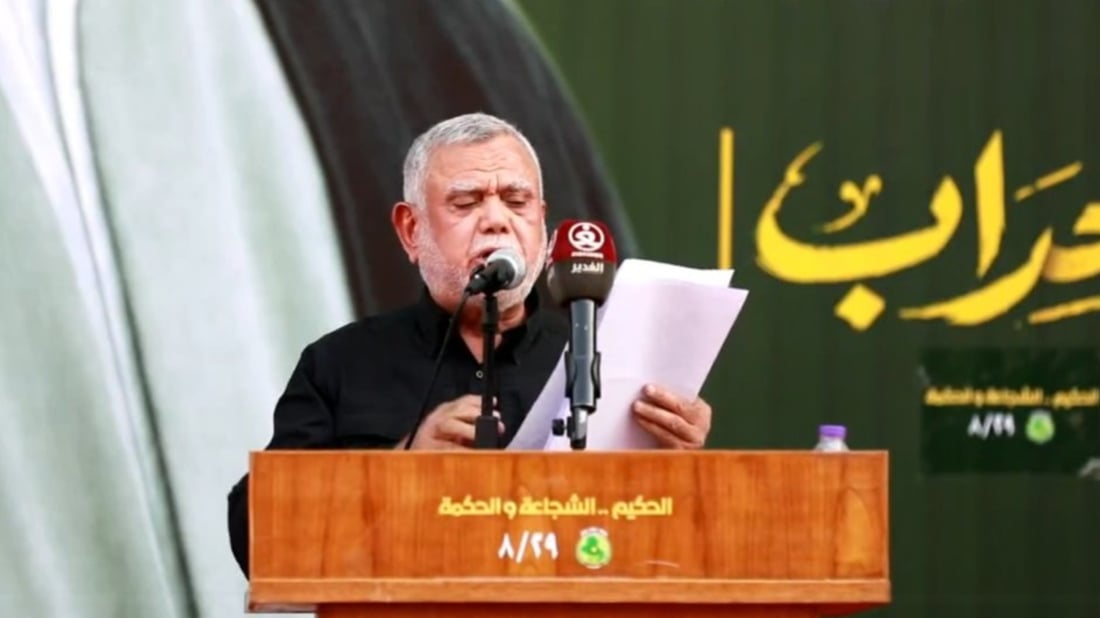
Badr Organization leader Hadi al-Amiri speaks during an event commemorating the anniversary of the killing of Mohammed Baqir al-Hakim in Baghdad on Aug. 30, 2026.
Hadi al-Amiri says Iraq weapons policy is domestic decision, rules out clash with factions
BAGHDAD — Badr Organization leader Hadi al-Amiri gave an unqualified assurance on Sunday that the government’s weapons policy will not end in confrontation, calling the effort a constitutional objective and an Iraqi decision rather than one imposed from outside.
“I assure everyone there will absolutely be no clash between the state and the resistance,” he said at an event marking the anniversary of the killing of Mohammed Baqir al-Hakim, who led the Supreme Council for the Islamic Revolution in Iraq, the movement from which Badr emerged. Regulating weapons is “a legitimate national and constitutional objective and a foundation for building a strong state capable of protecting Iraq and preserving its security, sovereignty and dignity,” he said, and “not an external decision, but an entirely Iraqi one.”
Badr holds more than 20 PMF brigades and has moved toward compliance, and he sits on the Coordination Framework committee formed to handle the weapons file with the government, alongside Mohammed Shia al-Sudani and Nouri al-Maliki. He appealed for a stand-down this month before Iran-aligned factions said they called off a planned attack on Saudi Arabia and U.S. bases.
The factions refusing to disarm have been setting terms rather than softening. Kataib Sayyid al-Shuhada said Saturday it would engage only if 10 conditions were met, including full American and Turkish withdrawal, federal control of the Kurdistan Region’s border crossings and the removal of the PKK and Iranian opposition groups from Iraqi territory. Kataib Hezbollah earlier set three, among them the dissolution of the Peshmerga, which President Nizar Amedi rejected as a constitutionally recognised force.
Prime Minister Ali al-Zaidi has ruled out military action and said the government is working through political understandings. Security adviser Qasim al-Araji has said Sept. 30 marks the end of the coalition mission and the start of further talks rather than an automatic handover date, after the State Administration Coalition said armed activity outside state authority after that date could fall under the Anti-Terrorism Law. Security Media Cell chief Saad Maan has said the policy targets weapons outside state authority rather than the PMF as an institution.
Amiri also said the Coordination Framework had agreed on confronting corruption and backed Zaidi’s campaign.