
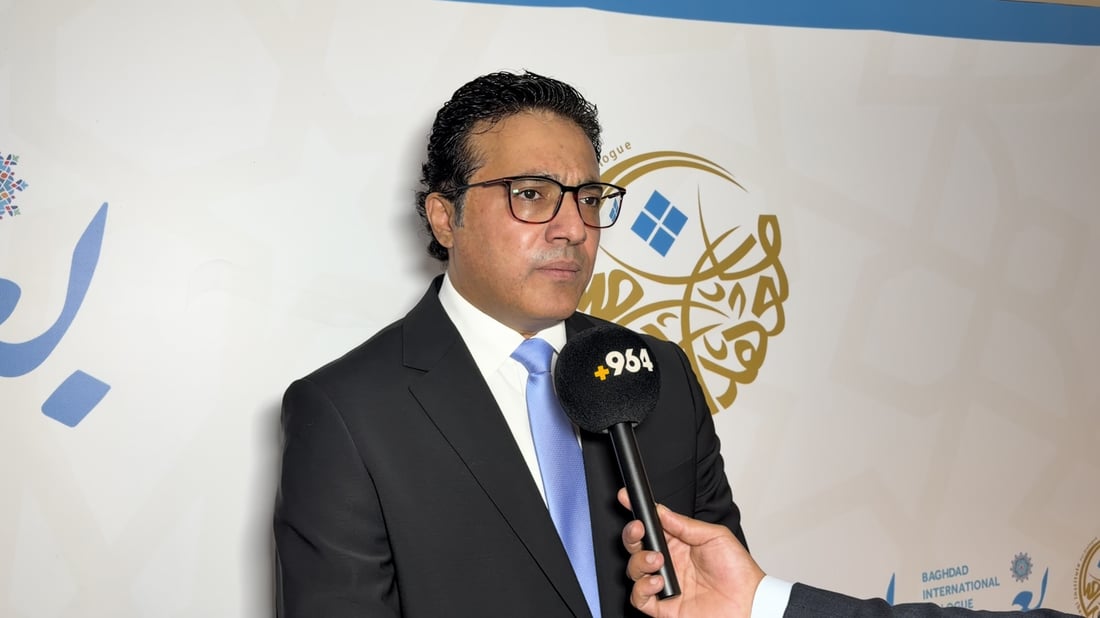
Iraqi government spokesperson Haider al-Aboudi speaks to 964media on the sidelines of the eighth Baghdad Dialogue Conference in Baghdad on Aug. 21, 2026. (Photo: 964media)
No foreign mediation on weapons talks, Iraqi government spokesperson says
BAGHDAD — Talks between the government and armed factions on bringing weapons under state control have reached an advanced stage and no outside party is mediating, government spokesperson Haider al-Aboudi said Friday.
“There are no international mediations in the file of restricting weapons to calm the situation, because it represents a purely Iraqi sovereign matter, and all dialogues are led by national political forces because the file is not limited to the responsibility of the government alone, but is the responsibility of the state with all its federal authorities and political forces,” he told 964media on the sidelines of the eighth Baghdad Dialogue Conference.
Remaining differences concern “the issue of mechanisms,” he said, with agreement on the underlying principles of state sovereignty and the national interest. “Things, according to their realistic indicators, are moving in the right direction that spares the Iraqi people any potential difficulty or challenge,” he said, adding that Iraq remains far from confrontation with the factions, which he described as forces that had helped defend the country.
Nouri al-Maliki told U.S. Chargé d’Affaires Joshua Harris on Tuesday that the Coordination Framework had formed a committee to work with the government on those mechanisms. National Security Adviser Qasim al-Aboudi briefed EU ambassadors on the policy on Wednesday.
Asaib Ahl al-Haq, Saraya al-Salam and the Imam Ali Battalions have moved toward compliance. Harakat al-Nujaba, Kataib Hezbollah and Kataib Sayyid al-Shuhada have refused while U.S. forces remain. Ahmed al-Mousawi, deputy head of Asaib Ahl al-Haq’s Sadiqoun bloc, said this week that all factions agree in principle but tied implementation to the withdrawal of foreign forces and the state’s ability to protect Iraqi sovereignty.
The friction became visible with the arrest of Abbas al-Yaqoubi, the PMF intelligence director for Baghdad Belt Operations and an official associated with Nujaba, who was detained by Counter-Terrorism Service forces in Dhi Qar and released after the judiciary dismissed the accusations. Nujaba accused the government of escalating against armed factions; Mousawi, from a faction backing the policy, criticised how the arrest was handled. After his release Yaqoubi said he would sue the National Intelligence Service and accused U.S. envoy Tom Barrack of trying to control Iraq’s decision-making.
Prime Minister Ali al-Zaidi has tied Sept. 30, when the coalition mission ends, to the policy, and the State Administration Coalition has said armed activity outside state authority after that date could be handled under the Anti-Terrorism Law. Maliki’s Islamic Dawa Party called this week for a national conference to establish a “safe and reassuring” path.