
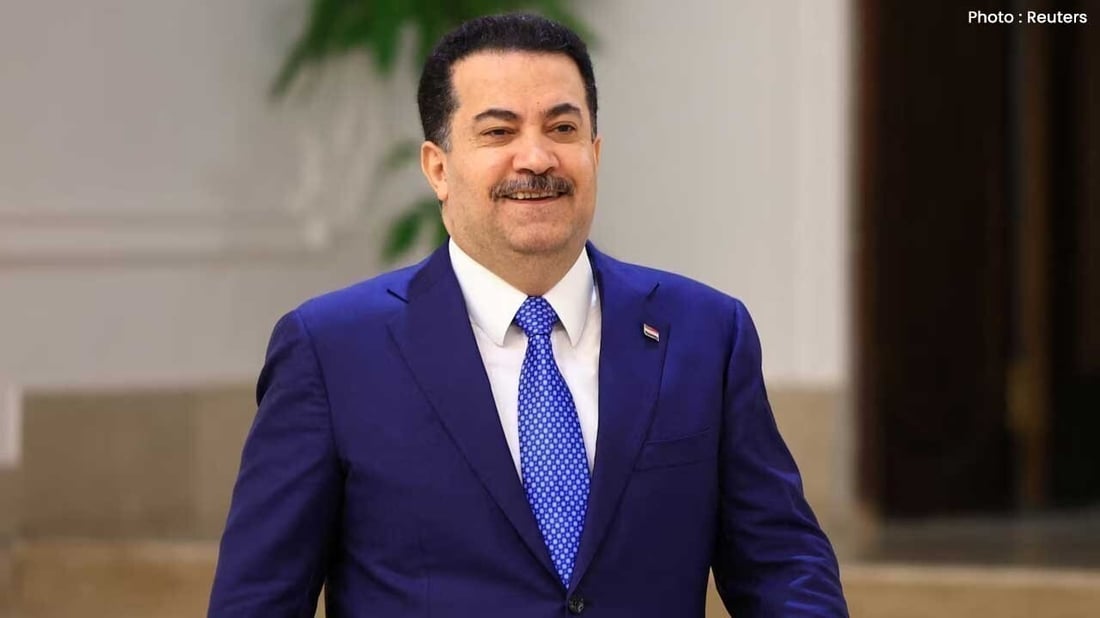
Reconstruction and Development Coalition leader Mohammed Shia Al-Sudani
Disarmament should be paired with an end to foreign air strikes, Sudani says
BAGHDAD — Former Prime Minister Mohammed Shia al-Sudani said restricting weapons to the state should go hand in hand with completing the U.S.-led coalition’s withdrawal, ending drone flights over Iraq and stopping foreign military aircraft using Iraqi airspace to strike neighbouring countries.
“Restricting weapons to the state cannot be achieved through confrontation, but rather through dialogue and communication among all parties,” Sudani told a meeting of his Reconstruction and Development Coalition’s parliamentary bloc on Tuesday, according to a coalition statement. He said there was broad preliminary agreement on that approach, and that airspace violations of the kind he described draw Iraq into other people’s wars.
The government’s position is narrower. Prime Minister Ali al-Zaidi has set Sept. 30, when the coalition mission ends, as the date for bringing all weapons under state control, without tying it to other steps. “After Sept. 30, there is no need for any faction,” he said at the White House on July 14. “Factions are a need, not a profession. There is no justification for their existence after Sept. 30.”
Sudani’s sequencing runs closer to the argument made by the factions refusing to take part. Kataib Hezbollah, Harakat al-Nujaba and Kataib Sayyid al-Shuhada have rejected the plan while U.S. forces remain in Iraq. Saraya al-Salam, Asaib Ahl al-Haq and the Imam Ali Battalions have moved to comply, though the command arrangements for them have not been made public.
His reference to foreign aircraft follows the U.S.-Saudi strikes on Popular Mobilization Forces sites in seven governorates in late July, which the force said killed at least 20 of its members. Since the U.S.-Israeli strikes on Iran in late February, factions under the Islamic Resistance in Iraq umbrella have carried out repeated drone, rocket and missile attacks on U.S. military and diplomatic targets in Baghdad and the Kurdistan Region, while PMF positions have been struck across several governorates, killing more than 100 fighters in attacks the force attributed to the United States and Israel.