
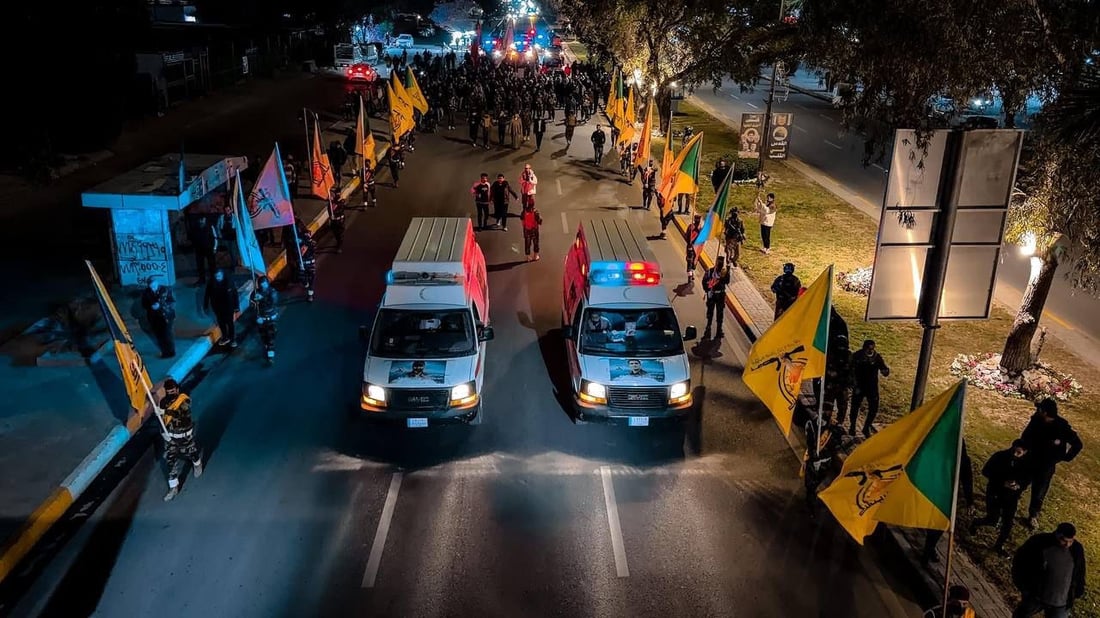
FILES: Supporters of Kataib Hezbollah carry flags and march during a funeral procession in Baghdad for two fighters killed in airstrikes on Jurf al-Sakher, Feb. 28, 2026.
Dialogue still 'priority'
Judiciary takes larger role in Iraq’s push to control weapons
BAGHDAD — Legal and judicial officials have gained a wider role in Prime Minister Ali al-Zaidi’s weapons-control policy, with the government seeking to build legal cases and gather evidence before taking enforcement action, a senior security source who asked not to be identified told 964media.
The source linked the approach to two June appointments: Basim al-Badri as head of the Iraqi National Security Service and Qasim al-Aboudi as national security adviser. Their selection “indicates a clear government direction toward managing security files through a legal approach based on building cases and evidence before moving to any executive measures,” the source said. Badri previously headed the Accountability and Justice Commission, which reviews links to the former Baath Party, while Aboudi has a judicial background.
Zaidi’s government is pursuing a plan to place weapons under state control, a policy dividing the Iran-aligned factions. Asaib Ahl al-Haq, Saraya al-Salam and the Imam Ali Battalions have moved to comply, while Kataib Hezbollah, Harakat al-Nujaba and Kataib Sayyid al-Shuhada have rejected disarmament, arguing their weapons remain necessary as long as U.S. forces are in Iraq.
Dialogue remains the government’s first option, the source said. “The priority during the current stage remains dialogue with the groups and formations because this path is the least costly and the most consistent with the nature of the Iraqi situation,” the source said, adding that this “does not mean legal alternatives are absent” and that the state could later turn to other tools, including classification systems or risk assessments, if talks stall.
The remarks follow earlier reports that the government was developing a framework to place armed groups into three categories by assessed risk, weighing religious ideology, missile and drone capabilities and foreign ties, with each category tied to a different legal or security response. The model draws on methodologies used by the U.S.-led coalition and NATO. The government has not publicly released or approved the system. A separate senior security source told 964media the assessment would be updated monthly and used by a government committee overseeing weapons restriction, made up of security and intelligence agencies and coordinating with judicial authorities.
The framework would also maintain a continually updated file on each group, the first source said. “The proposal is not limited to classifying groups,” the source said. “It also moves toward establishing an updated information bank for each formation, reviewed periodically according to changes on the ground.” The source described it as an Iraqi-developed guide for tracking weapons movement, illicit financing and group activity.
The source cited a June directive from the Supreme Judicial Council as evidence the judiciary was already moving in that direction. On June 24, the council instructed courts to apply the Anti-Terrorism Law to people who manufacture, use or possess drones for unlawful purposes; its published statement named no organization and was not limited to armed factions. That decision, the source said, showed authorities were assessing conduct rather than affiliation: “It confirms that the state began some time ago to adopt legal standards connected to the nature and danger of the act, rather than names or affiliations alone.”
Since the U.S.-Israeli strikes on Iran in late February, Iran-aligned factions under the Islamic Resistance in Iraq umbrella have carried out repeated drone, rocket and missile attacks on U.S. military and diplomatic targets in Baghdad and the Kurdistan Region as well as on civilian sites, while Popular Mobilization Forces positions have been struck across several governorates, killing about 100 fighters in attacks the group attributed to the United States and Israel.
At his White House meeting with U.S. President Donald Trump on July 14, Zaidi said the government intended to bring all weapons under state control once the coalition mission ends. “Whoever surrenders their weapons will turn into a political and civil entity,” he said. “After Sept. 30, there is no need for any faction. Factions are a need, not a profession. There is no justification for their existence after Sept. 30.” Sept. 30 is the end date of the anti-ISIS coalition’s mission and the departure of American troops.
The command structure for compliant factions has not been publicly detailed, with official statements using broad terms such as “integration” and “restructuring” without specifying whether fighters would be absorbed individually into army units or remain intact formations.