
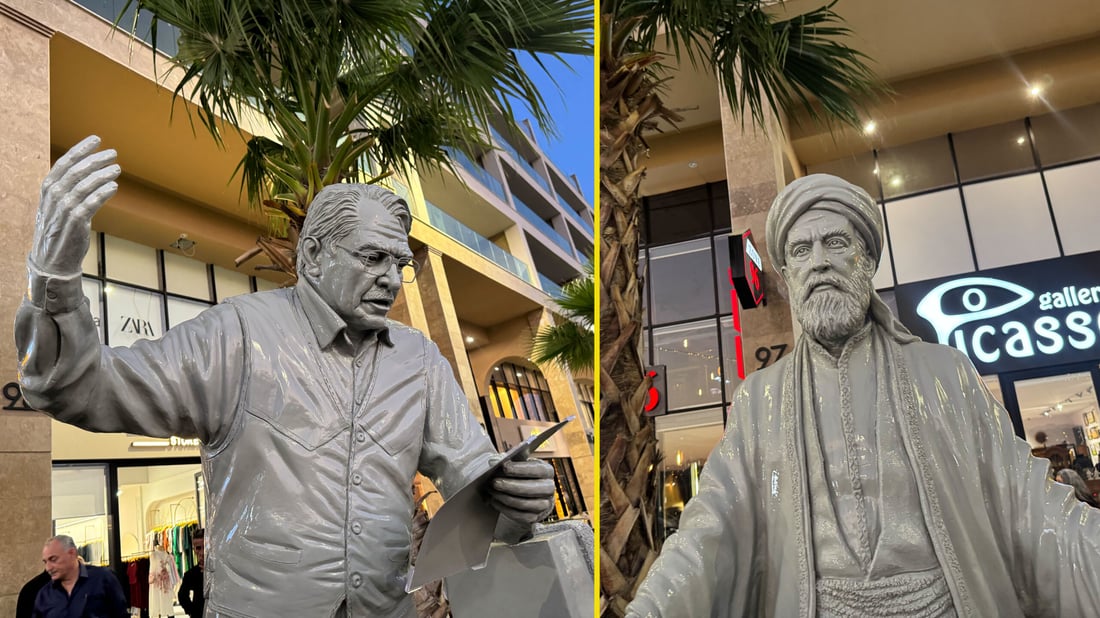
Statues of Kurdish poets Nali (right) and Sherko Bekas (left) stand on display after their unveiling in Sulaymaniyah on Wednesday. (Photo: 964media)
Statues of poets Nali and Sherko Bekas unveiled in Sulaymaniyah
SULAYMANIYAH — Statues of two of Kurdistan’s best-known poets, Nali and Sherko Bekas, were unveiled Wednesday evening in Sulaymaniyah at a ceremony attended by family members, artists and intellectuals.
Nali, who lived in the 19th century, is one of the leading poets of classical Kurdish literature, best known for his lyrical ghazals on love, nature and spirituality. His work helped shape the literary tradition of Sorani Kurdish and influenced generations of Kurdish poets. Bekas, a leading modern poet who died in 2013 at 73, is recognized for his influence on contemporary Kurdish literature.
Born in Sulaymaniyah on May 2, 1940, Bekas was a pivotal figure in Kurdish national identity and literature. His work spans more than 40 poetry collections exploring themes of homeland, freedom, justice, women’s rights and the tragedies of Halabja and Anfal. He founded the Sardam Publishing House in 1998, which still operates, and in 2009 completed a collection of his works totaling 8,000 pages. His final project, “Memories of a Kirkuki Bicycle,” was unfinished when he died.
Bekas’ widow, Nasrin Ahmad, attended the ceremony. “I feel happy and proud,” she said during the unveiling, noting that Bekas had written poems for her before and after they married.
Halo Sherko Bekas, the poet’s son, said the statues honor not only his father but Kurdish literature more broadly. “It is a great honor for us, not only because he is my father, but because he was a great poet, and Nali was also a great classical Kurdish poet,” he told 964media. “These statues will become part of the identity of this city. I hope statues will also be made for other Kurdish poets, writers, actors and artists.”
The statues were created by sculptor Chinar Nizar with sponsorship from the Picasso Gallery in Sulaymaniyah. “When they proposed the project to me, I was both happy and felt it was a responsibility,” Nizar told 964media.
He said the project took nearly a year to complete after extensive research. Bekas’ statue was easier because photographs and videos of him were available, while no photographs of Nali exist, Nizar said, so he relied on research into how people of Nali’s era looked and dressed.
Several other statues of both poets have previously been erected in different locations.