
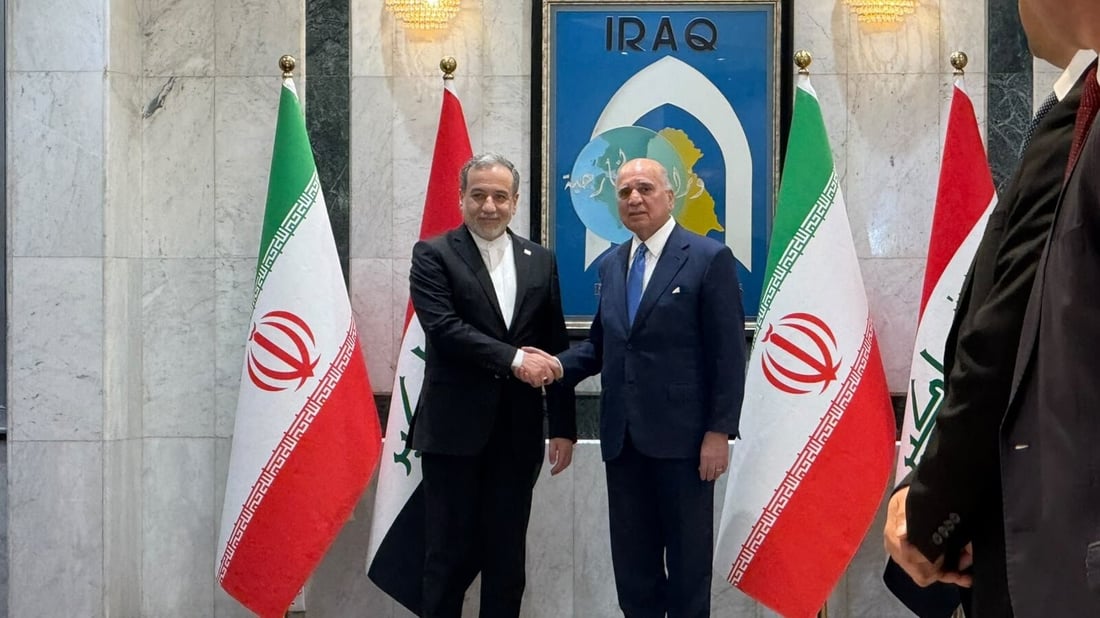
Iranian Foreign Minister Abbas Araghchi, left, and Iraqi Foreign Minister Fuad Hussein in Baghdad, June 28, 2026.
Iranian foreign minister visits Baghdad as US and Iran trade fresh strikes
BAGHDAD — Iranian Foreign Minister Abbas Araghchi arrived in Baghdad on Sunday for talks with senior Iraqi officials on bilateral relations, the U.S.-Iran agreement and coordination of funeral ceremonies in Iraq for Iran’s late Supreme Leader Ali Khamenei, hours after the United States and Iran exchanged strikes overnight in a renewed escalation.
Araghchi was received at Baghdad International Airport by Iraqi Communications Minister Mustafa Sanad. He later visited the memorial to Iranian Gen. Qassem Soleimani and Popular Mobilization Forces deputy commander Abu Mahdi al-Muhandis near the airport, both killed in a U.S. strike in Baghdad in 2020, before meeting Iraqi Foreign Minister Fuad Hussein.
Speaking at a joint news conference, Araghchi said the main purpose of his visit was “to thank the Iraqi government and people for their support.”
“The Iraqi government took clear positions in condemning the aggression, and the Iraqi people’s support gave the Iranian people a sense of solidarity,” he said, referring to the U.S.-Israeli war on Iran.
Araghchi said the memorandum of understanding reached with Washington this month requires fighting to stop “on all fronts, including Lebanon,” adding that continued Israeli attacks violate the agreement.
He also said the memorandum provides for the Strait of Hormuz to return to its pre-war operating capacity within 30 days once obstacles are removed, with management of the waterway remaining “the exclusive responsibility of the Islamic Republic of Iran.”
The remarks follow the Iran-U.S. agreement, which includes an end to military operations, a commitment to further negotiations and the reopening of the Strait of Hormuz. Announced through mediator Pakistan, the arrangement is expected to ease tensions and open a period for talks on Iran’s nuclear program and related issues.
The overnight strikes showed how fragile that agreement remains. The U.S. military struck multiple targets in Iran on Saturday, saying it was responding to continued Iranian aggression against commercial shipping near the Strait of Hormuz. Early Sunday, Iran’s Islamic Revolutionary Guard Corps said it had fired missiles and drones at U.S. military sites in Kuwait and Bahrain in retaliation.
The Guard warned that the U.S. strikes violated the ceasefire and would halt all diplomatic processes.
The prime minister’s media office said Araghchi also met Prime Minister Ali al-Zaidi, with talks focused on the agreement that halted the conflict and on regional efforts to promote security, stability and respect for the sovereignty and territorial integrity of states.
Zaidi said Iraq supported ending wars through dialogue and negotiation, calling it the priority for stability in the region. “Iraq stands with the priority of ending wars and adopting dialogue and negotiations to establish stability in the region,” he said, adding that the approach “will enhance the opportunity for development for neighboring peoples.”
At the news conference, Araghchi said another aim was to coordinate funeral ceremonies for Khamenei in Baghdad, Najaf and Karbala.
The visit comes days after a number of Iraqi lawmakers met officials at the Iranian Embassy in Baghdad over arrangements for the funeral. Lawmaker Youssef al-Kalabi said Monday that he and a group of parliament members visited the embassy to welcome Tehran’s approval of a procession through Iraq’s holy cities.
The arrangements followed an announcement by Tehran Mayor Alireza Zakani, who said in a televised address that Khamenei’s body would be transferred to Iraq on July 8. Farewell ceremonies will be held at the Imam Khomeini Mosalla in Tehran on July 4 and 5, followed by the main procession in the capital on July 6 and a separate ceremony in Qom on July 7 before the transfer the next day. The body will move through Najaf and Karbala on July 8, with burial expected to follow in Iran the next day at the Imam Reza shrine in Mashhad, according to Iran’s funeral organizers.
Zakani said the proposed Tehran route would run along Damavand, Enghelab and Azadi streets toward the Lashgari Expressway, though the final section was undecided. Khamenei was killed in U.S.-Israeli strikes on Feb. 28.
Araghchi welcomed Iraq’s proposal for an eight-party dialogue involving Iraq, Iran and the Gulf Cooperation Council states, saying Tehran is “fully prepared to cooperate with Baghdad to make this initiative a success.”
Speaking alongside him, Hussein said the conflict had directly affected Iraq. “We discussed that the closure of the Strait of Hormuz halted the flow of Iraqi oil, which affected Iraq’s financial and economic situation,” Hussein said.
Iraqi oil production fell sharply as the closure cut off southern export routes, reducing associated gas output. Exports dropped from nearly 100 million barrels in February to 18.6 million in March, while revenues fell from more than $6.8 billion to around $1.95 billion. Because oil accounts for the vast majority of government income, the disruption quickly translated into pressure on public finances.
Hussein invited Iran and the Gulf states to meet in Baghdad, saying Iraq is ready to host talks on regional security and ending the war. “The security of the region should be the responsibility of its peoples, and ending the war in the region is a priority for all of us,” he said.
He added that Iraq maintains “excellent relations” with both the United States and Iran and is prepared to work with both sides to help end the conflict, and that Iraq had played “an important role” in reaching the agreement between Washington and Tehran.
This article has been updated to include the visit to Iraq’s PM Al-Zaidi