
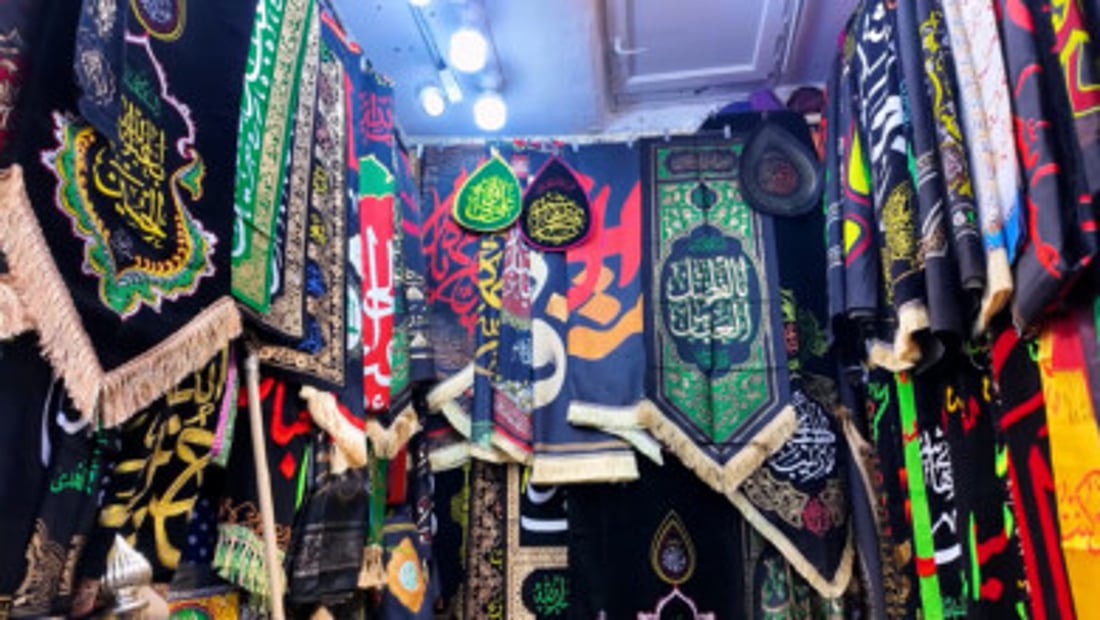
A calligraphy workshop in Najaf. (Photo: 964media)
Imported banners and AI reshape Najaf’s Ashura calligraphy trade
NAJAF — In Najaf, some of the calligraphers who once hand-lettered banners for Ashura now letter gravestones instead, as cheap imported flags and AI-generated designs push their craft to the margins.
Visiting calligraphy workshops and banner shops in Najaf’s Old City, 964media found merchants and calligraphers who said imported products from northern Iran, Pakistan and China now dominate much of the market on price and speed of production. In his workshop among brushes, inks and finished works, calligrapher Thaer Sabti said the trade had changed sharply. “The profession is no longer what it used to be after the arrival of imported products and the spread of modern printing and artificial intelligence,” he said.
Declining demand has pushed many out of the work, Sabti said. “A number of calligraphers and artists have had to look for other jobs that provide a better income,” he said. “Some have turned to engraving and writing on gravestones because demand for handmade artistic work has declined.”
A hand-lettered banner takes long hours and careful detail, he said, making it costlier than factory alternatives, though he said calligraphy remained part of Iraq’s cultural identity and still drew interest through exhibitions and training courses.
Calligrapher Abdul Amir Hussein said Chinese-made banners in particular had hit the market for handmade work. “Many customers prefer ready-made banners because they are cheaper and immediately available,” he said.
AI and digital printing now churn out ready-made calligraphic designs in bulk, he said, though large and custom-sized pieces commissioned by major mourning processions and hussainiyas still rely on Iraqi calligraphers because those specifications are not available off the shelf.
Price is the deciding factor for many buyers, merchants said. Mohammad al-Hamdani, who sells banners and flags, said ready-made Chinese banners go for 2,000 to 3,000 dinars (about $1.30 to $2) in some sizes, while handmade ones cost more for the skilled work and time involved.
Local markets now stock imported banners from China, Iran and Pakistan alongside machine-printed products, he said, widening choice while shrinking the share of handmade work.
Religious banners, known in Arabic as rayat (flags) or alam (standards), are central to Muharram, displayed on hussainiyas, mosques and streets and carried by mourning processions. They typically bear Quranic verses, the names of Imam Hussein and other revered figures, or inscriptions tied to the Battle of Karbala, in which Hussein, the grandson of the Prophet Muhammad, was killed on the 10th day of Muharram, Ashura, in 680 CE.
The commemoration is among the largest annual religious observances in Iraq, particularly in Karbala and Najaf.