
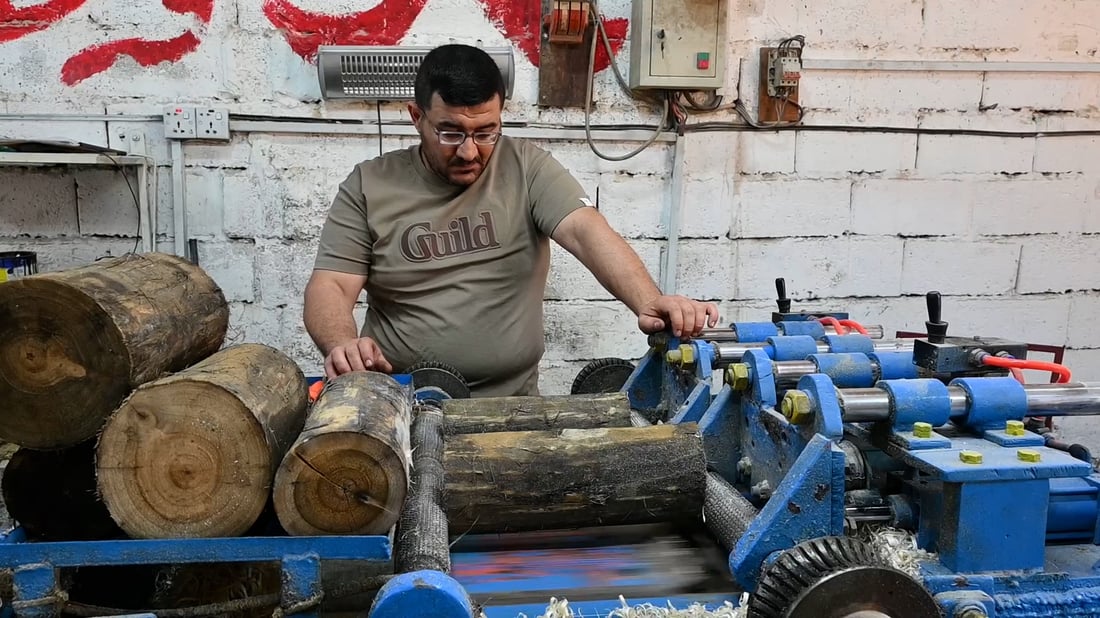
Muhyi al-Rubaie operates a machine processing imported Turkish wood into traditional cooler pads at his workshop in Khalis, Diyala governorate. The workshop produces up to 300 sets daily despite growing competition from imported cardboard alternatives. Photo by 964media.
Diyala craftsman fights to keep cooler pad business alive against flood of Chinese imports
DIYALA — In the industrial district of Khalis, craftsman Muhyi al-Rubaie continues producing traditional wood-shaving cooler pads despite the growing spread of cheap imported cardboard alternatives, saying his product retains a loyal customer base because of its cooling quality and resistance to mineral buildup.
Evaporative coolers — known locally as desert coolers — have been the dominant form of home cooling across Iraq for decades, where air conditioning remains too expensive for many households to run given frequent power outages and high electricity costs. The coolers work by drawing hot air through water-saturated pads, which cool it through evaporation before circulating it into the room. Traditionally those pads were made from compressed wood shavings, which absorb water well, resist salt deposits and carry a natural scent. In recent years cheaper cardboard pads imported from China have undercut local producers, driving several workshops out of business.
Rubaie imports wood from Turkey in two-meter sections, cut into 50-centimeter lengths and processed through cutting machines that produce straw-like fibers. “The Chinese cardboard pads clearly affected the business and caused several factories to shut down because people started using them in plastic coolers,” he told 964media. “But the quality, the coolness of the air and the lack of salt buildup in pads extracted from wood are better, especially the Turkish wood we use in this workshop because it does not leave unpleasant smells.”
He said Iraqi wood from northern areas was once widely used but had become harder because of climate change affecting the fibers. “Previously, we used to place a bar of soap in the cooler basin to prevent unpleasant odors, but now there is a perfumed product available in construction material shops,” he added.
The workshop produces between 250 and 300 cooler pad sets daily, with each bundle containing enough material for five coolers sold for 12,000 dinars ($7.84), or about 2,000 dinars ($1.31) per set. He supplies customers in Khalis, Baquba, Salah al-Din, Samarra and Baghdad.
Worker Jassim Mohammed described the final packaging process. “We place the cut wood inside mesh plastic bags, and the thickness of the pad is about seven centimeters,” he said. “Then it goes to the heat sealer to press the open side under temperatures between 750 and 1,000 degrees Celsius so it becomes ready for use.”
Production started a month later than usual this year, in April instead of March, because of prolonged rainfall and cooler weather. Rubaie said stable national electricity allows the workshop to run from morning until evening.