
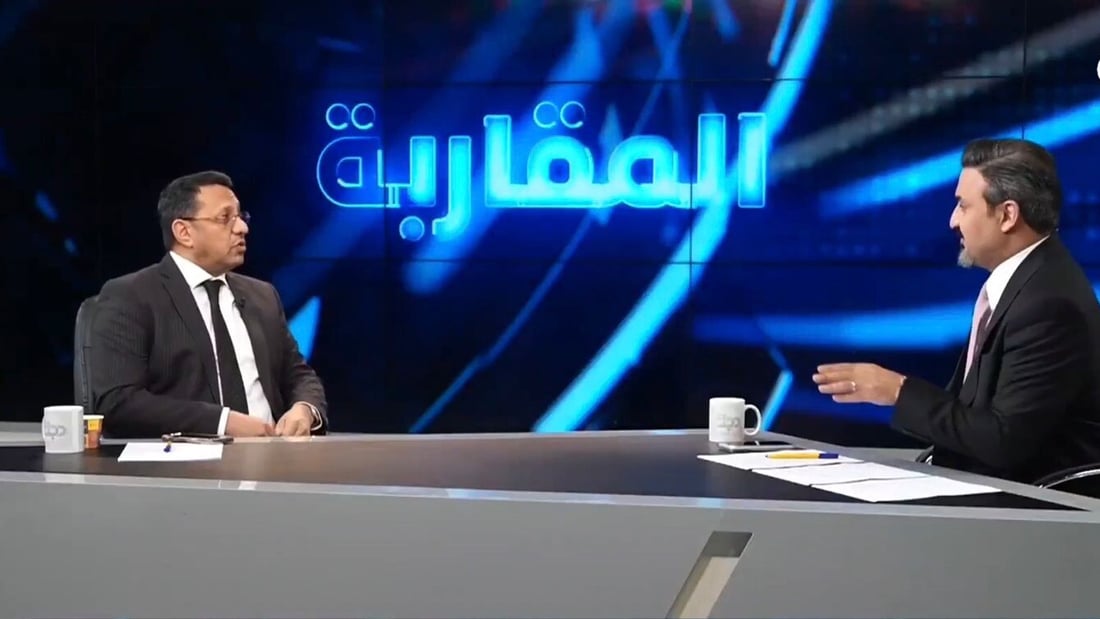
Dhia al-Nasiri, a member of the State of Law Coalition, speaks during an interview on Dijla TV in Baghdad.
US told Coordination Framework it opposes both Maliki and Sudani, official claims
BAGHDAD — The United States has informed leaders of Iraq’s Coordination Framework that it does not support renewing Prime Minister Mohammed Shia al-Sudani’s term, a State of Law Coalition official claimed, suggesting Washington is effectively blocking both leading candidates for the prime ministerial post.
Dhia al-Nasiri, a member of the coalition led by Nouri al-Maliki, said in an interview on Dijla TV that U.S. Chargé d’Affaires Joshua Harris met with Coordination Framework leaders and delivered a direct message. “He said that if you intend to withdraw al-Maliki’s nomination and replace him with al-Sudani, we do not approve, and we do not want a renewal of the current prime minister’s term,” al-Nasiri said.
The claim, if accurate, would significantly narrow the field of viable prime ministerial candidates at a critical moment. The Coordination Framework nominated al-Maliki in January, a move that drew internal divisions and public opposition from President Donald Trump, who warned Washington could “halt support for Iraq” if al-Maliki returned to power. Al-Nasiri’s account suggests the U.S. position has since hardened to also exclude al-Sudani, leaving the dominant Shiite alliance without an American-approved candidate.
Al-Nasiri described the political environment in vivid terms, saying Framework members came under intense pressure after al-Maliki’s nomination was settled. “When I rose to take charge, one group broke its pledge and another defected,” he said. “They began waiting for signals and even praying for another tweet to come down. Envoys then arrived, and threats began to fall upon us like rain.”
Iraq’s government formation has been deadlocked since November’s parliamentary elections. Parliament has scheduled an April 11 session to elect a president — a prerequisite for naming a prime minister-designate — with the KDP and PUK still at odds over the presidency. The stalemate comes as Iraq faces mounting security and economic pressures from the regional war, with no permanent government in place to manage the crisis.
Dhia al-Nasiri, a member of the State of Law Coalition led by Nouri al-Maliki, said in an interview on Dijla TV:
Question: Why was al-Maliki absent and then attended the most recent Coordination Framework meeting?
If you are referring to the meeting two weeks ago, which coincided with the martyrdom of Abu Mujtaba, Mr. al-Maliki was attending the funeral gathering (al-Fatiha). The political situation could not bear such timing — we had a major religious figure of such stature being martyred, and then a meeting is called the very next day? Frankly, the invitation was not appropriate, nor was responding to it.
As for the Framework session, there was a wave of pressure on social media, along with calls for demonstrations. Anyone who opposed holding the session was labeled a traitor to the الوطن. There were 299 members of parliament who called for this session, and the issue of the prime ministerial candidate had already been decided 10 days before the constitutional deadline. However, once it was settled, “when I rose to take charge, one group broke its pledge and another defected.” They began waiting for signals and even praying for another tweet to come down. Envoys then arrived, and threats began to fall upon us like rain.
Regarding the latest position: a new recommendation came from the U.S. Chargé d’Affaires, Joshua Harris, who visited some leaders within the Coordination Framework and said that if you intend to withdraw al-Maliki’s nomination and replace him with al-Sudani, we do not approve, and we do not want a renewal of the current prime minister’s term.