
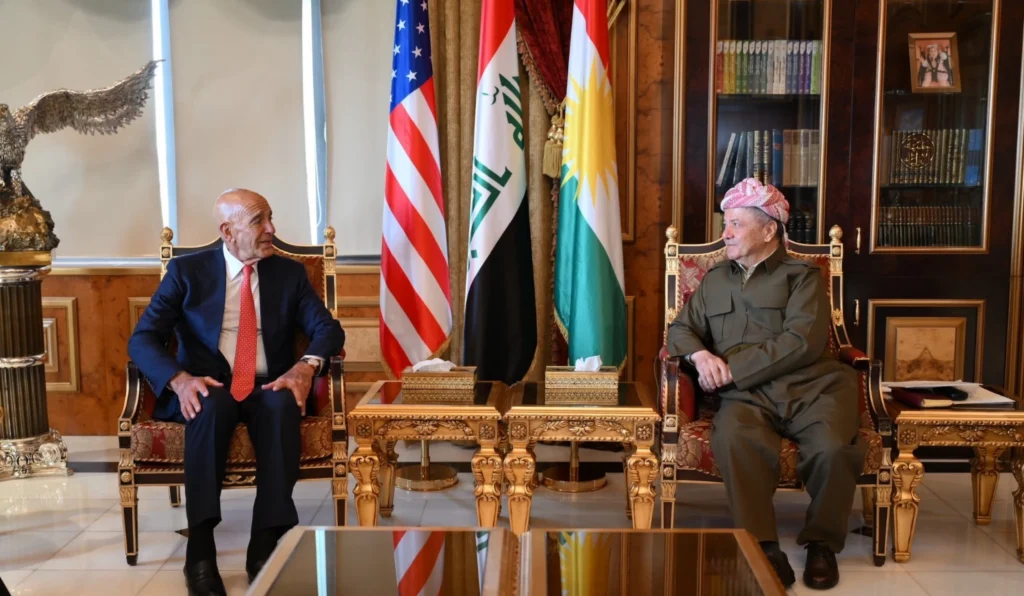
Kurdish leader Masoud Barzani meets U.S. Special Envoy for Syria Tom Barrack in Erbil on Jan. 17, 2026
Trump envoy calls attacks on Kurdistan Region ‘outrageous’ in call to Barzani
ERBIL — Kurdish leader Masoud Barzani spoke by phone Thursday with Tom Barrack, U.S. President Donald Trump’s special envoy for Syria and ambassador to Turkey, in a call focused on regional stability and keeping the Kurdistan Region and Iraq out of the ongoing conflict, according to a statement from Barzani Headquarters.
Barrack conveyed Trump’s greetings and “thanked him for his wise leadership in leading the region and protecting its stability, security and developments,” the statement said. According to the statement, Barrack told Barzani that “the United States continues to look at the Kurdistan Region as an ally and friend and will continue close coordination,” and stressed that Washington would continue to support both the Iraqi government and the KRG “to find resolution for the outstanding issues, in a manner that serves the interests of both sides across all sectors.”
Barzani briefed Barrack on “the recent outrageous attacks on the Kurdistan Region by some outlawed armed groups,” the statement said, and reaffirmed that “the Kurdistan Region always works on enhancing further stability for the whole region,” adding that “the Kurdistan Region is always part of the solution and never been or will be part of any problem.”
Both sides stressed the importance of preventing the Kurdistan Region and Iraq from being drawn into the conflict, according to the statement.
The call follows Barzani’s warning on March 8 that “restraint also has limits,” when he called on the Iraqi government, parliament and the Coordination Framework to intervene and stop attacks by armed groups. The Kurdistan Region has faced at least 200 drone, missile and rocket attacks since the war began Feb. 28, killing four people and injuring 19, according to Community Peacemaker Teams – Iraqi Kurdistan. The IRGC and affiliated Iran-aligned armed groups have claimed responsibility for many of the strikes, which have hit military installations, diplomatic facilities, airports, oil sites and residential areas across Erbil and Sulaymaniyah governorates.