
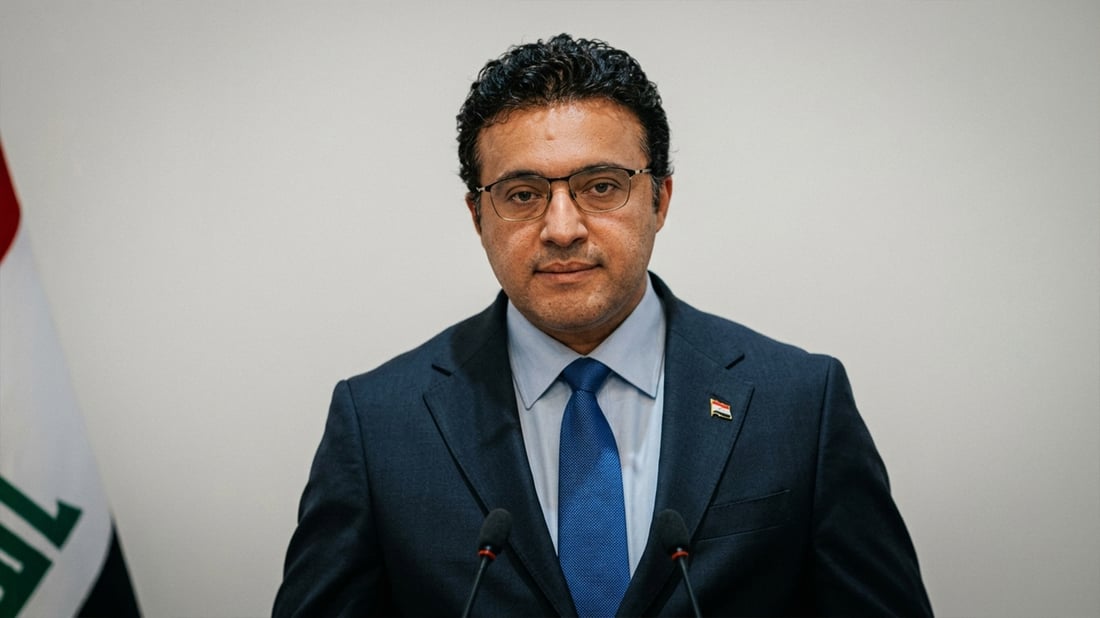
Iraqi government spokesman Haider al-Aboudi
Media monitor
Government aims to ‘halve’ oil dependence over next decade, spox says
BAGHDAD — Prime Minister Ali al-Zaidi is overseeing a committee tasked with cutting Iraq’s reliance on oil from 90% of the state budget to 45% over the next 10 years, government spokesperson Haider al-Aboudi said Tuesday.
In an interview on Alawla TV, Aboudi said the government had begun tackling economic and administrative challenges just over a month after taking office. “The new Iraqi government is one month and nine days old, but it has approached issues boldly and started looking for what is needed to restore trust between citizens and the government, especially after corruption became dominant in public opinion,” he said.
Aboudi said Zaidi treated the economy as his first priority, with the government needing to secure no less than 10 trillion dinars a month for salaries and public spending. “This figure requires revenue engineering in light of the current crisis, which is by no means easy,” he said.
He said Zaidi had brought the Central Bank and Finance Ministry together in a “Financial Stability Council” to find ways for the state to keep meeting its obligations, relying on domestic measures rather than borrowing. “The Central Bank had an important role in these solutions, and these internal solutions are what keep employee salaries secure,” he said.
Aboudi denied reports of plans to print money or change the dollar peg. “There is no direction toward printing currency or raising the dollar exchange rate to compensate for lost liquidity, and such indicators do not serve the citizen and constitute a burden on him,” he said.
On the longer term, Aboudi said Zaidi was personally supervising a committee aimed at reducing oil’s share of the budget to no more than 45% within a decade by maximizing non-oil revenues, including fighting corruption, automating border and customs procedures and stepping up fee collection.
Successive Iraqi governments have pledged for nearly two decades to diversify the economy away from oil, which still funds roughly 90% of the budget, with little durable progress, and no administration has come close to halving that dependence.
Aboudi linked the long-term plan to Zaidi not seeking a second term nor forming a political party. “The prime minister has freed himself from a fundamental constraint represented by the pursuit of a second term,” he said. “No prior calculations or commitments weigh on him.”
Iraq’s finances were hit hard by this year’s conflict between Iran and U.S.-Israeli forces. Oil production fell sharply after the closure of the Strait of Hormuz cut southern export routes, with exports dropping from nearly 100 million barrels in February to 18.6 million in March and revenues falling from more than $6.8 billion to around $1.95 billion. Because oil accounts for the vast majority of state income, the disruption quickly translated into pressure on public finances.
Zaidi, a businessman and political newcomer, was named prime minister-designate by the Coordination Framework in late April as a compromise candidate and approved by parliament in mid-May, ending months of deadlock after the November 2025 elections. He succeeded Mohammed Shia al-Sudani.