
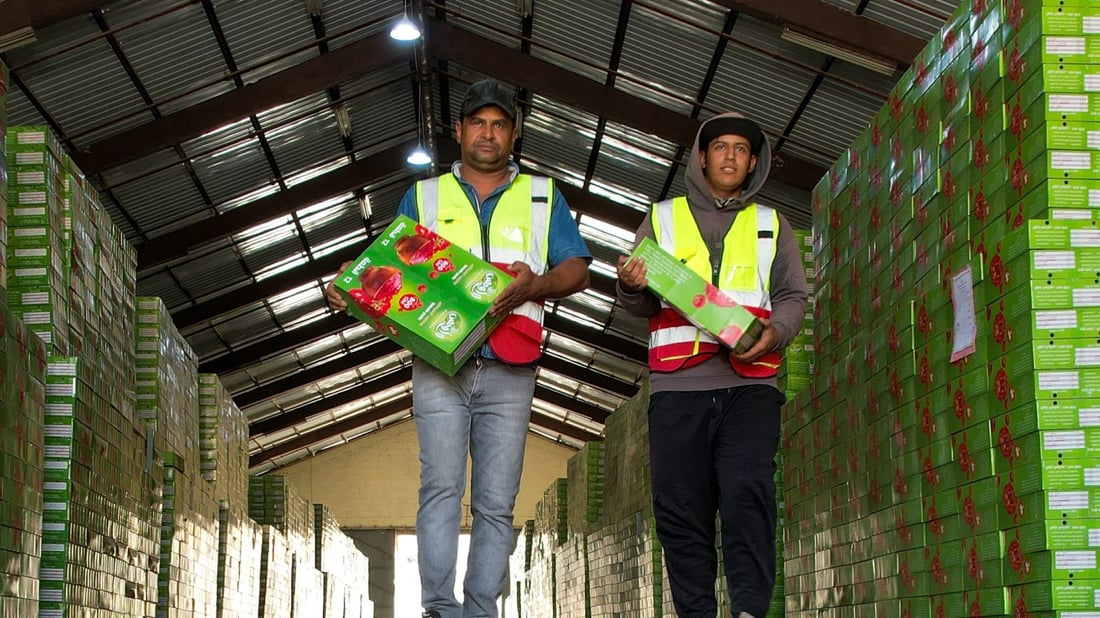
Workers carry boxes inside a warehouse stacked with packaged goods.
'Tangible shift'
Trade Ministry claims customs tariffs ‘boosting demand’ for local products
BAGHDAD — Iraq’s Trade Ministry claimed Sunday that the application of customs tariffs has directly stimulated demand for domestic products and strengthened the competitiveness of local industry, describing the move as part of a broader government system to protect national production.
Ministry spokesman Mohammed Hanoun told the Iraqi News Agency that “the customs tariff was not intended to restrict citizens, but came as a step to regulate the market and prevent the dumping policy of imported goods,” adding that “imposing a carefully studied tariff on specific goods has given local industry real competitive capacity against its foreign counterparts.”
Hanoun said “there is a tangible shift by consumers toward the local alternative, especially with the availability of the required quality and appropriate price.”
He added that “demand for local industries, particularly in the food and consumer goods sectors, is witnessing a noticeable gradual improvement,” pointing to “the rising awareness of citizens about the importance of supporting the national economy.”
The comments come as the government continues implementing a new customs tariff framework alongside enforcement of the ASYCUDA electronic customs system at federal border crossings. The rollout earlier this year triggered protests by traders in Baghdad, Basra and other governorates.
Traders said duties on some imports had risen to nearly 30 percent, warning that higher clearance costs were leading to price increases and goods being held at ports. “Customs has reached 30 percent, and now goods are stuck at the port,” trader Ziad Salem said during one protest. Ahmed Abboud said containers that once cost 3 million dinars ($2,000) to clear now face 30 percent duties, adding, “This will double prices for citizens.”
Customs officials have denied introducing new taxes. Customs Director General Thamer Qassim said earlier that “there are no new taxes imposed on imported goods,” explaining that ASYCUDA applies existing tariffs under the Customs Tariff Law No. 22 of 2010.
The Trade Ministry has also denied raising duties on basic food items. Hanoun previously said “the government has not approved any amendment to the customs tariff on basic needs, particularly food items,” attributing some market price increases to speculation.
In recent weeks, the General Commission of Customs announced a 5 percent tariff on solar power system supplies and confirmed a 0.5 percent duty on veterinary medicines and vaccines under Cabinet Decision No. 957 of 2025.